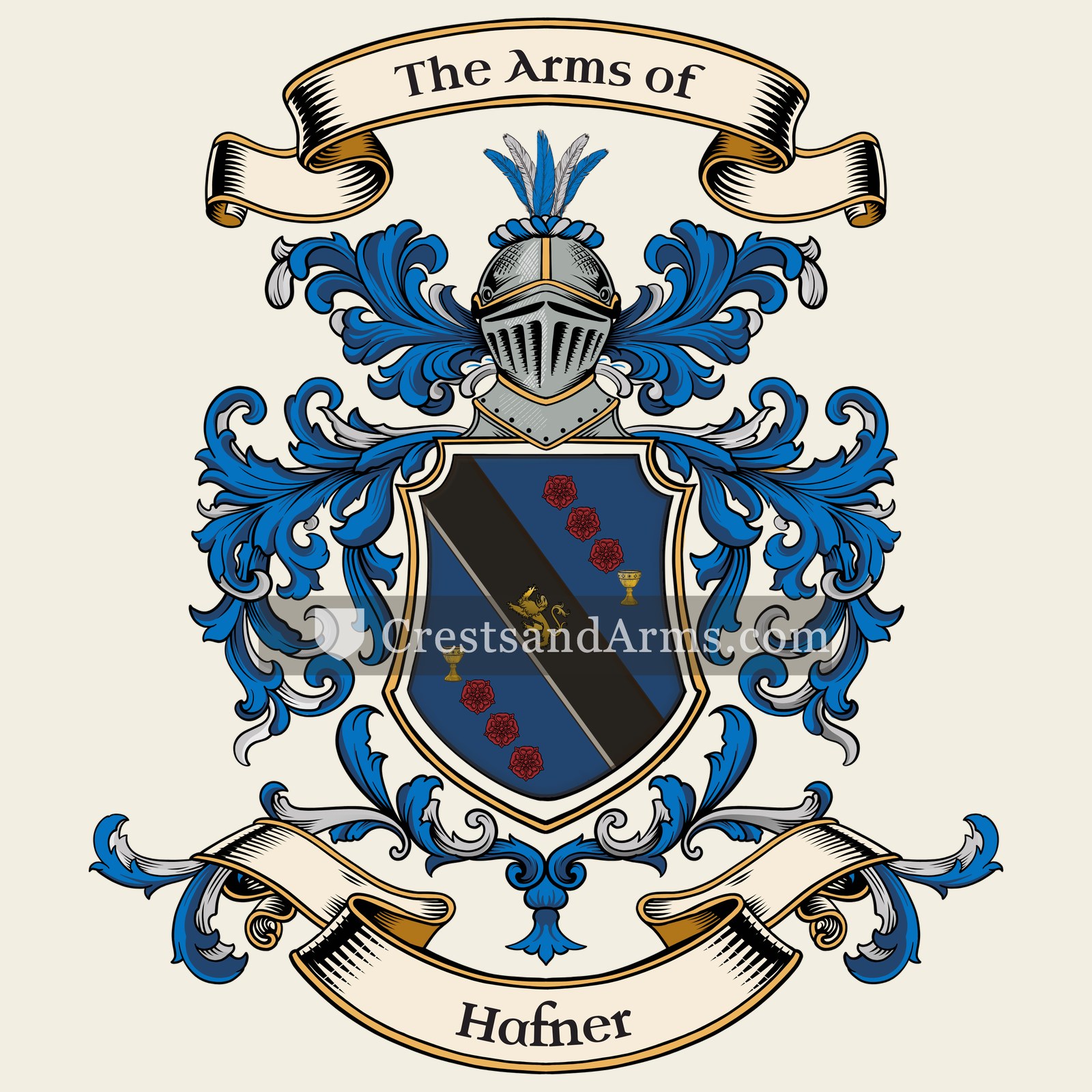
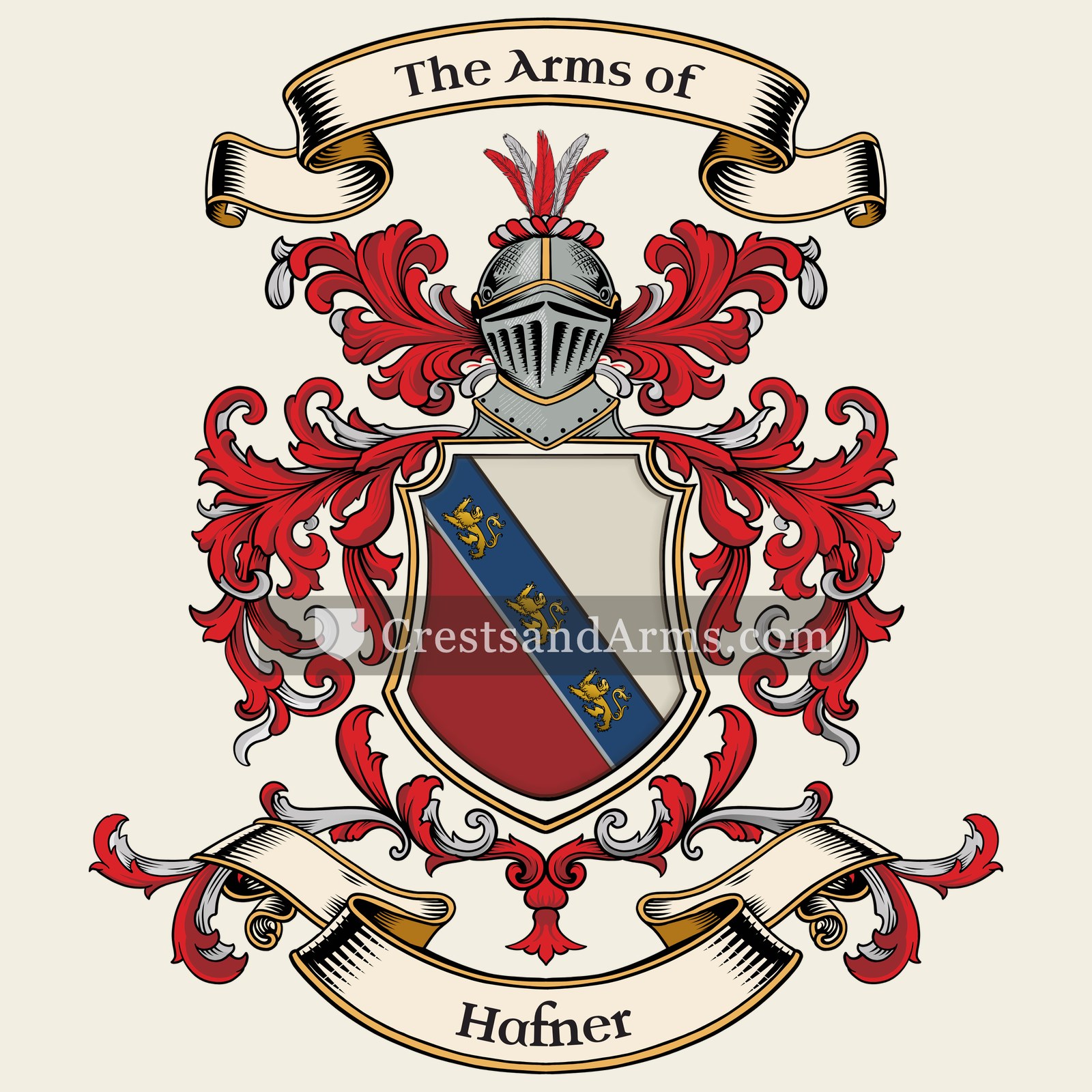
A record of documented arms, meaning and origin, researched for the Hafner family lines. Documented in 2 countries.
Reg. 7971 · German, G–I
Coat of Arms & Family Crest Details
Symbols on this shield
bendDefence, and the scarf of a commander
lionCourage, strength and royalty
cupFaith, office, and a trust discharged
roseThe seventh son, and beauty with grace
Colours
Blue (Azure)Means: Loyalty and truth
Black (Sable)Means: Constancy
Gold (Or)Means: Generosity
Red (Gules)Means: Military strength
Historical info
Source
J. B. Rietstap, Armorial Général, Gouda: G. B. van Goor Zonen, 1884–87
Blazon (the actual original written record)
“D'azur à la bande de sa., ch. d'un lion léopardé d'or, cour. du même et acc. de deux vases à deux anses d'or, chaque vase rempli de trois roses de gu., tigées et feuillées de sin. Cq. cour. C.: un lion iss. d'or. L. d'or et de sa.”
Germanyc. 1765
Where the Hafner Arms Were Recorded
Bavaria
Map of Germany showing where the Hafner arms are recorded
The Hafner arms were recorded in Germany, c. 1765.
Arms such as these were typically recorded in Bavaria.
Bavaria was a country of old landed families and walled market towns. Estates passed down the same line for centuries, and both the landowners and the leading townsmen kept arms, which is why so many Bavarian names sit in the registers.
This is where the arms were entered in the register. Families often moved to other parts of the country, so the same name can turn up in more than one region.
The body that granted and recorded arms in Germany in this period.
Francis I, Holy Roman Emperor
Sovereign of the period
Francis I, Holy Roman Emperor
1745–1765
Reigning in Germany when the Hafner arms are first recorded.
How Arms Worked in Germany
In the Holy Roman Empire, coats of arms were often granted to individuals by the Emperor or his representatives. These arms were then passed down through the generations to all legitimate descendants of the original holder. Younger branches of a family usually kept the same shield design without needing to change it, as the arms belonged to the entire lineage.
Granting authority
The Holy Roman Emperor held the sole power to grant new coats of arms throughout his vast imperial territories.
How they got arms
Families typically obtained their coats of arms through a formal imperial grant or by proving their noble status to the authorities.
Where arms were recorded
These grants were officially recorded in the Imperial Chancery registers, which began keeping formal records of such honors during the Middle Ages.
The family's standing
Recorded among the armigerous families of Germany.
Origin & History of the Hafner Family in Germany
The surname Hafner is an occupational name that originated in the German-speaking regions of Europe during the Middle Ages. It is derived from the Middle High German word "hafen," which refers to a pot or a vessel. Consequently, the name was historically given to individuals who worked as potters or stove makers. By the time the family was recorded in Bavaria in 1765, the name was already well-established across southern Germany. These early family members likely lived in small village communities where their craft was essential for daily life. Because pottery was a vital trade for storing food and heating homes, the Hafner family name became a common identifier for those who mastered the art of shaping clay. Over generations, this professional title transitioned into a permanent family surname, marking the lineage of skilled artisans who helped build the infrastructure of early German towns.
Coat of Arms & Family Crest Details
Symbols on this shield
bendDefence, and the scarf of a commander
lionCourage, strength and royalty
Colours
Red (Gules)Means: Military strength
Silver (Argent)Means: Peace and sincerity
Blue (Azure)Means: Loyalty and truth
Gold (Or)Means: Generosity
Historical info
Source
J. B. Rietstap, Armorial Général, Gouda: G. B. van Goor Zonen, 1884–87
Blazon (the actual original written record)
“Tranché de gu. sur arg.; à la bande d'azur, br. sur le tranché et ch. de trois têtes de lion d'or, celle du milieu cour. du même. Cq. cour. C.: un lion iss. d'or, cour. du même; entre deux prob. coupées, à dextre de gu. sur arg., à sen. d'or sur azur. L.: à dextre d'or et d'azur, à sen. d'arg. et de gu.”
Austriac. 1829
Where the Hafner Arms Were Recorded
Tyrol
Map of Austria showing where the Hafner arms are recorded
The Hafner arms were recorded in Austria, c. 1829.
Arms such as these were typically recorded in Tyrol.
Tyrol was mountain country in western Austria, where the valleys were held by families who had been there a very long time. Old tenure counted for more than money, and old families carried arms.
This is where the arms were entered in the register. Families often moved to other parts of the country, so the same name can turn up in more than one region.
Region
Tyrol
First recorded
1829
Granting Authority for the Hafner Arms
Imperial and Royal chancery
Sodacan · CC BY-SA 3.0
The body that granted and recorded arms in Austria in this period.
Francis II, Holy Roman Emperor
Sovereign of the period
Francis II, Holy Roman Emperor
1804–1835
Reigning in Germany when the Hafner arms are first recorded.
How Arms Worked in Austria
Austrian coats of arms were often linked directly to noble titles granted by the Emperor. These symbols belonged to the entire family line rather than just one individual. When a family grew, new branches kept the original design without needing to change it. This system allowed all members of a noble house to share the same identity across many generations.
Granting authority
The Imperial and Royal chancery managed all heraldic matters and controlled the official granting of arms throughout the Austrian lands.
How they got arms
Families typically received their arms through a formal imperial decree that often accompanied the elevation of a person to noble status.
Where arms were recorded
Official records of these grants were kept in the Imperial Register of Nobility which began its formal documentation process in 1453.
The family's standing
Recorded among the armigerous families of Austria.
Origin & History of the Hafner Family in Austria
The surname Hafner is a classic occupational name that originated in the German-speaking regions of Europe, including the mountainous landscapes of Austria. The word itself comes from the Middle High German term *hafner*, which referred to a potter or a maker of clay vessels. In the early nineteenth century, families carrying this name were well-established in the Tyrol region, a territory known for its rugged terrain and deep-rooted traditions. Because pottery was an essential craft for storing food and water in rural alpine communities, individuals with this name were often vital members of their local villages. By 1829, the Hafner family was already deeply woven into the social fabric of Tyrol, likely working as skilled artisans who provided necessary goods to their neighbors. Their history reflects the broader story of Austrian families who built their livelihoods through specialized trade and community service in the heart of the Alps.
Related Branches & Arms
Root word
Hafen
A vessel, pot, or container made of clay.
This name
HafnerAn occupational surname for a potter or someone who makes earthenware vessels.
also spelled
Haffner
Hafener
Hafnerh
Related arms
Erhardtsimilar arms
Haffnervariant spelling
Documented Sources
J. B. Rietstap, Armorial Général, Gouda: G. B. van Goor Zonen, 1884–87
Bahlow, Hans, Deutsches Namenlexikon: Familien- und Vornamen nach Ursprung und Sinn erklärt, 1967
Heintze, Albert, Die deutschen Familiennamen: geschichtlich, geographisch, sprachlich, 1903


 bendDefence, and the scarf of a commander
 lionCourage, strength and royalty
 cupFaith, office, and a trust discharged
 roseThe seventh son, and beauty with grace
 bendDefence, and the scarf of a commander
 lionCourage, strength and royalty
 cupFaith, office, and a trust discharged
 roseThe seventh son, and beauty with grace