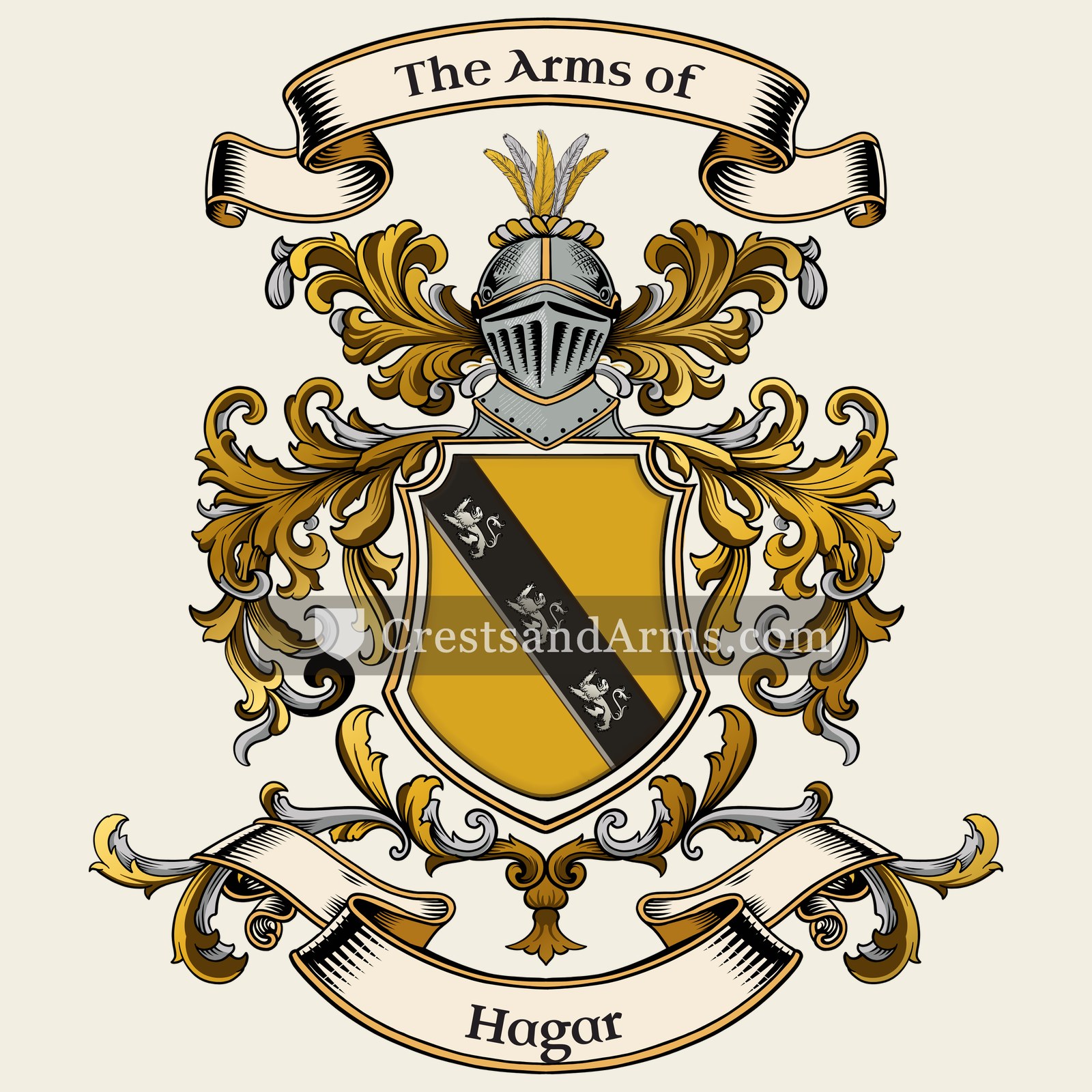
A record of documented arms, meaning and origin, researched for the Hagar family of England.
Reg. 4564 · English, G–I
Coat of Arms & Family Crest Details
Symbols on this shield
bendDefence, and the scarf of a commander
lionCourage, strength and royalty
Colours
Gold (Or)Means: Generosity
Black (Sable)Means: Constancy
Silver (Argent)Means: Peace and sincerity
Historical info
Source
Sir Bernard Burke, The General Armory of England, Scotland, Ireland and Wales, London: Harrison & Sons, 1884
Blazon (the actual original written record)
“Or, on a bend sa. three lions pass. ar”
EssexBourne · Essex, c. 1605
Where the Hagar Arms Were Recorded
Essex
Map of England showing where the Hagar arms are recorded
The Hagar arms were recorded in Essex, c. 1605.
Essex lay close enough to London for City money to buy land there. Merchants who prospered moved out to estates within a day's ride, and a new landowner almost always wanted arms to go with the ground.
This is where the arms were entered in the register. Families often moved to other parts of the country, so the same name can turn up in more than one region.
The body that granted and recorded arms in England in this period.
James VI and I
Sovereign of the period
James VI and I
1603–1625
Reigning in England when the Hagar arms are first recorded.
How Arms Worked in England
English heraldry allowed arms to be shared by all legitimate descendants of the original owner. These symbols were treated as personal property that moved through the generations to all children. While the eldest son kept the original design, other family members could use the same shield without needing to change it or register their own unique versions.
Granting authority
The College of Arms in London has regulated the use of coats of arms throughout England and Wales since 1484.
How they got arms
Families typically obtained their coats of arms through a formal grant from the Crown or by proving their ancient right to them.
Where arms were recorded
All official coats of arms are recorded in the registers kept at the College of Arms, which date back to the fifteenth century.
The family's standing
Recorded among the armigerous families of Essex.
Origin & History of the Hagar Family in England
The surname Hagar has deep roots in the English county of Essex, where records confirm the family was well-established by the early seventeenth century. The name is often categorized as a locative or habitational surname, meaning it likely originated from a specific place name or a geographic feature near where the first bearers lived. During the 1600s, families with this name were active members of local rural communities, often working as farmers or tradespeople within the parish system. Because surnames were still becoming standardized during this era, the spelling occasionally shifted in church registers and legal documents, yet the core identity remained tied to the East Anglian region. These early ancestors were part of the foundational population that helped shape the social and economic landscape of Essex before many descendants eventually moved to other parts of the world.
Related Branches & Arms
Root word
Hagar
Derived from the Hebrew word for flight or stranger.
This name
HagarAn English habitational surname referring to someone who lived near a hedge or enclosure.
also spelled
Hager
Hagger
Related arms
Haggervariant spelling
Haggarrecorded with Hagar, same area
Documented Sources
Sir Bernard Burke, The General Armory of England, Scotland, Ireland and Wales, London: Harrison & Sons, 1884
Reaney, P.H., A Dictionary of British Surnames, 1958
Essex Record Office, Parish Registers of Essex, D/P series
Lower, Mark Antony, Patronymica Britannica: A Dictionary of the Family Names of the United Kingdom, 1860
Digital archive packCoat of arms PNG, gold border print PDF, vector SVG and the certificate of authenticity. Sent to your email in minutes.


 bendDefence, and the scarf of a commander
 lionCourage, strength and royalty
 bendDefence, and the scarf of a commander
 lionCourage, strength and royalty