A record of documented arms, meaning and origin, researched for the Hager family lines. Documented in 3 countries.
Reg. 7381 · Polish, G–I
Coat of Arms & Family Crest Details
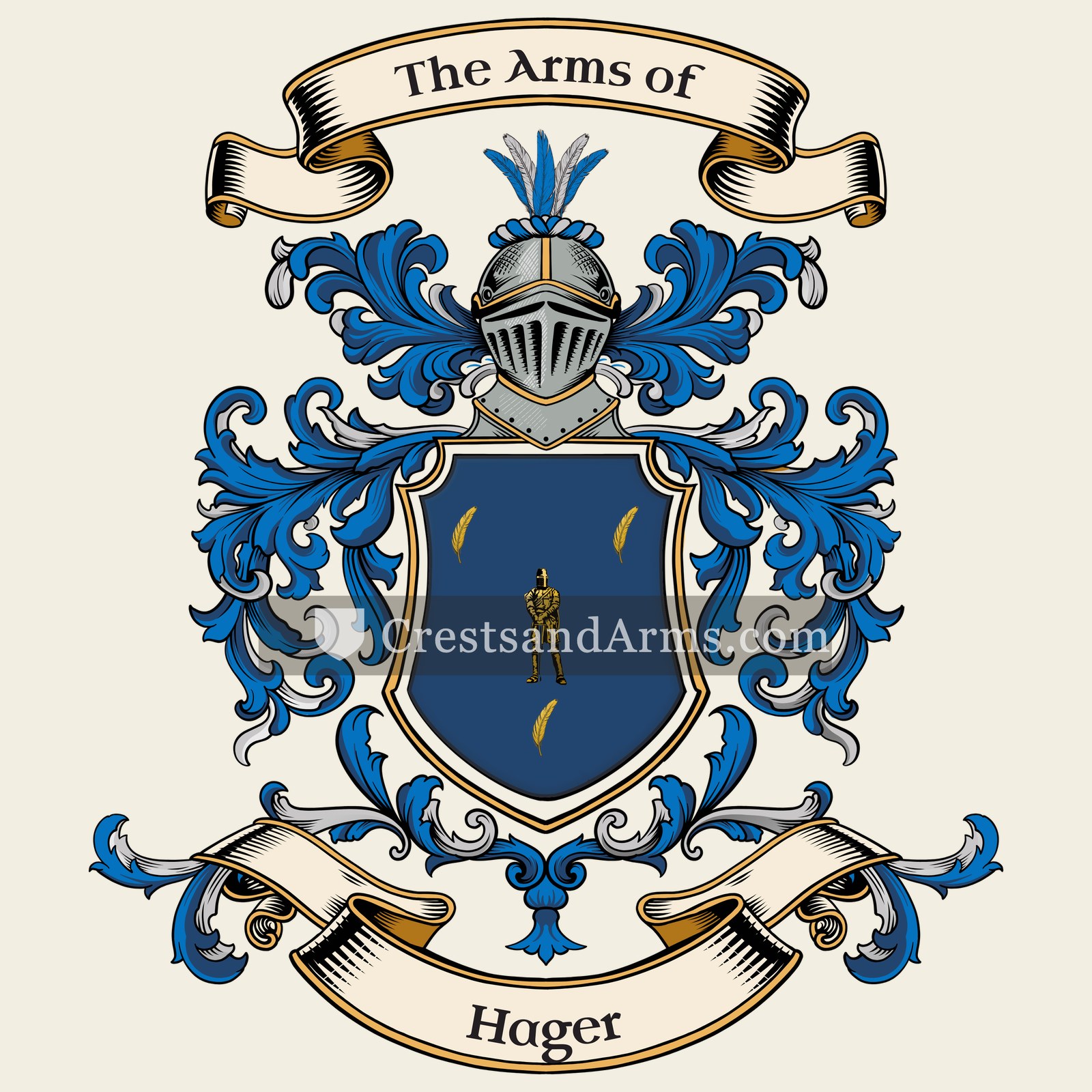
Symbols on this shield
knightChivalry and service in arms
feathersWilling obedience and serenity
Colours
Blue (Azure)Means: Loyalty and truth
Gold (Or)Means: Generosity
Historical info
Source
J. B. Rietstap, Armorial Général, Gouda: G. B. van Goor Zonen, 1884–87
Blazon (the actual original written record)
“D'azur à un buste d'homme, hab. d'or, iss. d'une couronne du même, la tête tort. d'or et sommée de trois pl. d'aut., une d'azur entre deux d'or.”
LivoniaLivonia, c. 1772
Where the Hager Arms Were Recorded
Map of Poland showing where the Hager arms are recorded
The Hager arms were recorded in Livonia, c. 1772.
Livonia was Baltic country held by a small number of landed families who kept their estates for centuries. Land there passed down whole rather than being divided, and long unbroken tenure is what fills a register.
This is where the arms were entered in the register. Families often moved to other parts of the country, so the same name can turn up in more than one region.
Region
Livonia
First recorded
1772
Granting Authority for the Hager Arms
Ennoblement by the Sejm
Author: Olek Remesz · CC BY-SA 3.0
The body that granted and recorded arms in Poland in this period.
Stanisław August Poniatowski
Sovereign of the period
Stanisław August Poniatowski
1764–1795
Reigning in Poland when the Hager arms are first recorded.
How Arms Worked in Poland
Polish noble families shared a single coat of arms across many different surnames, creating large clans rather than individual designs. These symbols were held collectively by all members of the clan regardless of their specific family name. When a new family joined the nobility, they were adopted into an existing clan and began using that group's established shield.
Granting authority
The Sejm, which was the Polish parliament, held the power to grant noble status and the right to bear arms.
How they got arms
Families typically received their coat of arms through a formal act of ennoblement granted by the Sejm for distinguished service.
Where arms were recorded
These grants were officially recorded in the Crown Metrica, which served as the central archive for state documents starting in the sixteenth century.
The family's standing
Recorded among the armigerous families of Livonia.
Origin & History of the Hager Family in Poland
The history of the Hager family in the Polish-Lithuanian sphere is deeply connected to the movement of people across the Baltic region during the eighteenth century. By 1772, records confirm that members of the family were established in Livonia, a territory that served as a cultural crossroads between Germanic influence and the Polish-Lithuanian Commonwealth. The name itself likely originated as a descriptive term for a person who lived near a hedge or a fenced enclosure, reflecting the agricultural roots of many families in Northern Europe at the time. As the political borders shifted during the partitions of Poland, families like the Hagers often found themselves navigating complex loyalties between local landholding traditions and the expanding imperial administrations. Their presence in Livonia suggests they were part of a mobile professional or land-owning class that moved between urban centers and rural estates, helping to shape the social fabric of the region during a period of intense historical change.
Coat of Arms & Family Crest Details
Symbols on this shield
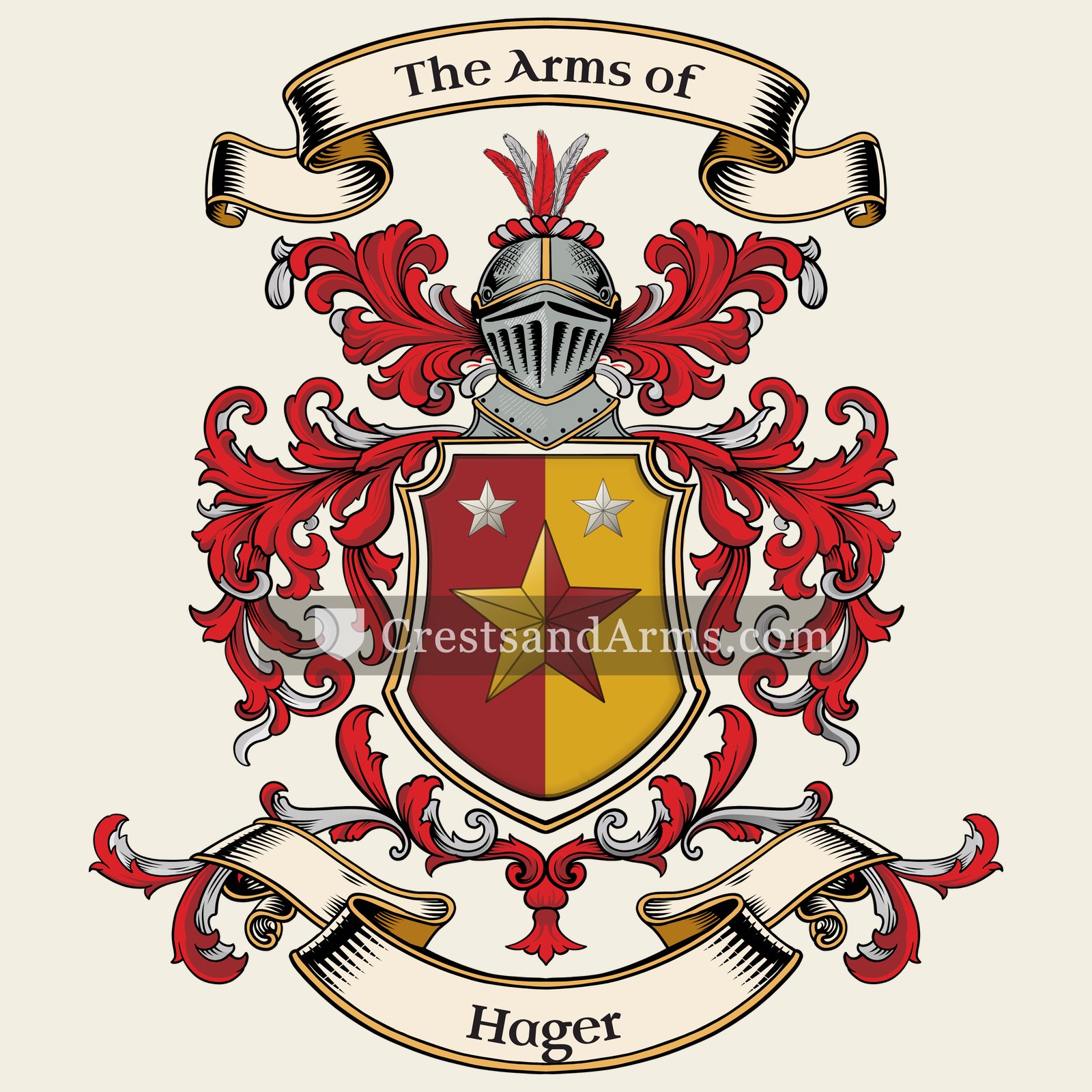
mulletThe third son, and a divine quality from above
Colours
Red (Gules)Means: Military strength
Gold (Or)Means: Generosity
Silver (Argent)Means: Peace and sincerity
Historical info
Source
J. B. Rietstap, Armorial Général, Gouda: G. B. van Goor Zonen, 1884–87
Blazon (the actual original written record)
“Parti de gu. et d'or; à une étoile d'arg. en chef sur le gu., une étoile pareille en chef sur l'or, et une troisième étoile de l'un en l'autre en p., br. sur le parti. C.: un homme iss., hab. de gu., tenant de sa main dextre un chicot au nat. L. d'or et de gu.”
GermanyFrancfort s, c. 1765
Where the Hager Arms Were Recorded
Francfort s
Map of Germany showing where the Hager arms are recorded
The Hager arms were recorded in Francfort s, c. 1765.
This is where the arms were entered in the register. Families often moved to other parts of the country, so the same name can turn up in more than one region.
The body that granted and recorded arms in Germany in this period.
Francis I, Holy Roman Emperor
Sovereign of the period
Francis I, Holy Roman Emperor
1745–1765
Reigning in Poland when the Hager arms are first recorded.
How Arms Worked in Germany
In the Holy Roman Empire, coats of arms were often granted to individuals by the Emperor or his representatives. These arms were then passed down through the generations to all legitimate descendants of the original holder. Younger branches of a family usually kept the same shield design without needing to change it, as the arms belonged to the entire lineage.
Granting authority
The Holy Roman Emperor held the sole power to grant new coats of arms throughout his vast imperial territories.
How they got arms
Families typically obtained their coats of arms through a formal imperial grant or by proving their noble status to the authorities.
Where arms were recorded
These grants were officially recorded in the Imperial Chancery registers, which began keeping formal records of such honors during the Middle Ages.
The family's standing
Recorded among the armigerous families of Germany.
Origin & History of the Hager Family in Germany
The surname Hager is deeply rooted in the German language and historically functioned as a descriptive name for people living in specific environments. Derived from the Middle High German word *hage*, which refers to a hedge, an enclosure, or a fenced-in piece of land, the name likely identified early ancestors who lived near a boundary or managed a protected plot of ground. By the time members of the family were documented in Frankfurt in 1765, the name had already been established for centuries across various German-speaking regions as a way to denote one’s residence or occupation. These early families were often part of the growing urban middle class, contributing to the trade and civic life of cities like Frankfurt during the eighteenth century. As the family moved through these historical landscapes, the name served as a simple but effective way to connect individuals to their ancestral homes and the rural traditions of the German countryside.
Coat of Arms & Family Crest Details
Symbols on this shield
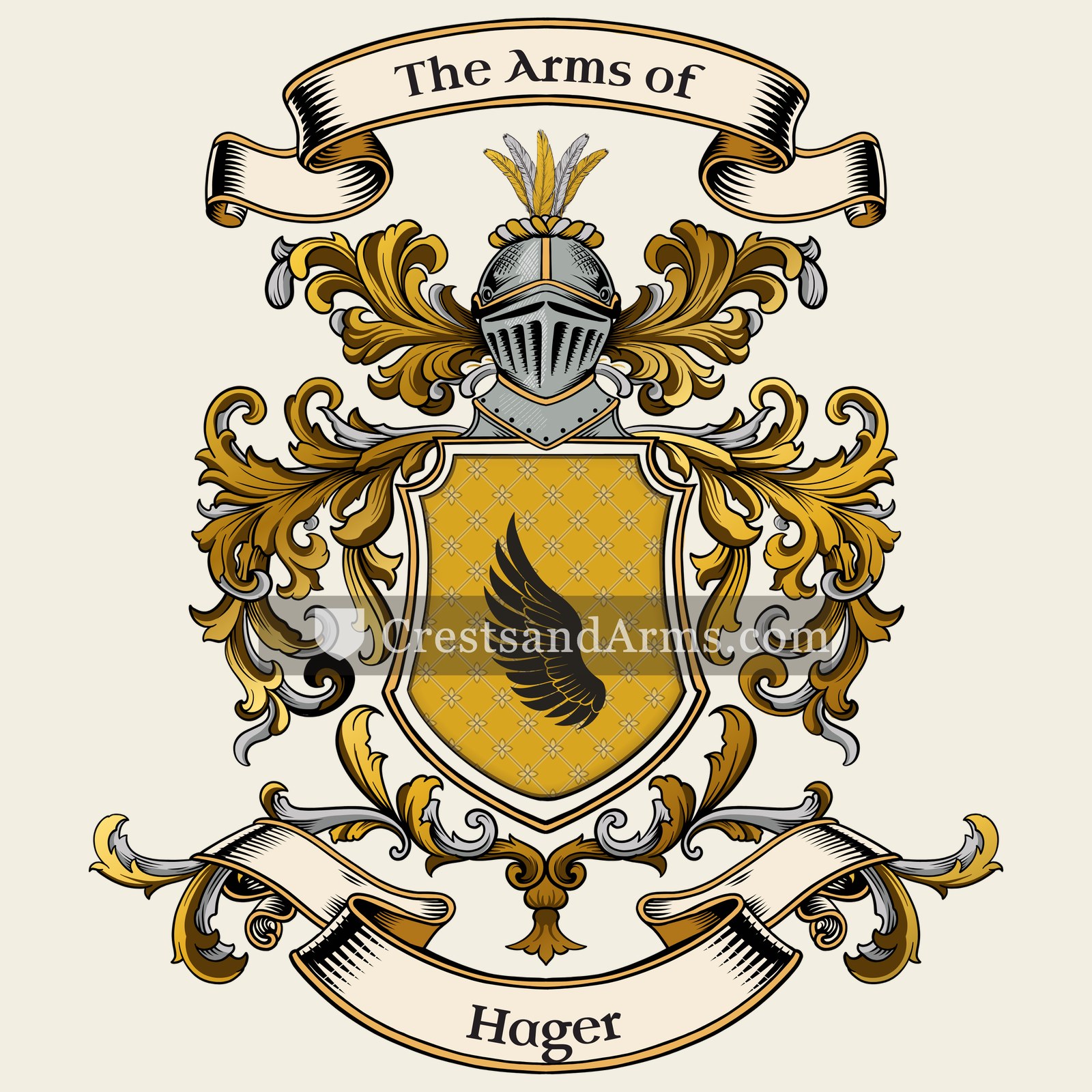
wingSwiftness, and protection under a raised wing
Colours
Gold (Or)Means: Generosity
Black (Sable)Means: Constancy
Historical info
Source
J. B. Rietstap, Armorial Général, Gouda: G. B. van Goor Zonen, 1884–87
Blazon (the actual original written record)
“D'or à un demi-vol de sa. Cq. cour. C.: le demi-vol.”
AustriaGratz Styrie, c. 1772
Where the Hager Arms Were Recorded
Gratz
Map of Austria showing where the Hager arms are recorded
The Hager arms were recorded in Gratz Styrie, c. 1772.
This is where the arms were entered in the register. Families often moved to other parts of the country, so the same name can turn up in more than one region.
Region
Gratz
Town
Gratz Styrie
First recorded
1772
Granting Authority for the Hager Arms
Imperial and Royal chancery
Sodacan · CC BY-SA 3.0
The body that granted and recorded arms in Austria in this period.
Joseph II, Holy Roman Emperor
Sovereign of the period
Joseph II, Holy Roman Emperor
1765–1790
Reigning in Poland when the Hager arms are first recorded.
How Arms Worked in Austria
Austrian coats of arms were often linked directly to noble titles granted by the Emperor. These symbols belonged to the entire family line rather than just one individual. When a family grew, new branches kept the original design without needing to change it. This system allowed all members of a noble house to share the same identity across many generations.
Granting authority
The Imperial and Royal chancery managed all heraldic matters and controlled the official granting of arms throughout the Austrian lands.
How they got arms
Families typically received their arms through a formal imperial decree that often accompanied the elevation of a person to noble status.
Where arms were recorded
Official records of these grants were kept in the Imperial Register of Nobility which began its formal documentation process in 1453.
The family's standing
Recorded among the armigerous families of Austria.
Origin & History of the Hager Family in Austria
The family name Hager is deeply rooted in the German-speaking regions of Central Europe, where it originally functioned as a topographic descriptor for people living near a hedge or an enclosed field. By the time the family established a documented presence in Graz in 1772, the name had already been in use for centuries across the Austrian lands. In the social structure of the late eighteenth century, families like the Hagers in Graz were often part of the growing urban middle class, which included skilled artisans, merchants, or minor civil servants. Living in a major hub like Graz allowed these early family members to participate in the economic expansion of the Habsburg Monarchy. As the name spread through the region, it became associated with the steady development of Austrian town life, reflecting a history defined by local community ties rather than noble titles.
Related Branches & Arms
Root word
Hag
A hedge or an enclosure marking a boundary.
This name
HagerA person who lived near a hedge or worked as a hedge-maker.
also spelled
Hagger
Haeger
Hagar
Related arms
Haagervariant spelling
Dieffenbachrecorded with Hager, same area
Fraidrecorded with Hager, same area
Freybergerrecorded with Hager, same area
Documented Sources
J. B. Rietstap, Armorial Général, Gouda: G. B. van Goor Zonen, 1884–87
Kasekamp, Andres. A History of the Baltic States. 2010
Plakans, Andrejs. The Kinship of the Baltic People. 1994
Latvian State Historical Archives (Latvijas Valsts vēstures arhīvs), Fond 235: Livonian Land Registry records
Estonian Historical Archives (Eesti Ajalooarhiiv), Fond 854: Records of Baltic German families and land holdings
Digital archive packCoat of arms PNG, gold border print PDF, vector SVG and the certificate of authenticity. Sent to your email in minutes.


 knightChivalry and service in arms
 feathersWilling obedience and serenity
 knightChivalry and service in arms
 feathersWilling obedience and serenity

 mulletThe third son, and a divine quality from above

 wingSwiftness, and protection under a raised wing