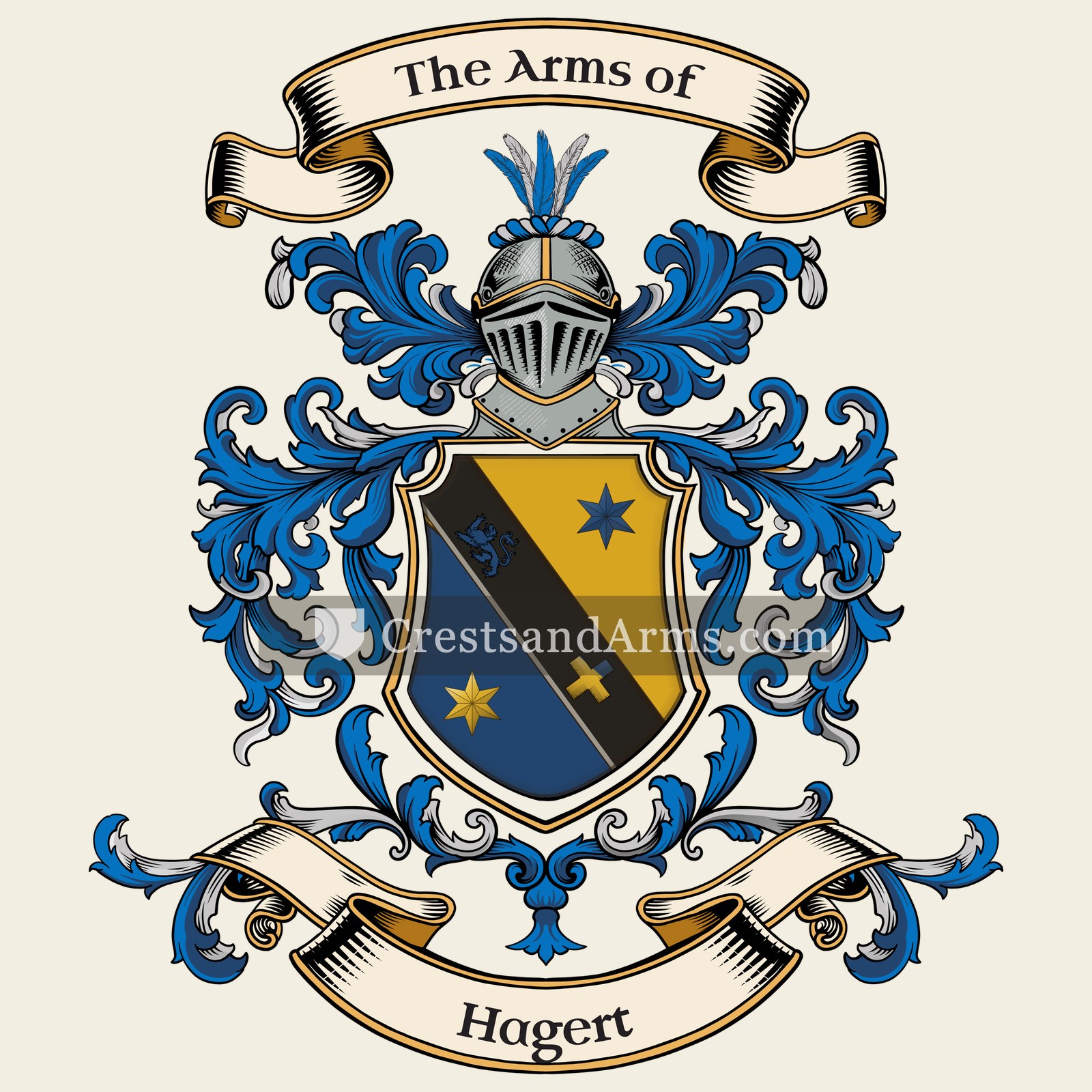
A record of documented arms, meaning and origin, researched for the Hagert family of England.
Reg. 5674 · English, G–I
Coat of Arms & Family Crest Details
Symbols on this shield
bendDefence, and the scarf of a commander
cross symbolChristian faith and service
lionCourage, strength and royalty
starThe celestial goddess, and nobility
Colours
Blue (Azure)Means: Loyalty and truth
Gold (Or)Means: Generosity
Black (Sable)Means: Constancy
Silver (Argent)Means: Peace and sincerity
Historical info
Source
Sir Bernard Burke, The General Armory of England, Scotland, Ireland and Wales, London: Harrison & Sons, 1884
Blazon (the actual original written record)
“Per bend az. and or, on a bend sa. betw. two estoiles of sixteen points, counterchanged, a lion pass. ar. betw. as many crosses moline of the second”
SurreyEastbury Manor · Surrey, c. 1814
Where the Hagert Arms Were Recorded
Surrey
Map of England showing where the Hagert arms are recorded
The Hagert arms were recorded in Surrey, c. 1814.
Surrey sat just south of London and filled up with families who had made money in the City. Buying an estate there was the usual next step, and an estate was the usual reason to take arms.
This is where the arms were entered in the register. Families often moved to other parts of the country, so the same name can turn up in more than one region.
The body that granted and recorded arms in England in this period.
George III of Great Britain
Sovereign of the period
George III of Great Britain
1801–1820
Reigning in England when the Hagert arms are first recorded.
How Arms Worked in England
English heraldry allowed arms to be shared by all legitimate descendants of the original owner. These symbols were treated as personal property that moved through the generations to all children. While the eldest son kept the original design, other family members could use the same shield without needing to change it or register their own unique versions.
Granting authority
The College of Arms in London has regulated the use of coats of arms throughout England and Wales since 1484.
How they got arms
Families typically obtained their coats of arms through a formal grant from the Crown or by proving their ancient right to them.
Where arms were recorded
All official coats of arms are recorded in the registers kept at the College of Arms, which date back to the fifteenth century.
The family's standing
Recorded among the armigerous families of Surrey.
Origin & History of the Hagert Family in England
The family name Hagert likely finds its roots in the linguistic traditions of Northern Europe, where names were often derived from specific occupations or geographic features. By the early 19th century, members of the Hagert family were established in Surrey, England. During this period, Surrey was transitioning from a largely rural landscape into a region increasingly influenced by the proximity of London. Families living in this area often worked in agriculture, local trades, or the growing service industries that supported the expanding population of the capital. While the name is relatively uncommon, its presence in Surrey by 1814 suggests that the family was part of the stable, working population that helped shape the local community during the late Georgian era. These early ancestors lived through a time of significant social change in England, contributing to the development of the region through their daily labor and community involvement.
Related Branches & Arms
Root word
Hagard
Old French term meaning hedge or enclosure.
This name
HagertA habitational name for someone living near a fenced enclosure or hedge.
also spelled
Hagert
Hagard
Documented Sources
Sir Bernard Burke, The General Armory of England, Scotland, Ireland and Wales, London: Harrison & Sons, 1884
Ancestry, England, Select Births and Christenings, 1538-1975, 2014
Surrey History Centre, Parish Registers for Surrey, 1814
The National Archives, Census Returns of England and Wales, 1841
Digital archive packCoat of arms PNG, gold border print PDF, vector SVG and the certificate of authenticity. Sent to your email in minutes.


 bendDefence, and the scarf of a commander
 cross symbolChristian faith and service
 lionCourage, strength and royalty
 starThe celestial goddess, and nobility
 bendDefence, and the scarf of a commander
 cross symbolChristian faith and service
 lionCourage, strength and royalty
 starThe celestial goddess, and nobility