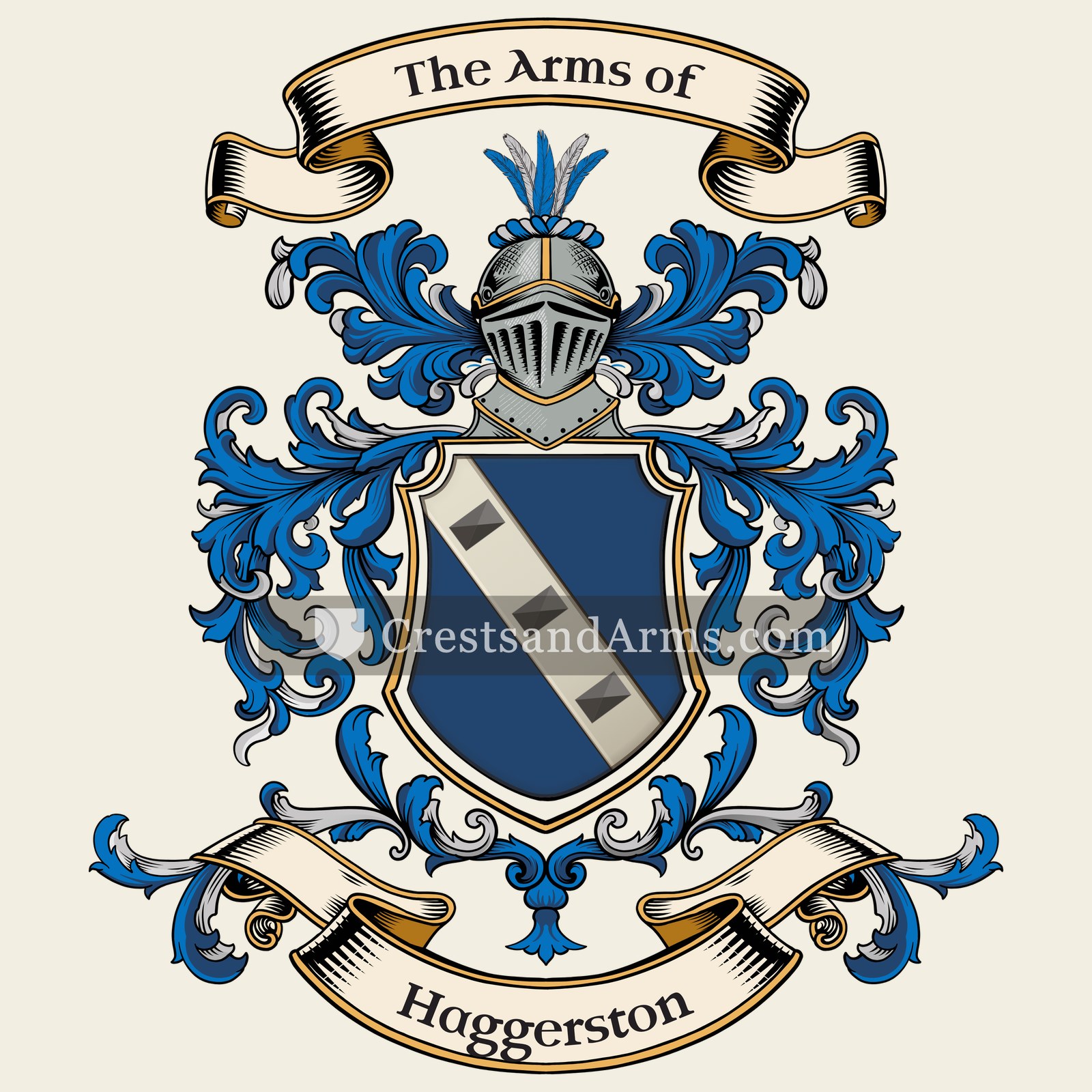
A record of documented arms, meaning and origin, researched for the Haggerston family lines. Documented in 2 countries.
Reg. 1278 · Britain, G–I
Coat of Arms & Family Crest Details
Symbols on this shield
bendDefence, and the scarf of a commander
billetThe sealed letter, and a message delivered
Colours
Blue (Azure)Means: Loyalty and truth
Silver (Argent)Means: Peace and sincerity
Black (Sable)Means: Constancy
Historical info
Source
J. B. Rietstap, Armorial Général, Gouda: G. B. van Goor Zonen, 1884–87
Blazon (the actual original written record)
“D'azur à la bande coticée d'arg., ch. de trois bill. de sa., posées dans le sens de la bande. C.: un lion léopardé d'arg.”
NorthumberlandNorthumberland, c. 1700
Where the Haggerston Arms Were Recorded
Northumberland
Map of Britain showing where the Haggerston arms are recorded
The Haggerston arms were recorded in Northumberland, c. 1700.
Northumberland was border country facing Scotland, raided and fought over for three hundred years. Families held their land in return for defending it, and a defending household carried a shield.
This is where the arms were entered in the register. Families often moved to other parts of the country, so the same name can turn up in more than one region.
The body that granted and recorded arms in Britain in this period.
William III of England
Sovereign of the period
William III of England
1694–1702
Reigning in Britain when the Haggerston arms are first recorded.
How Arms Worked in Britain
English heraldry allowed arms to be shared by all legitimate descendants of the original owner. These symbols were treated as personal property that moved through the generations to all children. While the eldest son kept the original design, other family members could use the same shield without needing to change it or register their own unique versions.
Granting authority
The College of Arms in London has regulated the use of coats of arms throughout England and Wales since 1484.
How they got arms
Families typically obtained their coats of arms through a formal grant from the Crown or by proving their ancient right to them.
Where arms were recorded
All official coats of arms are recorded in the registers kept at the College of Arms, which date back to the fifteenth century.
The family's standing
Recorded among the armigerous families of Northumberland.
Origin & History of the Haggerston Family in Britain
The Haggerston family name is deeply rooted in the rugged landscape of Northumberland, where the family established a significant presence by the start of the 18th century. The name itself is locational, derived from the township of Haggerston near the border of Scotland and England. During the medieval period, families often took their surnames from the specific lands they held or managed, and the Haggerstons were closely tied to this northern territory for generations. Their history is defined by their long-standing residence in this border region, a place frequently shaped by the complex political tensions between the two kingdoms. By the 1700s, the family had solidified their identity as landed gentry, maintaining a strong connection to their ancestral estate while navigating the social and economic changes of the British countryside. This geographic stability allowed the family to remain a recognizable part of the Northumbrian community for centuries.
Coat of Arms & Family Crest Details
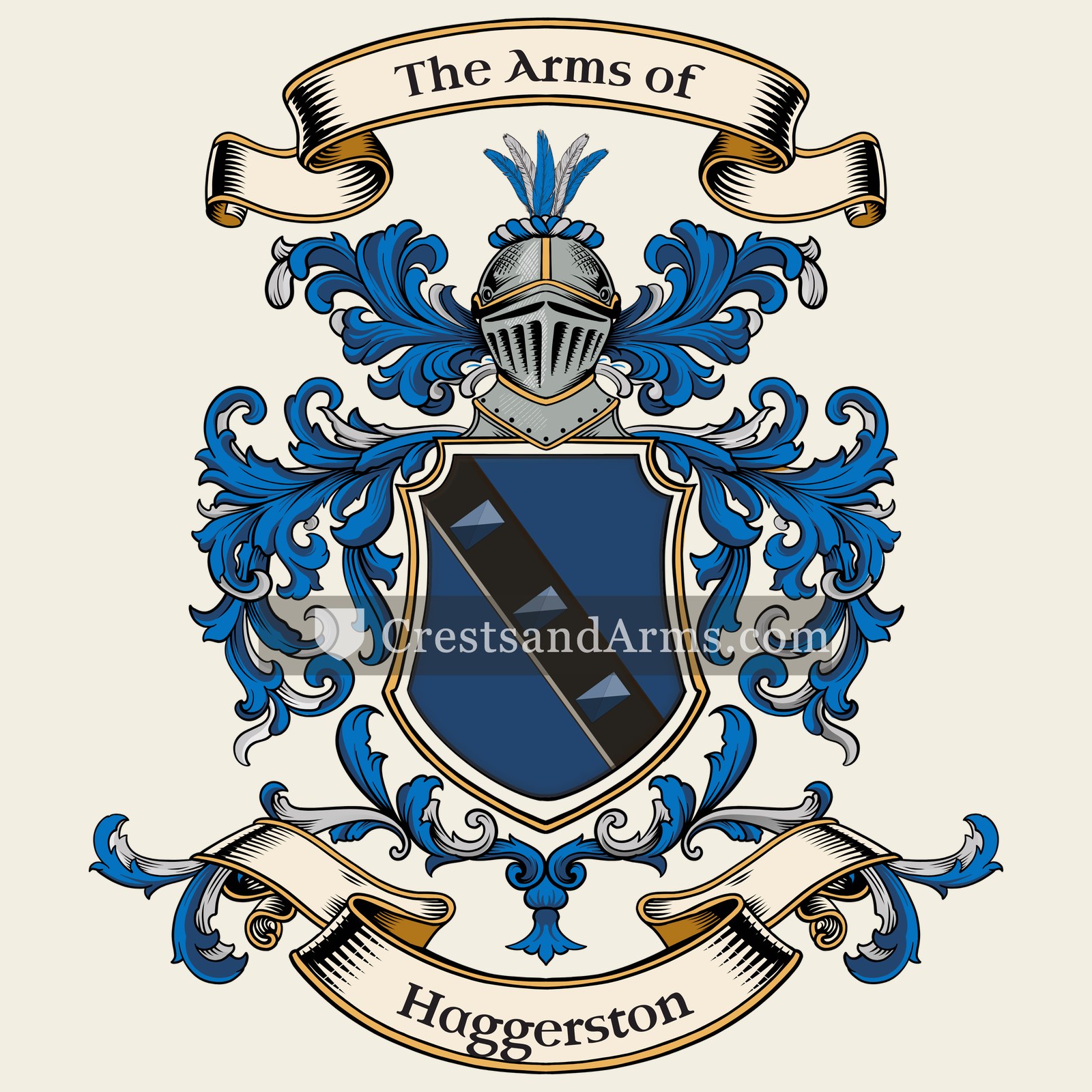
Symbols on this shield
bendDefence, and the scarf of a commander
billetThe sealed letter, and a message delivered
Colours
Blue (Azure)Means: Loyalty and truth
Black (Sable)Means: Constancy
Historical info
Source
Sir Bernard Burke, The General Armory of England, Scotland, Ireland and Wales, London: Harrison & Sons, 1884
Blazon (the actual original written record)
“Az. on a bend cotised ar. three billets sa”
NorthumberlandHaggerston Castle · Northumberland, c. 1620
Where the Haggerston Arms Were Recorded
Northumberland
Map of England showing where the Haggerston arms are recorded
The Haggerston arms were recorded in Northumberland, c. 1620.
Northumberland was border country facing Scotland, raided and fought over for three hundred years. Families held their land in return for defending it, and a defending household carried a shield.
This is where the arms were entered in the register. Families often moved to other parts of the country, so the same name can turn up in more than one region.
The body that granted and recorded arms in England in this period.
James VI and I
Sovereign of the period
James VI and I
1603–1625
Reigning in Britain when the Haggerston arms are first recorded.
How Arms Worked in England
English heraldry allowed arms to be shared by all legitimate descendants of the original owner. These symbols were treated as personal property that moved through the generations to all children. While the eldest son kept the original design, other family members could use the same shield without needing to change it or register their own unique versions.
Granting authority
The College of Arms in London has regulated the use of coats of arms throughout England and Wales since 1484.
How they got arms
Families typically obtained their coats of arms through a formal grant from the Crown or by proving their ancient right to them.
Where arms were recorded
All official coats of arms are recorded in the registers kept at the College of Arms, which date back to the fifteenth century.
The family's standing
Recorded among the armigerous families of Northumberland.
Origin & History of the Haggerston Family in England
The Haggerston family name originates from the village of Haggerston in the county of Northumberland, located in the far north of England near the Scottish border. By the early 17th century, the family had established a significant presence in this rugged region, where they were deeply connected to the local landscape and the complex politics of the borderlands. During this era, families in Northumberland often lived in fortified homes to protect themselves from the frequent raids and instability that defined the area. The Haggerstons were known as prominent landowners who maintained their influence through generations of local governance and agricultural management. Their history is tied to the development of northern English society, as they navigated the transition from the medieval period into the early modern age while remaining rooted in the same ancestral territory for centuries.
Related Branches & Arms
Root word
Hagard
Old Norse name meaning hedge or enclosure
This name
HaggerstonDerived from a place in Northumberland meaning the stone enclosure or hedge settlement
also spelled
Hagerston
Haggerstoun
Haggeston
Documented Sources
J. B. Rietstap, Armorial Général, Gouda: G. B. van Goor Zonen, 1884–87
Hodgson, John. A History of Northumberland. 1827
Raine, James. The History and Antiquities of North Durham. 1852
The National Archives, Kew. Records of the Haggerston Family of Haggerston Castle. Reference ZHE
Northumberland Archives, Woodhorn. Haggerston Estate Records. Reference NRO 496
Digital archive packCoat of arms PNG, gold border print PDF, vector SVG and the certificate of authenticity. Sent to your email in minutes.


 bendDefence, and the scarf of a commander
 billetThe sealed letter, and a message delivered
 bendDefence, and the scarf of a commander
 billetThe sealed letter, and a message delivered