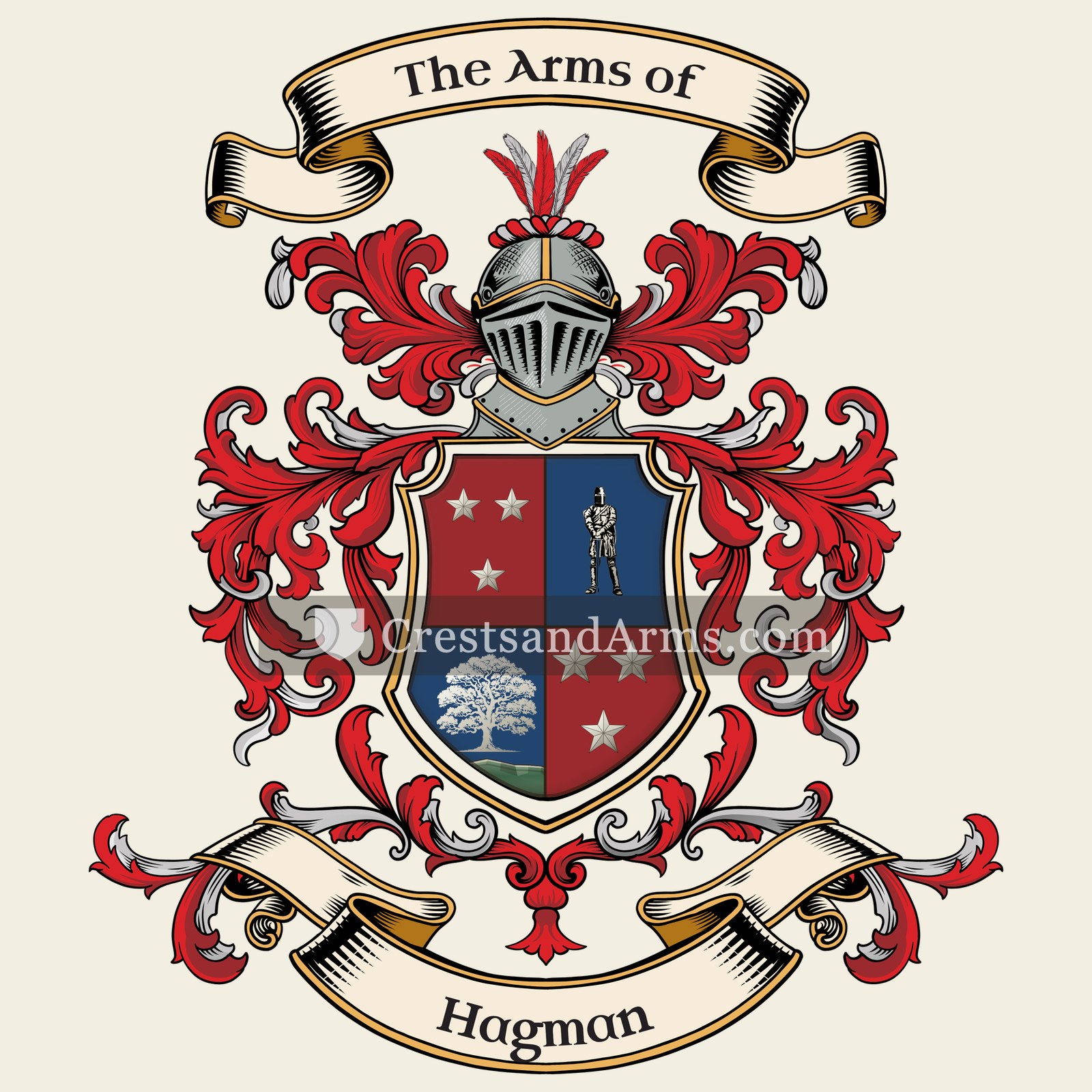
A record of documented arms, meaning and origin, researched for the Hagman family of Russia.
Reg. 5053 · Russian, G–I
Coat of Arms & Family Crest Details
Symbols on this shield
mountThe ground held, and steadfastness upon it
mulletThe third son, and a divine quality from above
knightChivalry and service in arms
treeLife, endurance and deep roots
Colours
Red (Gules)Means: Military strength
Blue (Azure)Means: Loyalty and truth
Green (Vert)Means: Hope
Silver (Argent)Means: Peace and sincerity
Historical info
Source
J. B. Rietstap, Armorial Général, Gouda: G. B. van Goor Zonen, 1884–87
Blazon (the actual original written record)
“Ec.: aux 1 et 4 de gu. à trois étoiles mal-ordonnées d'arg.; au 2 d'azur à un sauvage de carn., ceint et cour. de lierre, tenant une massue, la tête en bas; au 3 d'azur à un arbre terrassé au nat. Cq. cour. C.: deux branches d'olivier de sin., posées en chev. renv. L.: à dextre d'arg. et de gu., à sen. d'arg. et d'azur.”
RussiaEsthonie, c. 1784
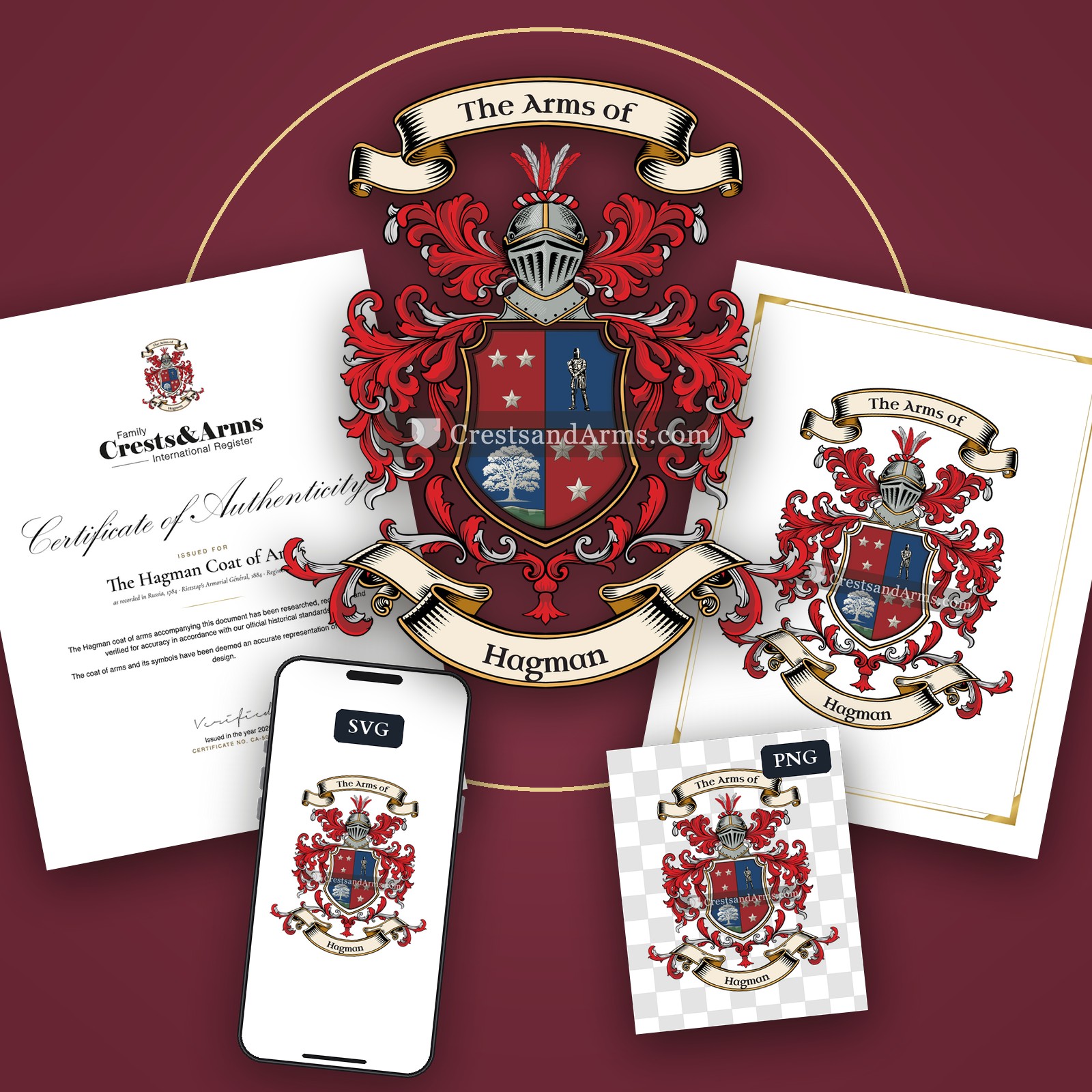
Digital archive packCoat of arms PNG, gold border print PDF, vector SVG and the certificate of authenticity. Sent to your email in minutes.
Map of Russia showing where the Hagman arms are recorded
The Hagman arms were recorded in Esthonie, c. 1784.
Arms such as these were typically recorded in Moscow.
Moscow held the Russian court, and rank there came from service rather than land. Families who served the Tsar were entered in the registers of nobility, and that entry is where their arms are recorded.
This is where the arms were entered in the register. Families often moved to other parts of the country, so the same name can turn up in more than one region.
The body that granted and recorded arms in Russia in this period.
Catherine II of Russia
Sovereign of the period
Catherine II of Russia
1762–1796
Reigning in Russia when the Hagman arms are first recorded.
How Arms Worked in Russia
Russian heraldry was strictly tied to the nobility and the state service system. Families proved their ancient status or earned new rank to receive an official grant from the Tsar. These symbols were then inherited by all legitimate children of the noble line. If a family lacked proof of their status, they were often excluded from the official records entirely.
Granting authority
The Herald Master's Office acted as the central state body that strictly regulated and verified all noble heraldic symbols.
How they got arms
Families typically received their arms through a formal state grant or by proving their noble status to the government authorities.
Where arms were recorded
All approved coats of arms were officially recorded in the General Armorial of the Noble Families of the Russian Empire starting in 1797.
The family's standing
Recorded among the armigerous families of Russia.
Origin & History of the Hagman Family in Russia
The surname Hagman is rooted in Germanic and Scandinavian linguistic traditions, where it typically describes a person who lived near a hedge or a protected forest clearing. By the late 18th century, the family had established a notable presence in Moscow, appearing in official records by 1784. During this period, Moscow served as a major crossroads for international trade and professional migration, drawing skilled craftsmen and merchants from across Northern Europe. Members of the Hagman family likely integrated into the city’s growing expatriate community, contributing to the local economy and social structure. Their presence in the Russian capital during this era suggests they were part of a wider movement of families seeking new opportunities in the rapidly changing landscape of the Russian Empire.
Hagman Meaning & Related Branches
Root word
Hage
Old Norse term for an enclosure, hedge, or fenced garden area.
This name
HagmanOccupational surname referring to a person who lived near or tended a fenced enclosure.
also spelled
Hagman
Hagmon
Documented Sources
J. B. Rietstap, Armorial Général, Gouda: G. B. van Goor Zonen, 1884–87
Kappeler, Andreas. Rußland als Vielvölkerreich: Entstehung, Geschichte, Zerfall. 1992
Russian State Archive of Ancient Acts (RGADA), Fond 16, Delo 784: Records of Foreigners in Moscow. 1784
Sjöberg, Maria. Släktforskning: En vägvisare. 2005
Digital archive packCoat of arms PNG, gold border print PDF, vector SVG and the certificate of authenticity. Sent to your email in minutes.


 mountThe ground held, and steadfastness upon it
 mulletThe third son, and a divine quality from above
 knightChivalry and service in arms
 treeLife, endurance and deep roots
 mountThe ground held, and steadfastness upon it
 mulletThe third son, and a divine quality from above
 knightChivalry and service in arms
 treeLife, endurance and deep roots