A record of documented arms, meaning and origin, researched for the Hainer family lines. Documented in 3 countries.
Reg. 4369 · French, G–I
Meaning of the Hainer family crest colors & symbols
Symbols on this shield
lionCourage, strength and royalty
Colours
Silver (Argent)Means: Peace and sincerity
Blue (Azure)Means: Loyalty and truth
Historical info
Source
J. B. Rietstap, Armorial Général, Gouda: G. B. van Goor Zonen, 1884–87
Blazon (the actual original written record)
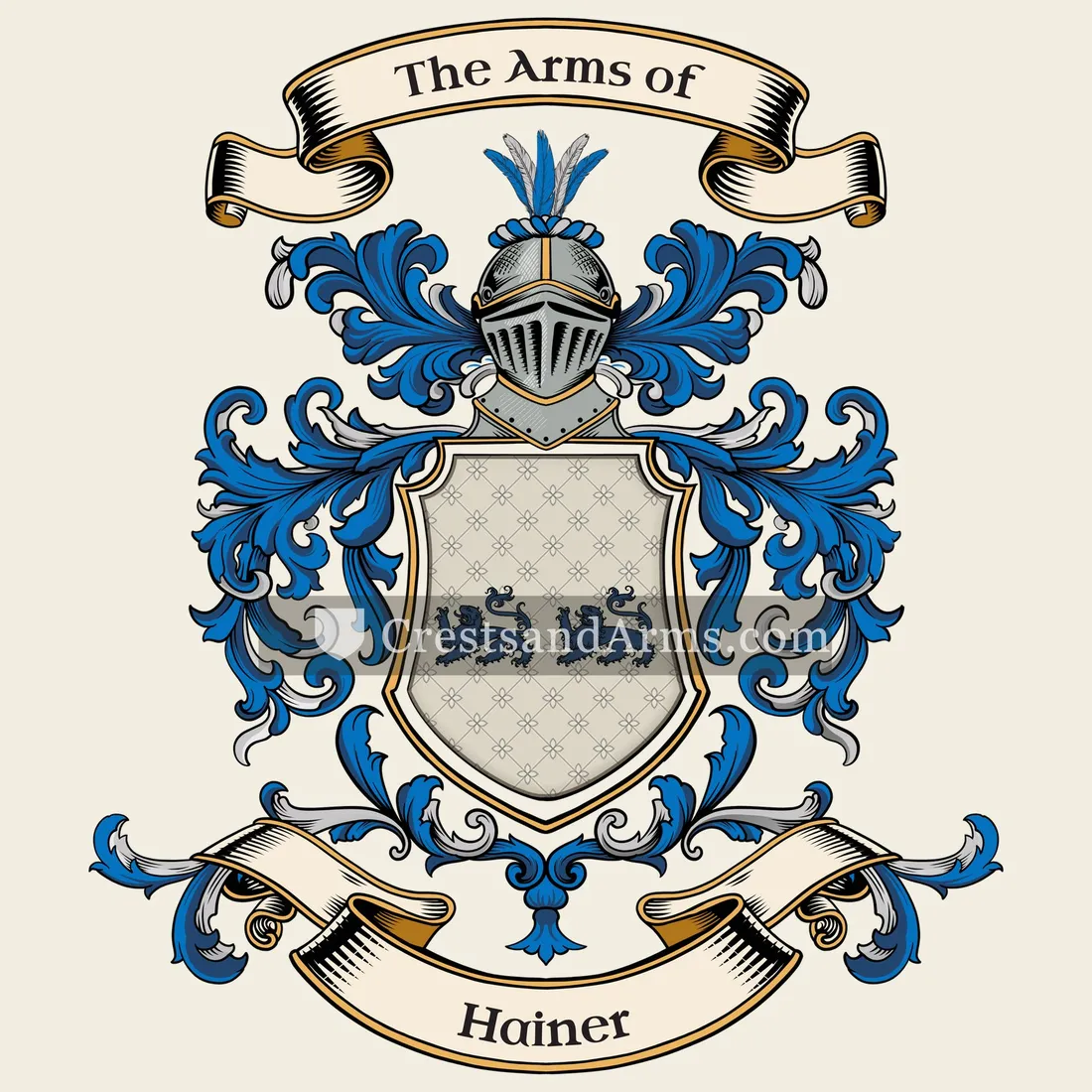
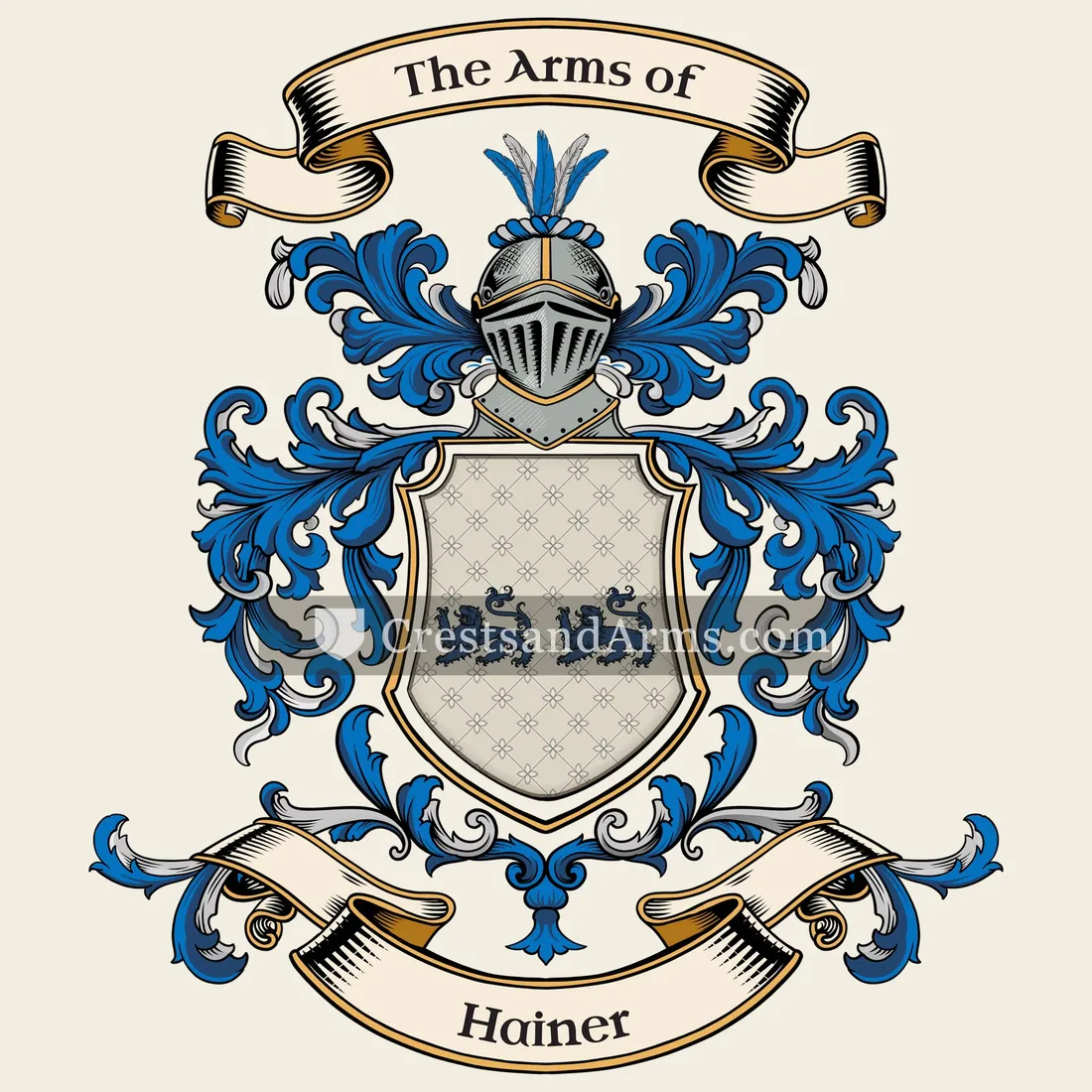
“D'arg. à deux léopards d'azur, arm. et lamp. de gu., l'un sur l'autre. C.: un léopard d'arg., assis sur un chapeau de tournoi de gu., retr. d'herm. S.: à dextre un cygne d'arg. et à sen. une cigogne au nat., tenant chacun au bec une rose de gu., tigée et feuillée de sin. D.: GARDEZ L'HONNEUR.”
Francec. 1725
Digital archive packCoat of arms PNG, gold border print PDF, vector SVG and the certificate of authenticity. Sent to your email in minutes.
Map of France showing where the Hainer arms are recorded
The Hainer arms were recorded in France, c. 1725.
Arms such as these were typically recorded in Bretagne.
More families held coats of arms in Bretagne than anywhere else in France. The land was divided into many small estates rather than a few large ones, so far more households counted as gentry, and each needed a shield of its own to be told apart.
This is where the arms were entered in the register. Families often moved to other parts of the country, so the same name can turn up in more than one region.
The body that granted and recorded arms in France in this period.
Louis XV of France
Sovereign of the period
Louis XV of France
1715–1774
Reigning in France when the Hainer arms are first recorded.
How Arms Worked in France
In France, a coat of arms was a mark of honor that passed down through the male line to all legitimate descendants. Families often used the same shield without changes to show their shared heritage. If a branch wanted to stand out, they could add a small mark to their shield to show their specific place in the family tree.
Granting authority
The Juge d'armes de France acted as the official authority that regulated and verified coats of arms across the country.
How they got arms
Families typically inherited their arms from ancestors, though they could also receive them through royal grants or by proving their noble status.
Where arms were recorded
Coats of arms were officially recorded in the Armorial Général de France, which began its main collection in the year 1696.
The family's standing
Recorded among the armigerous families of France.
Origin & History of the Hainer Family in France
The family name Hainer carries a distinct history rooted in the northwestern region of France known as Bretagne. By the year 1725, records confirm that members of the family were already established within this coastal province, a land defined by its unique Celtic heritage and strong maritime traditions. During this period, the Hainer family likely lived in a society shaped by local agricultural practices and the influence of the Catholic Church, which maintained the primary records of birth and marriage for the population. Because Bretagne remained somewhat culturally isolated from the rest of France for centuries, families in the region often developed deep ties to their specific parishes and local trade guilds. The presence of the family in this area suggests they were part of the hardworking rural or artisan classes that formed the backbone of the Breton economy during the early eighteenth century. As they navigated the social shifts of the era, the Hainer family contributed to the long-standing cultural identity of a region that has always prided itself on its independence and historical depth.
Meaning of the Hainer family crest colors & symbols
Symbols on this shield
lionCourage, strength and royalty
Colours
Silver (Argent)Means: Peace and sincerity
Blue (Azure)Means: Loyalty and truth
Historical info
Source
Sir Bernard Burke, The General Armory of England, Scotland, Ireland and Wales, London: Harrison & Sons, 1884
Blazon (the actual original written record)
“Ar. two lions pass. guard. az. armed and langued gu”
Walesc. 1647
Digital archive packCoat of arms PNG, gold border print PDF, vector SVG and the certificate of authenticity. Sent to your email in minutes.
Map of Wales showing where the Hainer arms are recorded
The Hainer arms were recorded in Wales, c. 1647.
Arms such as these were typically recorded in Denbigh.
Denbighshire was north Welsh country of hills and small estates. Land was held by a great many families rather than a few, and each holding brought its own claim to a coat of arms.
This is where the arms were entered in the register. Families often moved to other parts of the country, so the same name can turn up in more than one region.
The body that granted and recorded arms in Wales in this period.
Charles I of England
Sovereign of the period
Charles I of England
1625–1649
Reigning in France when the Hainer arms are first recorded.
How Arms Worked in Wales
English heraldry allowed arms to be shared by all legitimate descendants of the original owner. These symbols were treated as personal property that moved through the generations to all children. While the eldest son kept the original design, other family members could use the same shield without needing to change it or register their own unique versions.
Granting authority
The College of Arms in London has regulated the use of coats of arms throughout England and Wales since 1484.
How they got arms
Families typically obtained their coats of arms through a formal grant from the Crown or by proving their ancient right to them.
Where arms were recorded
All official coats of arms are recorded in the registers kept at the College of Arms, which date back to the fifteenth century.
The family's standing
Recorded among the armigerous families of Wales.
Origin & History of the Hainer Family in Wales
The history of the Hainer name in Wales is rooted in the rugged landscape of Denbigh, where records confirm the family was established by 1647. During this period, Denbigh served as a vital market town and a center of local administration, placing the Hainer family at the heart of Welsh social and economic life following the turbulence of the English Civil War. The name likely evolved from local occupational roots or descriptive nicknames common to the region, reflecting the way families were identified before the widespread use of formal surnames. As inhabitants of a town with a long history of trade and fortification, the Hainers would have been deeply integrated into the community, likely working as skilled laborers or merchants who helped rebuild and maintain the town’s infrastructure during the mid-seventeenth century. By settling in this specific area, the family became part of the enduring cultural fabric of North Wales, contributing to the local growth that defined the post-war era.
Meaning of the Hainer family crest colors & symbols
Symbols on this shield
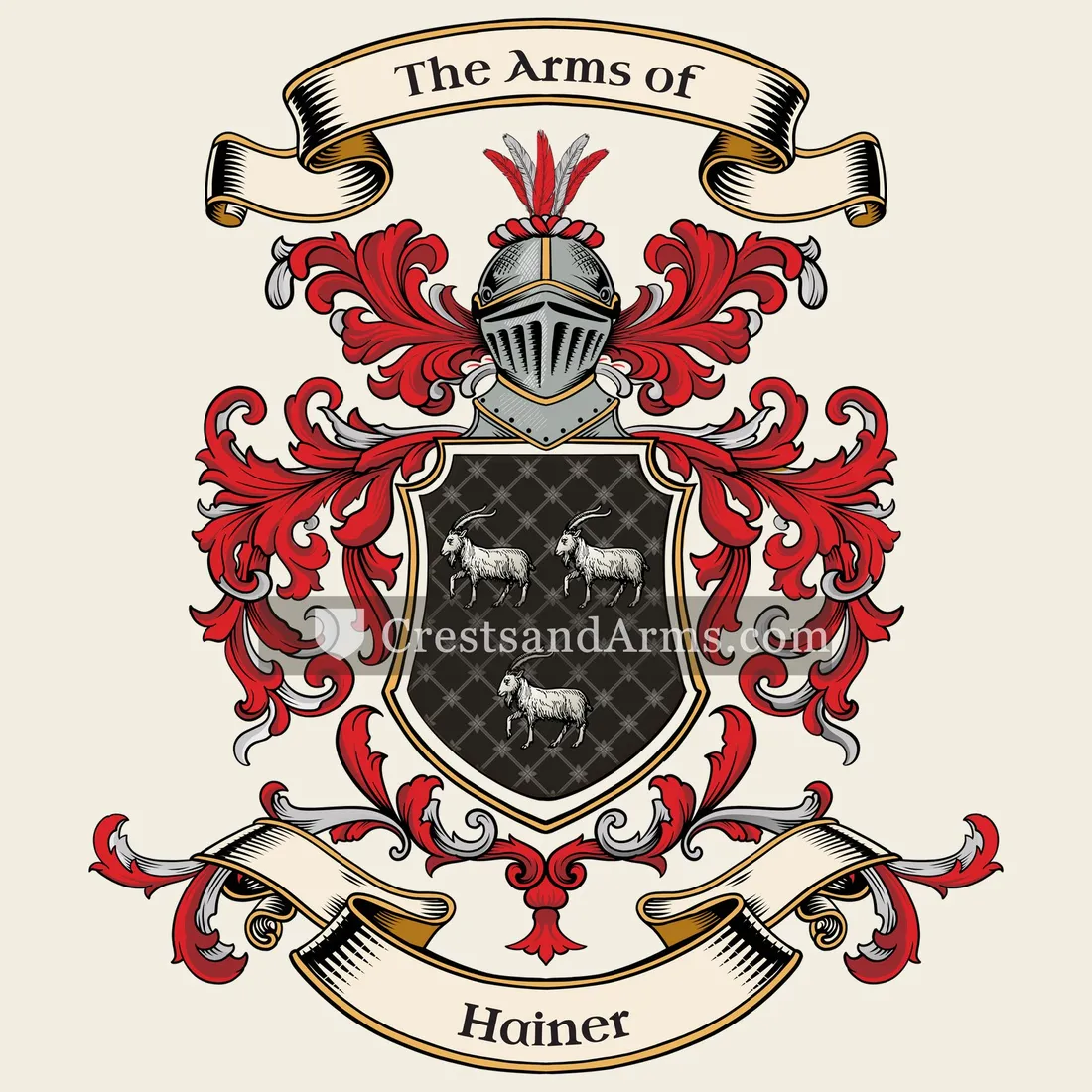
goatOne who wins by diplomacy rather than force
Colours
Black (Sable)Means: Constancy
Silver (Argent)Means: Peace and sincerity
Historical info
Source
Sir Bernard Burke, The General Armory of England, Scotland, Ireland and Wales, London: Harrison & Sons, 1884
Blazon (the actual original written record)
“Sa. three goats pass. ar”
SalopElweny Maptis · Salop, c. 1620
Digital archive packCoat of arms PNG, gold border print PDF, vector SVG and the certificate of authenticity. Sent to your email in minutes.
Map of England showing where the Hainer arms are recorded
The Hainer arms were recorded in Salop, c. 1620.
Shropshire lay on the Welsh border, and border country needed men who could fight. Families held their land in return for service, and service in arms is what a coat of arms was originally for.
This is where the arms were entered in the register. Families often moved to other parts of the country, so the same name can turn up in more than one region.
The body that granted and recorded arms in England in this period.
James VI and I
Sovereign of the period
James VI and I
1603–1625
Reigning in France when the Hainer arms are first recorded.
How Arms Worked in England
English heraldry allowed arms to be shared by all legitimate descendants of the original owner. These symbols were treated as personal property that moved through the generations to all children. While the eldest son kept the original design, other family members could use the same shield without needing to change it or register their own unique versions.
Granting authority
The College of Arms in London has regulated the use of coats of arms throughout England and Wales since 1484.
How they got arms
Families typically obtained their coats of arms through a formal grant from the Crown or by proving their ancient right to them.
Where arms were recorded
All official coats of arms are recorded in the registers kept at the College of Arms, which date back to the fifteenth century.
The family's standing
Recorded among the armigerous families of Salop.
Origin & History of the Hainer Family in England
The surname Hainer is deeply rooted in the history of the English West Midlands, particularly within the county of Shropshire, historically known as Salop. By the year 1620, records confirm that members of the Hainer family were already established residents in this region. The name likely evolved from occupational or topographical origins, reflecting the way people identified themselves in rural communities during the late Middle Ages and the early modern period. In the seventeenth century, families in Salop often lived in close-knit agricultural parishes where they contributed to the local economy through farming and trade. As the family grew, they became part of the social fabric of the English countryside, leaving behind traces in local parish registers and legal documents that track their movement through the generations. This early presence in Shropshire highlights the family’s long-standing connection to the landscape and the traditional way of life in Western England.
Hainer Meaning & Related Branches
Root word
Hagano
A Germanic term referring to a hedge or an enclosed area.
This name
HainerAn occupational surname for someone who lived near or maintained a hedge or boundary.
also spelled
Hannmer
Hanmere
Hanmmer
Hanmar
Documented Sources
J. B. Rietstap, Armorial Général, Gouda: G. B. van Goor Zonen, 1884–87
Archives départementales du Finistère, Registres paroissiaux et d'état civil
Archives départementales d'Ille-et-Vilaine, Fonds de l'intendance de Bretagne
Le Moyne de La Borderie, Arthur, Histoire de Bretagne, 1896
Meyer, Jean, La noblesse bretonne au XVIIIe siècle, 1966
Digital archive packCoat of arms PNG, gold border print PDF, vector SVG and the certificate of authenticity. Sent to your email in minutes.


 lionCourage, strength and royalty
 lionCourage, strength and royalty




 goatOne who wins by diplomacy rather than force