Map of Germany showing where the Haldern arms are recorded
The Haldern arms were recorded in Bavaria, c. 1765.
Bavaria was a country of old landed families and walled market towns. Estates passed down the same line for centuries, and both the landowners and the leading townsmen kept arms, which is why so many Bavarian names sit in the registers.
This is where the arms were entered in the register. Families often moved to other parts of the country, so the same name can turn up in more than one region.
The body that granted and recorded arms in Germany in this period.
Francis I, Holy Roman Emperor
Sovereign of the period
Francis I, Holy Roman Emperor
1745–1765
Reigning in Germany when the Haldern arms are first recorded.
How Arms Worked in Germany
In the Holy Roman Empire, coats of arms were often granted to individuals by the Emperor or his representatives. These arms were then passed down through the generations to all legitimate descendants of the original holder. Younger branches of a family usually kept the same shield design without needing to change it, as the arms belonged to the entire lineage.
Granting authority
The Holy Roman Emperor held the sole power to grant new coats of arms throughout his vast imperial territories.
How they got arms
Families typically obtained their coats of arms through a formal imperial grant or by proving their noble status to the authorities.
Where arms were recorded
These grants were officially recorded in the Imperial Chancery registers, which began keeping formal records of such honors during the Middle Ages.
The family's standing
Recorded among the armigerous families of Bavaria.
Origin & History of the Haldern Family in Germany
The family name Haldern is rooted in the regional geography of Germany, where surnames often emerged to describe the specific landscape or settlement where a family resided. By the mid-eighteenth century, records confirm that members of the Haldern family were established in the southern region of Bavaria. During this era, Bavaria was a collection of territories undergoing significant social and economic shifts, and families like the Halderns were typically integrated into the local agrarian or trade-based economy. Because the name is locational in origin, it suggests that the earliest ancestors likely lived near a prominent slope or a specific wooded area, as the root of the name is often associated with these natural features in the German language. As these families moved through the Bavarian countryside in 1765 and beyond, they contributed to the local community structure, leaving behind a legacy tied to the development of the region’s rural parishes and village life.
Meaning of the Haldern family crest colors & symbols
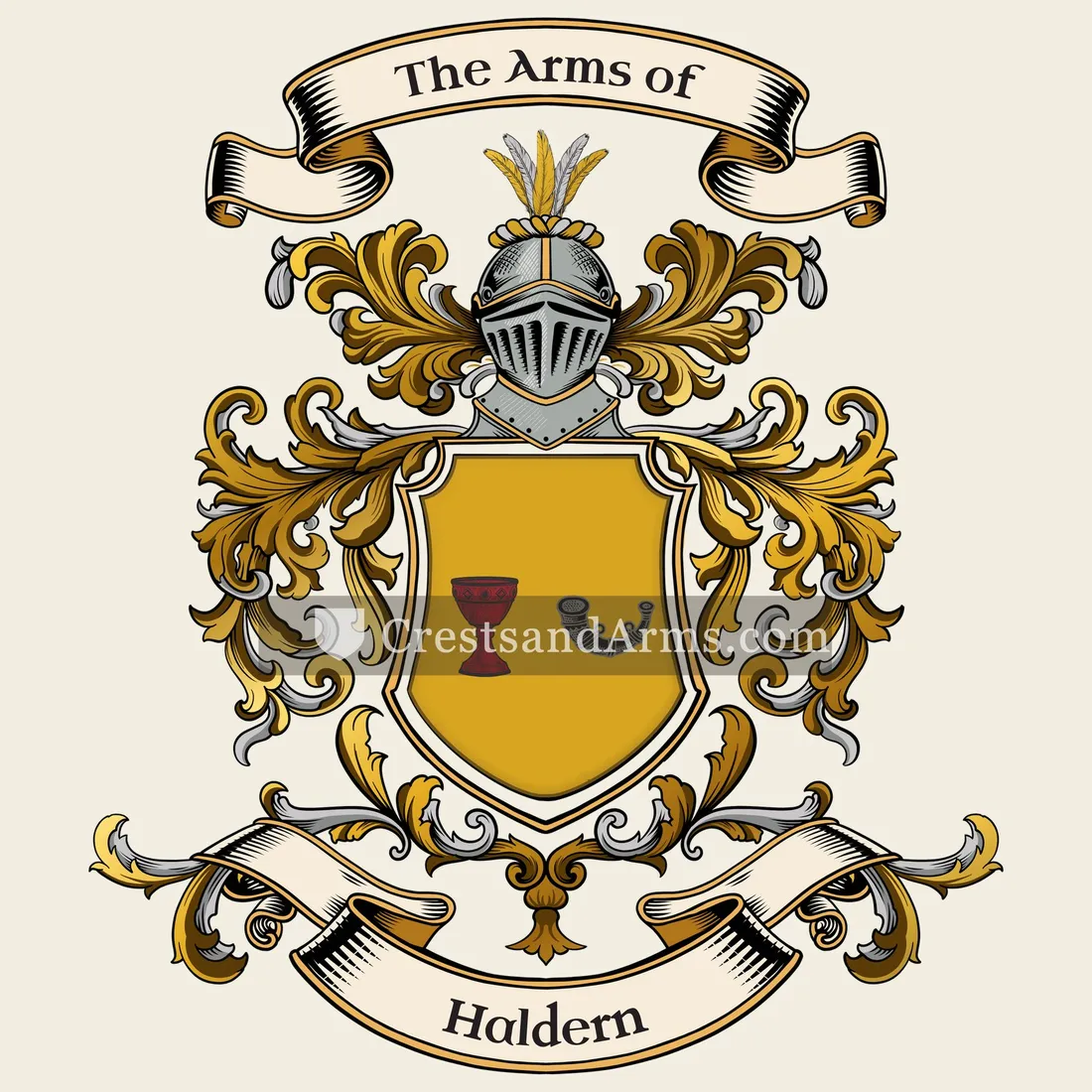
Symbols on this shield
cupFaith, office, and a trust discharged
hunting horn stringedOne who delights in the chase
Colours
Gold (Or)Means: Generosity
Red (Gules)Means: Military strength
Black (Sable)Means: Constancy
Historical info
Source
J. B. Rietstap, Armorial Général, Gouda: G. B. van Goor Zonen, 1884–87
Blazon (the actual original written record)
“D'or à un chaudron de gu., à cornière de sa. C.: un homme iss., hab. de gu., rebr. d'or, au rabat du même, tenant de ses mains la cornière élevée au-dessus de sa tête.”
Switzerlandc. 1745
Digital archive packCoat of arms PNG, gold border print PDF, vector SVG and the certificate of authenticity. Sent to your email in minutes.
Map of Switzerland showing where the Haldern arms are recorded
The Haldern arms were recorded in Switzerland, c. 1745.
Arms such as these were typically recorded in Bern.
Bern was the largest of the Swiss cantons and ran itself, with its own council and its own courts. Its governing families held office for generations, and office of that kind carried a shield with it.
This is where the arms were entered in the register. Families often moved to other parts of the country, so the same name can turn up in more than one region.
The body that granted and recorded arms in Switzerland in this period.
How Arms Worked in Switzerland
In Switzerland, coats of arms were not restricted to the nobility and were often adopted by common citizens and families. These symbols were passed down through generations to show family identity. When branches of a family grew, they often changed small details of the design to distinguish their own line from the original group.
Granting authority
Cantonal and civic authorities managed the use of coats of arms within their specific regions and local jurisdictions.
How they got arms
Families typically assumed their own coats of arms based on local custom rather than receiving them from a central monarch.
Where arms were recorded
Arms were recorded in various cantonal and civic registers starting from the fourteenth century throughout the Swiss region.
The family's standing
Recorded among the armigerous families of Switzerland.
Origin & History of the Haldern Family in Switzerland
The history of the Haldern family in Switzerland is rooted in the social and economic landscape of the eighteenth century, particularly within the city of Bern. By 1745, records confirm that members of the family were established residents of this influential Swiss canton. During this period, Bern was a powerful city-state governed by a strict hierarchy, and families like the Halderns were often integrated into the local merchant or craft guilds that controlled the city's trade. The name itself suggests a connection to geographic origins, as it likely refers to individuals who migrated from the town of Haldern in present-day Germany to seek new opportunities in the Swiss Confederation. Once in Bern, these early family members navigated the complex legal and social requirements of the time, eventually becoming part of the permanent citizenry. Their presence reflects the broader patterns of migration that brought skilled workers and families into the Swiss heartland to contribute to the growing urban economy of the Enlightenment era.
Haldern Meaning & Related Branches
Root word
Halde
A steep slope, hillside, or incline in Middle High German.
This name
HaldernRefers to someone who lived near or on a steep hillside or slope.
also spelled
Haldere
Halderh
Halderr
Documented Sources
J. B. Rietstap, Armorial Général, Gouda: G. B. van Goor Zonen, 1884–87
Bavarian State Archives (Bayerisches Hauptstaatsarchiv), Kurbayern Hofkammer Buchhaltung
Bavarian State Archives (Bayerisches Hauptstaatsarchiv), General-Landes-Archivalien
Gottschald, Max, Deutsche Namenkunde: Unsere Familiennamen nach ihrer Entstehung und Bedeutung, 1971
Heintze, Albert, Die deutschen Familiennamen: geschichtlich, geographisch, sprachlich, 1933
Digital archive packCoat of arms PNG, gold border print PDF, vector SVG and the certificate of authenticity. Sent to your email in minutes.


 fessThe military belt, and readiness to serve
 fessThe military belt, and readiness to serve
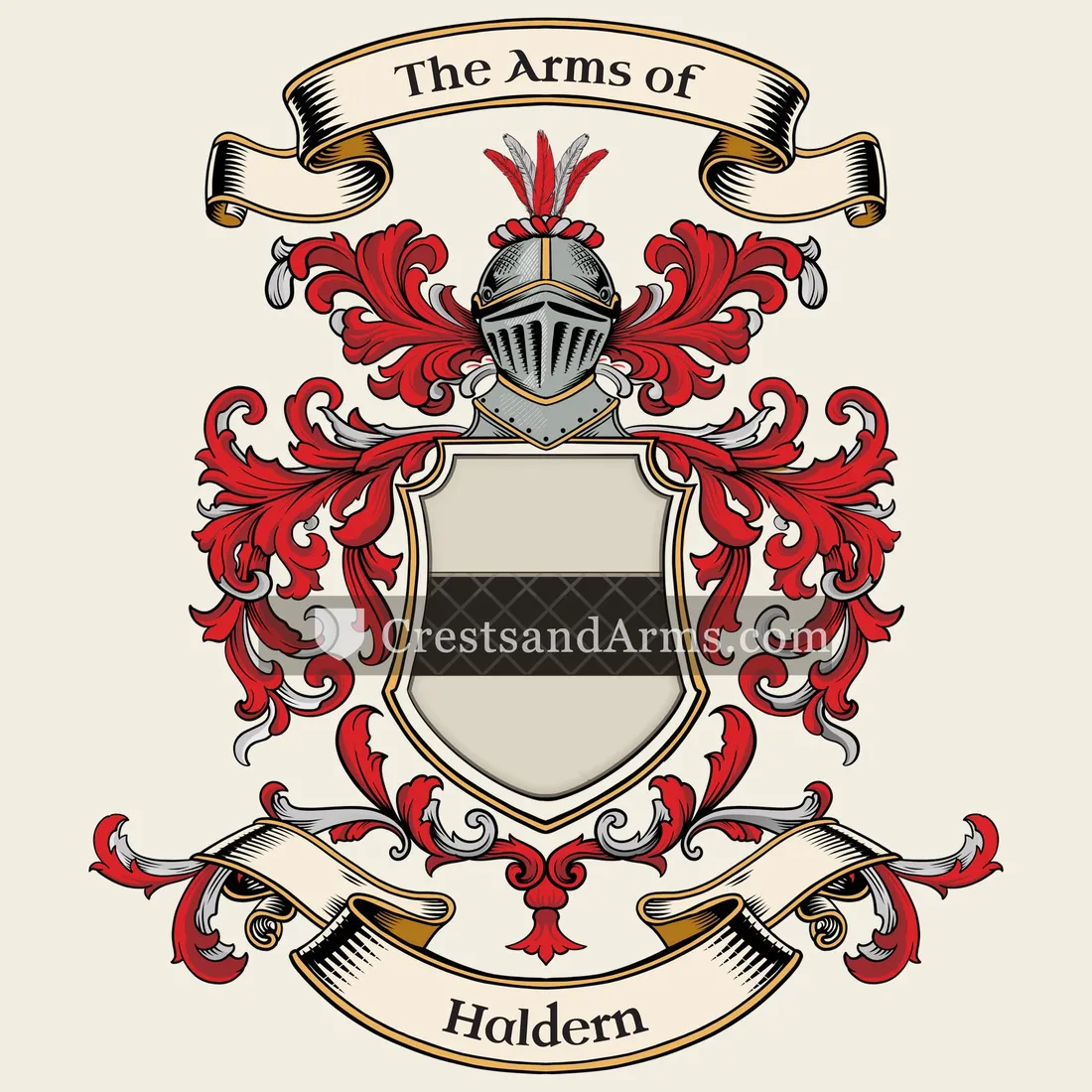


 cupFaith, office, and a trust discharged
 hunting horn stringedOne who delights in the chase