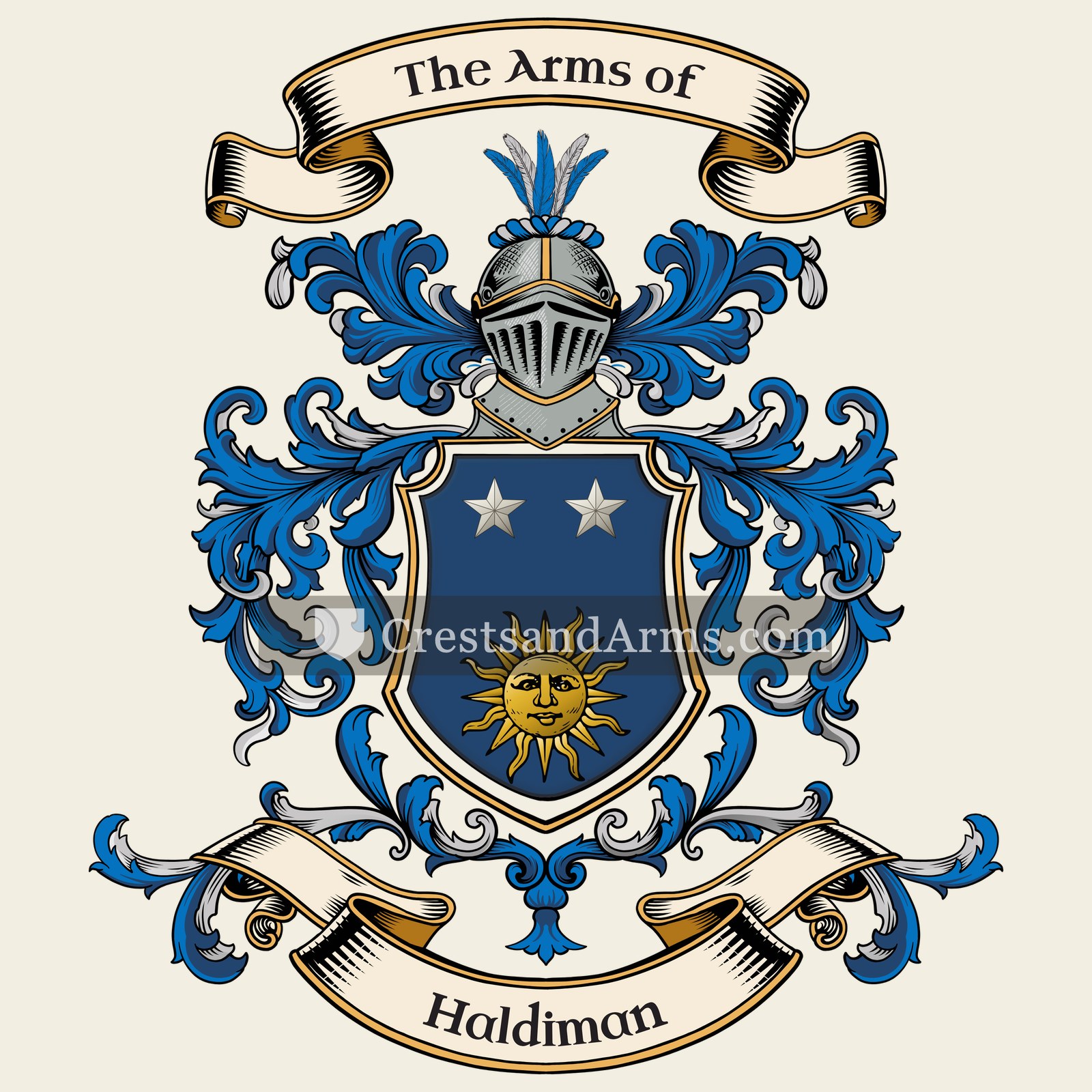
A record of documented arms, meaning and origin, researched for the Haldiman family of Switzerland.
Reg. 9178 · Swiss, G–I
Coat of Arms & Family Crest Details
Symbols on this shield
sunGlory, splendour and the source of life
mulletThe third son, and a divine quality from above
Colours
Blue (Azure)Means: Loyalty and truth
Gold (Or)Means: Generosity
Silver (Argent)Means: Peace and sincerity
Historical info
Source
J. B. Rietstap, Armorial Général, Gouda: G. B. van Goor Zonen, 1884–87
Blazon (the actual original written record)
“D'azur à un soleil d'or, acc. en chef de deux étoiles (5) d'arg.”
SwitzerlandYverdon, c. 1725
Where the Haldiman Arms Were Recorded
Yverdon
Map of Switzerland showing where the Haldiman arms are recorded
The Haldiman arms were recorded in Yverdon, c. 1725.
This is where the arms were entered in the register. Families often moved to other parts of the country, so the same name can turn up in more than one region.
The body that granted and recorded arms in Switzerland in this period.
How Arms Worked in Switzerland
In Switzerland, coats of arms were not restricted to the nobility and were often adopted by common citizens and families. These symbols were passed down through generations to show family identity. When branches of a family grew, they often changed small details of the design to distinguish their own line from the original group.
Granting authority
Cantonal and civic authorities managed the use of coats of arms within their specific regions and local jurisdictions.
How they got arms
Families typically assumed their own coats of arms based on local custom rather than receiving them from a central monarch.
Where arms were recorded
Arms were recorded in various cantonal and civic registers starting from the fourteenth century throughout the Swiss region.
The family's standing
Recorded among the armigerous families of Switzerland.
Origin & History of the Haldiman Family in Switzerland
The Haldiman family name traces its roots to the French-speaking regions of Switzerland, with a significant presence established in the town of Yverdon by the early eighteenth century. During this period, the family became deeply integrated into the local community, often participating in the professional and civic life of the Vaud region. The name itself is thought to be of Germanic origin, likely evolving from older linguistic roots that identified a person by their residence or specific geographic location. As the family grew, members became known for their roles in commerce and public administration, helping to shape the social landscape of the area. By 1725, records confirm that the Haldimans were well-settled citizens, contributing to the development of Yverdon as a center for trade and regional governance.
Related Branches & Arms
Root word
Halde
A slope, hillside, or steep terrain.
This name
HaldimanRefers to a person who lived or worked on a steep hillside or slope.
also spelled
Haldiman
Haldimant
Haldemand
Haldemant
Documented Sources
J. B. Rietstap, Armorial Général, Gouda: G. B. van Goor Zonen, 1884–87
Godet, Marcel, Dictionnaire historique et biographique de la Suisse, 1928


 sunGlory, splendour and the source of life
 mulletThe third son, and a divine quality from above
 sunGlory, splendour and the source of life
 mulletThe third son, and a divine quality from above