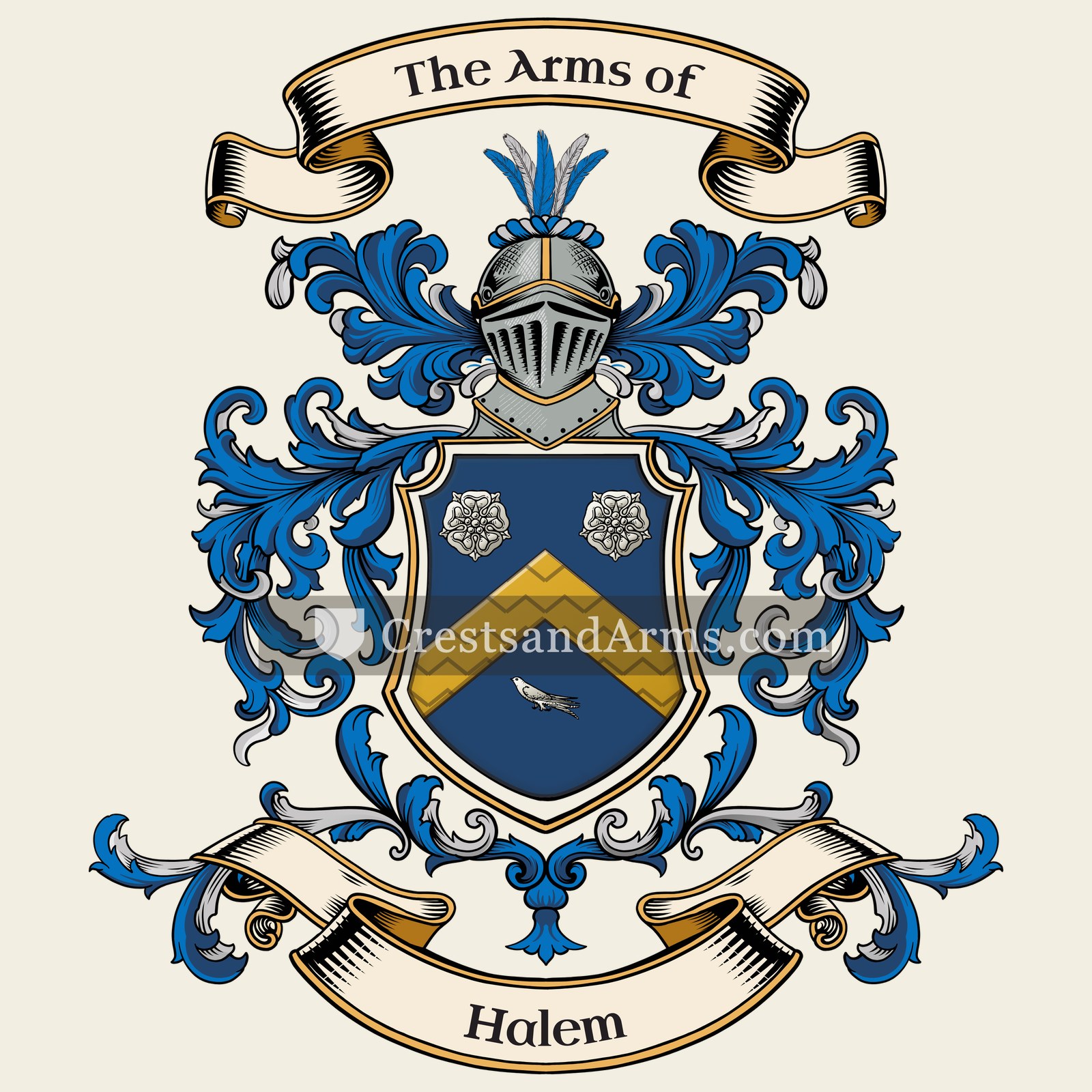
A record of documented arms, meaning and origin, researched for the Halem family of Germany.
Reg. 3308 · German, G–I
Coat of Arms & Family Crest Details
Symbols on this shield
chevronProtection, and faithful service completed
roseThe seventh son, and beauty with grace
martletA younger son, who must win his own land
Colours
Blue (Azure)Means: Loyalty and truth
Gold (Or)Means: Generosity
Silver (Argent)Means: Peace and sincerity
Historical info
Source
J. B. Rietstap, Armorial Général, Gouda: G. B. van Goor Zonen, 1884–87
Blazon (the actual original written record)
“D'azur au chev. d'or, acc. en chef de deux roses d'arg., bout. d'or, et en p. d'un oiseau d'arg., bq. et m. d'or. C.: deux pl. d'aut. d'azur. L. d'or et d'azur.”
GermanyOldenbourg, c. 1765
Where the Halem Arms Were Recorded
Oldenbourg
Map of Germany showing where the Halem arms are recorded
The Halem arms were recorded in Oldenbourg, c. 1765.
This is where the arms were entered in the register. Families often moved to other parts of the country, so the same name can turn up in more than one region.
The body that granted and recorded arms in Germany in this period.
Francis I, Holy Roman Emperor
Sovereign of the period
Francis I, Holy Roman Emperor
1745–1765
Reigning in Germany when the Halem arms are first recorded.
How Arms Worked in Germany
In the Holy Roman Empire, coats of arms were often granted to individuals by the Emperor or his representatives. These arms were then passed down through the generations to all legitimate descendants of the original holder. Younger branches of a family usually kept the same shield design without needing to change it, as the arms belonged to the entire lineage.
Granting authority
The Holy Roman Emperor held the sole power to grant new coats of arms throughout his vast imperial territories.
How they got arms
Families typically obtained their coats of arms through a formal imperial grant or by proving their noble status to the authorities.
Where arms were recorded
These grants were officially recorded in the Imperial Chancery registers, which began keeping formal records of such honors during the Middle Ages.
The family's standing
Recorded among the armigerous families of Germany.
Origin & History of the Halem Family in Germany
The history of the Halem family is deeply rooted in the cultural and professional landscape of Oldenburg, Germany, where the family became a prominent fixture by the mid-eighteenth century. Records confirm that the family was established in this region by 1765, a time when Oldenburg was transitioning through significant political and social changes. Members of the family were often associated with the intellectual and administrative life of the city, frequently serving as lawyers, writers, and public officials. This focus on education and civic duty allowed the family to gain social standing within the local community. By settling in this specific area, the Halem family helped shape the professional traditions of the region for generations to come.
Related Branches & Arms
Root word
Hal
A Germanic element referring to a salt works or salt production site.
This name
HalemDerived from a topographic location associated with salt extraction or a dweller near a salt spring.
also spelled
Halem
Documented Sources
J. B. Rietstap, Armorial Général, Gouda: G. B. van Goor Zonen, 1884–87
Gerhard Anton von Halem, Lebensbeschreibung, 1803
Hans Friedl, Biographisches Handbuch zur Geschichte des Landes Oldenburg, 1992
Niedersächsisches Landesarchiv (Oldenburg location), Bestand 261-11: Nachlass Gerhard Anton von Halem
Digital archive packCoat of arms PNG, gold border print PDF, vector SVG and the certificate of authenticity. Sent to your email in minutes.


 chevronProtection, and faithful service completed
 roseThe seventh son, and beauty with grace
 martletA younger son, who must win his own land
 chevronProtection, and faithful service completed
 roseThe seventh son, and beauty with grace
 martletA younger son, who must win his own land