A record of documented arms, meaning and origin, researched for the Haliburton family lines. Documented in 2 countries.
Reg. 8006 · French, G–I
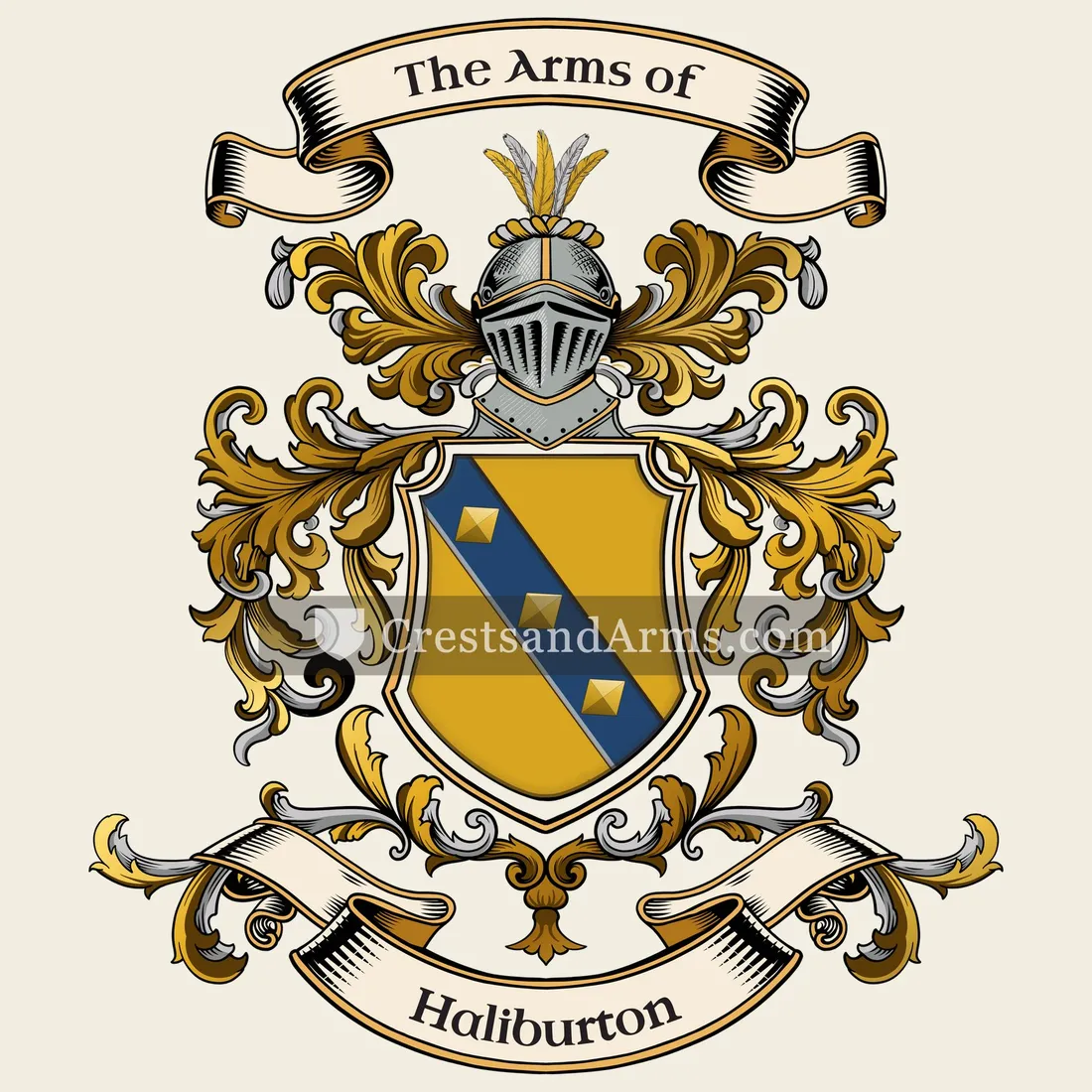
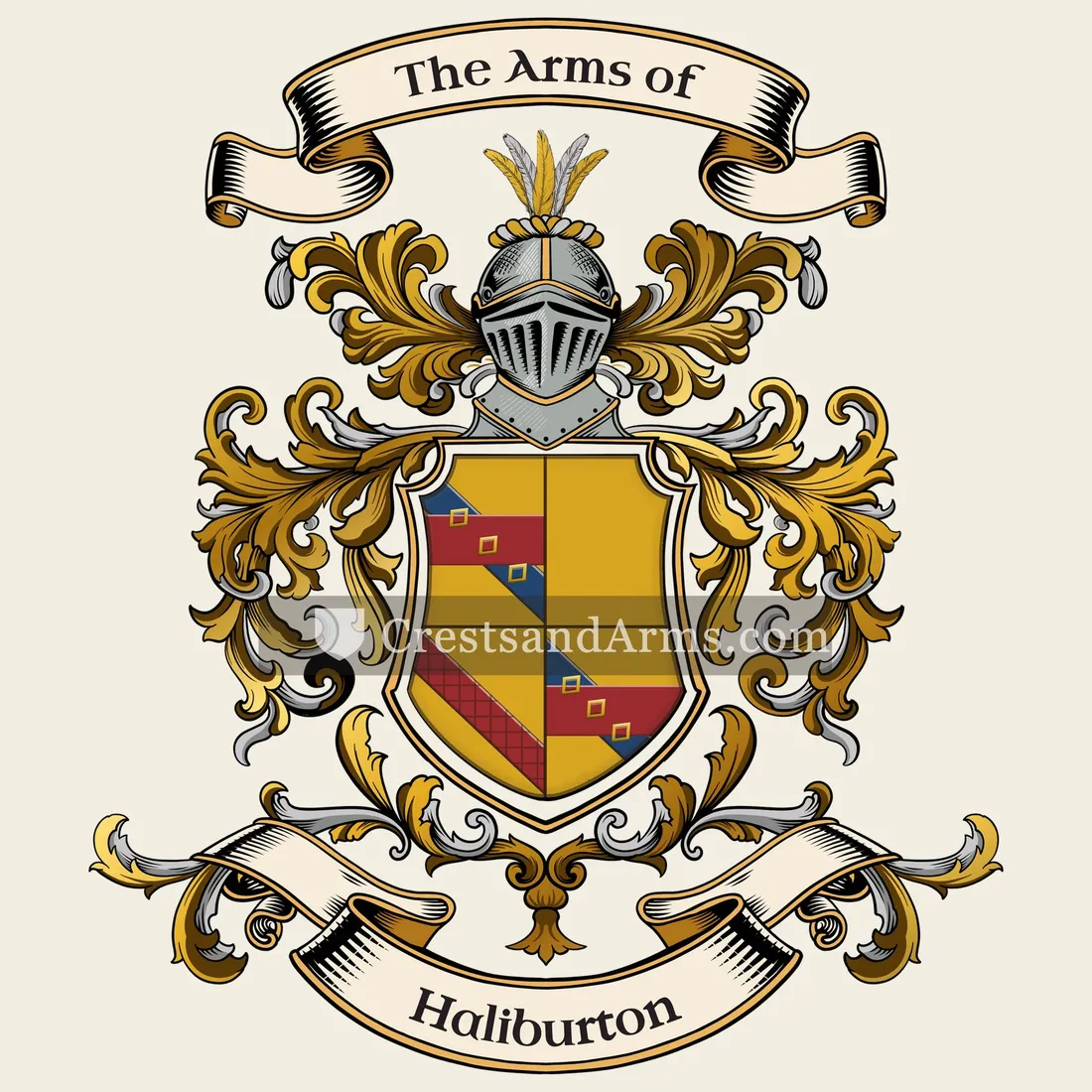
Meaning of the Haliburton family crest colors & symbols
Symbols on this shield
bendDefence, and the scarf of a commander
fessThe military belt, and readiness to serve
masclePersuasion and the mail of a knight's coat
Colours
Gold (Or)Means: Generosity
Blue (Azure)Means: Loyalty and truth
Red (Gules)Means: Military strength
Historical info
Source
J. B. Rietstap, Armorial Général, Gouda: G. B. van Goor Zonen, 1884–87
Blazon (the actual original written record)
“Ec.: aux 1 et 4 d'or à la bande d'azur, ch. de trois mâcles du champ, posées dans le sens de la bande (Halyburton); au 2 d'or à trois fasces de gu. (Cameron); au 3 d'arg. à la bande de gu. (Vaux). C.: une tête de More, tort. d'arg. S.: deux Mores, ceints et tort. d'arg. D.: WATCH WELL.”
Francec. 1725
Digital archive packCoat of arms PNG, gold border print PDF, vector SVG and the certificate of authenticity. Sent to your email in minutes.
Map of France showing where the Haliburton arms are recorded
The Haliburton arms were recorded in France, c. 1725.
Arms such as these were typically recorded in Bretagne.
More families held coats of arms in Bretagne than anywhere else in France. The land was divided into many small estates rather than a few large ones, so far more households counted as gentry, and each needed a shield of its own to be told apart.
This is where the arms were entered in the register. Families often moved to other parts of the country, so the same name can turn up in more than one region.
The body that granted and recorded arms in France in this period.
Louis XV of France
Sovereign of the period
Louis XV of France
1715–1774
Reigning in France when the Haliburton arms are first recorded.
How Arms Worked in France
In France, a coat of arms was a mark of honor that passed down through the male line to all legitimate descendants. Families often used the same shield without changes to show their shared heritage. If a branch wanted to stand out, they could add a small mark to their shield to show their specific place in the family tree.
Granting authority
The Juge d'armes de France acted as the official authority that regulated and verified coats of arms across the country.
How they got arms
Families typically inherited their arms from ancestors, though they could also receive them through royal grants or by proving their noble status.
Where arms were recorded
Coats of arms were officially recorded in the Armorial Général de France, which began its main collection in the year 1696.
The family's standing
Recorded among the armigerous families of France.
Origin & History of the Haliburton Family in France
The history of the Haliburton name in France is deeply tied to the region of Bretagne during the early eighteenth century. While the name itself has roots in the Scottish Borders, members of the family established a notable presence in French coastal towns by 1725. During this period, the family integrated into the local social and economic structures of the province. They often participated in the active maritime trade that defined the Breton ports at the time. Living in Bretagne allowed these individuals to navigate the complex cultural exchange between the British Isles and the French mainland. Their presence in the region highlights how families of northern origin adapted to life in western France while maintaining their distinct identity. By settling in this area, they became part of the long history of migration and settlement that shaped the demographic landscape of eighteenth-century France.
Meaning of the Haliburton family crest colors & symbols
Symbols on this shield
bendDefence, and the scarf of a commander
lozengeHonour and nobility, and the arms of a woman
Colours
Gold (Or)Means: Generosity
Blue (Azure)Means: Loyalty and truth
Historical info
Source
Sir Bernard Burke, The General Armory of England, Scotland, Ireland and Wales, London: Harrison & Sons, 1884
Blazon (the actual original written record)
“Or, on a bend wavy az. three lozenges of the first”
HaddingtonEgliscairnie · Haddington, c. 1748
Digital archive packCoat of arms PNG, gold border print PDF, vector SVG and the certificate of authenticity. Sent to your email in minutes.
Map of Scotland showing where the Haliburton arms are recorded
The Haliburton arms were recorded in Haddington, c. 1748.
Haddington, now East Lothian, was the best farmland in Scotland and lay close to Edinburgh. Good land near the capital stayed in the hands of families of standing, and standing brought arms.
This is where the arms were entered in the register. Families often moved to other parts of the country, so the same name can turn up in more than one region.
The body that granted and recorded arms in Scotland in this period.
George II of Great Britain
Sovereign of the period
George II of Great Britain
1727–1760
Reigning in France when the Haliburton arms are first recorded.
How Arms Worked in Scotland
Scottish heraldry is unique because it treats a coat of arms as a piece of personal property protected by law. Only one person can own a specific design at any given time. When a family grows, the head keeps the original shield while other relatives must apply for their own distinct version with slight changes to prove their specific identity.
Granting authority
The Court of the Lord Lyon acts as the official body that regulates and controls all heraldic matters throughout Scotland.
How they got arms
Individuals obtain a legal right to their arms through a formal petition process that confirms their identity and family connection.
Where arms were recorded
All valid coats of arms are officially entered into the Public Register of All Arms and Bearings starting from 1672.
The family's standing
Recorded among the armigerous families of Haddington.
Origin & History of the Haliburton Family in Scotland
The surname Haliburton originates from the lands of Halyburton in the parish of Greenlaw, located in the Scottish Borders. The name is territorial, meaning the family took their identity from the specific geography of their ancestral estate. By the mid-eighteenth century, members of the family had established a notable presence in Haddington, a historic market town in East Lothian. During this era, the family was deeply integrated into the local social and economic life of the region, often appearing in town records as landowners, merchants, or professionals. Because the name is tied to the landscape of the Scottish Lowlands, the history of the Haliburtons is closely linked to the development of Scottish agriculture and the growth of town governance during the 1700s. Their transition from the Borders to the fertile plains of East Lothian reflects the broader movement of families seeking new opportunities in the administrative and trade centers of Scotland.
Haliburton Meaning & Related Branches
Root word
Haliburton
Derived from the Old English words for holy and estate or town.
This name
HaliburtonRefers to a person originating from the holy estate or sacred settlement.
also spelled
Haliburton
Hallyburton
Halyburtoun
Related arms
Halyburtonvariant spelling
Documented Sources
J. B. Rietstap, Armorial Général, Gouda: G. B. van Goor Zonen, 1884–87
Archives départementales d'Ille-et-Vilaine, Série B: Cours et juridictions
Delumeau, Jean, Histoire de la Bretagne, 1969
Meyer, Jean, La noblesse bretonne au XVIIIe siècle, 1966
Digital archive packCoat of arms PNG, gold border print PDF, vector SVG and the certificate of authenticity. Sent to your email in minutes.


 bendDefence, and the scarf of a commander
 fessThe military belt, and readiness to serve
 masclePersuasion and the mail of a knight's coat
 bendDefence, and the scarf of a commander
 fessThe military belt, and readiness to serve
 masclePersuasion and the mail of a knight's coat


 lozengeHonour and nobility, and the arms of a woman