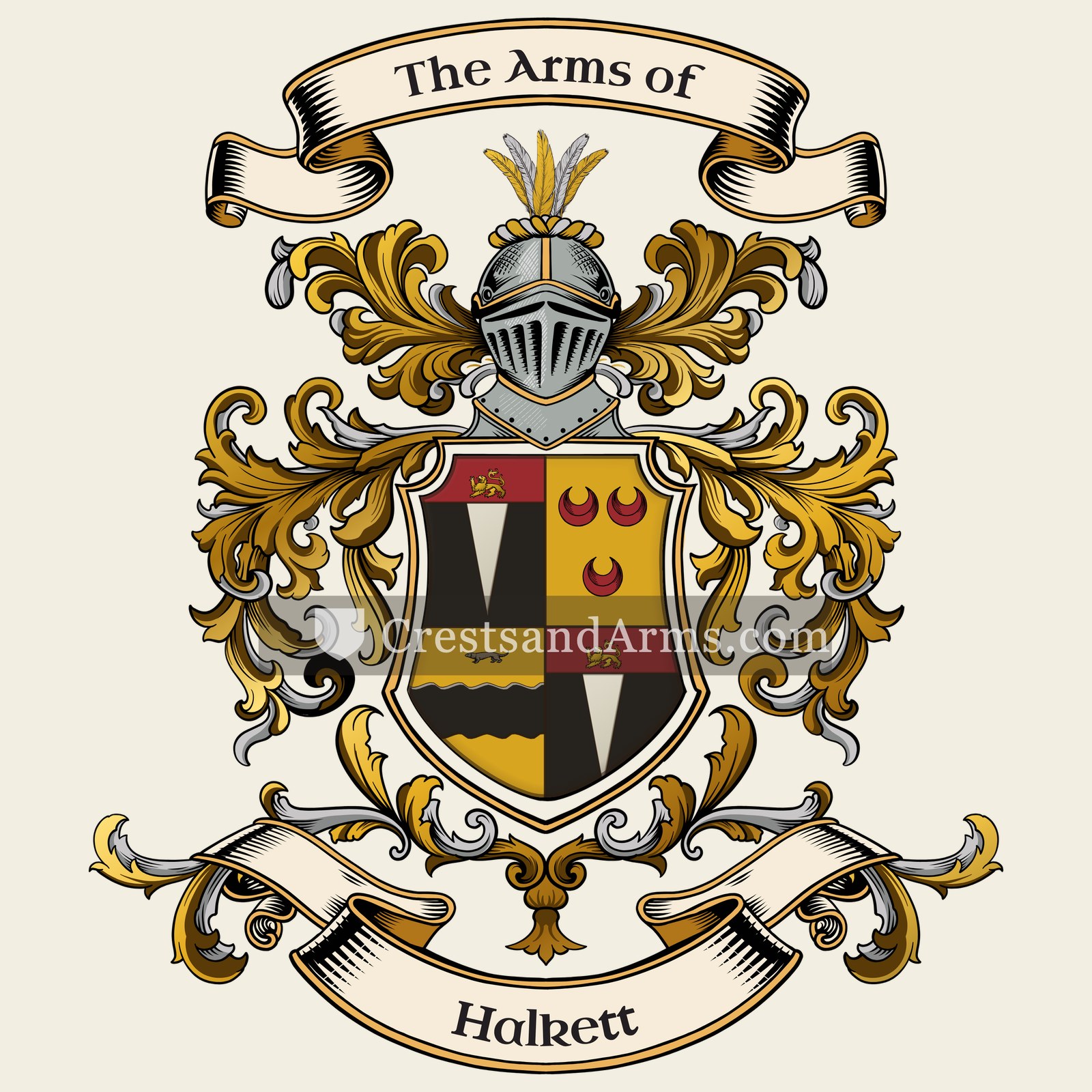
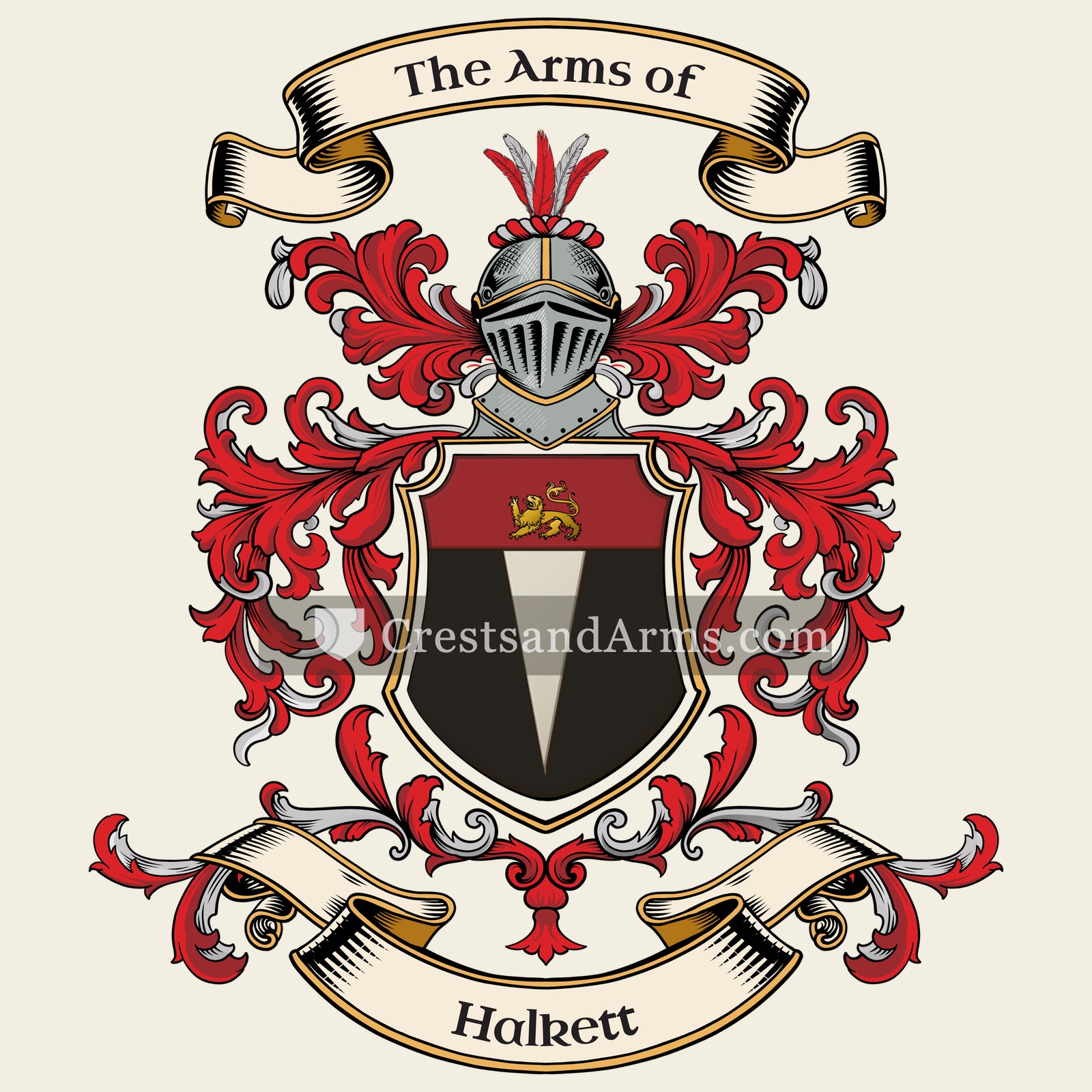
A record of documented arms, meaning and origin, researched for the Halkett family lines. Documented in 2 countries.
Reg. 8103 · German, G–I
Coat of Arms & Family Crest Details
Symbols on this shield
pileWell-doing, and a mark of distinction
chiefAuthority, wisdom and dominion
fessThe military belt, and readiness to serve
lionCourage, strength and royalty
crescentHonour by the sovereign, and the second son
otterOne who lives life to the full
Colours
Black (Sable)Means: Constancy
Gold (Or)Means: Generosity
Silver (Argent)Means: Peace and sincerity
Red (Gules)Means: Military strength
Historical info
Source
J. B. Rietstap, Armorial Général, Gouda: G. B. van Goor Zonen, 1884–87
Blazon (the actual original written record)
“Ec.: aux 1 et 4 de sa. à trois piles d'arg., dirigées vers la p. ; au chef de gu., ch. d'un léopard d'or (Halkett) ; au 2 d'or à trois croiss. de gu., enclos dans un double trêcheur fleur. et c.-fleur. du même (Seton) ; au 3 d'arg. à une fasce ondée de sa., et une loutre naiss. au nat., cour. de gu., mouv. de ladite fasce (Meldrum). Cq. cour. C.: une tête et col de faucon au nat., surm. de la D.: FIDES SUFFICIT. L. d'arg. et de sa. S.: deux faucons au nat., cour. d'or, coll. de couronnes de laurier de sin.”
GermanyHan, c. 1765
Where the Halkett Arms Were Recorded
Han
Map of Germany showing where the Halkett arms are recorded
The Halkett arms were recorded in Han, c. 1765.
This is where the arms were entered in the register. Families often moved to other parts of the country, so the same name can turn up in more than one region.
The body that granted and recorded arms in Germany in this period.
Francis I, Holy Roman Emperor
Sovereign of the period
Francis I, Holy Roman Emperor
1745–1765
Reigning in Germany when the Halkett arms are first recorded.
How Arms Worked in Germany
In the Holy Roman Empire, coats of arms were often granted to individuals by the Emperor or his representatives. These arms were then passed down through the generations to all legitimate descendants of the original holder. Younger branches of a family usually kept the same shield design without needing to change it, as the arms belonged to the entire lineage.
Granting authority
The Holy Roman Emperor held the sole power to grant new coats of arms throughout his vast imperial territories.
How they got arms
Families typically obtained their coats of arms through a formal imperial grant or by proving their noble status to the authorities.
Where arms were recorded
These grants were officially recorded in the Imperial Chancery registers, which began keeping formal records of such honors during the Middle Ages.
The family's standing
Recorded among the armigerous families of Germany.
Origin & History of the Halkett Family in Germany
The history of the Halkett family in Germany is deeply rooted in the region of Hanover, where members of the family were documented as early as 1765. The name itself reflects a lineage that transitioned from its origins in the British Isles to become a prominent part of the military and administrative life within the Electorate of Hanover. During the eighteenth century, the family became closely associated with the Hanoverian service, often serving as officers who bridged the cultural gap between their ancestral roots and their new German home. This period was marked by the family’s integration into the local nobility and civil service, where they held positions of trust and responsibility. By settling in Hanover, the Halketts participated in the complex political landscape of the Holy Roman Empire, eventually establishing a lasting legacy that blended their international heritage with the traditions of Northern Germany.
Coat of Arms & Family Crest Details
Symbols on this shield
pileWell-doing, and a mark of distinction
chiefAuthority, wisdom and dominion
lionCourage, strength and royalty
Colours
Black (Sable)Means: Constancy
Silver (Argent)Means: Peace and sincerity
Red (Gules)Means: Military strength
Gold (Or)Means: Generosity
Historical info
Source
Sir Bernard Burke, The General Armory of England, Scotland, Ireland and Wales, London: Harrison & Sons, 1884
Blazon (the actual original written record)
“Sa. three piles conjoined in base ar. on a chief gu. a lion pass. guard. or”
FifePitfirrane · Fife, c. 1662
Where the Halkett Arms Were Recorded
Fife
Map of Scotland showing where the Halkett arms are recorded
The Halkett arms were recorded in Fife, c. 1662.
Fife was farming country between two firths, with royal palaces and old burghs along its coast. Its landed families were numerous and close to the court, and closeness to the court brought arms.
This is where the arms were entered in the register. Families often moved to other parts of the country, so the same name can turn up in more than one region.
The body that granted and recorded arms in Scotland in this period.
Charles II of England
Sovereign of the period
Charles II of England
1660–1685
Reigning in Germany when the Halkett arms are first recorded.
How Arms Worked in Scotland
Scottish heraldry is unique because it treats a coat of arms as a piece of personal property protected by law. Only one person can own a specific design at any given time. When a family grows, the head keeps the original shield while other relatives must apply for their own distinct version with slight changes to prove their specific identity.
Granting authority
The Court of the Lord Lyon acts as the official body that regulates and controls all heraldic matters throughout Scotland.
How they got arms
Individuals obtain a legal right to their arms through a formal petition process that confirms their identity and family connection.
Where arms were recorded
All valid coats of arms are officially entered into the Public Register of All Arms and Bearings starting from 1672.
The family's standing
Recorded among the armigerous families of Fife.
Origin & History of the Halkett Family in Scotland
The Halkett family name is deeply rooted in the history of Fife, Scotland, where the family established a significant presence by the mid-seventeenth century. Records from 1662 confirm their residence in this region, particularly around the lands of Pitfirrane. The family became prominent figures in local society and politics, often serving as landowners and influential members of the community. Their history is closely tied to the development of the Scottish coal industry, as the family managed extensive mining operations that shaped the economy of the area for generations. By integrating themselves into the social fabric of Fife, the Halketts transitioned from local landholders to figures of regional importance, leaving a lasting mark on the landscape and the administrative records of the kingdom.
Related Branches & Arms
Root word
Halde
A slope, hillside, or steep incline in Middle High German.
This name
HalkettA topographic name for someone who lived on or near a hillside.
also spelled
Halket
Halkit
Documented Sources
J. B. Rietstap, Armorial Général, Gouda: G. B. van Goor Zonen, 1884–87
Niedersächsisches Landesarchiv (Hannover), Bestand Hann. 74: Militär- und Zivilpersonen
Stadtarchiv Hannover, Bürger- und Einwohnerverzeichnisse
Von Wissel, Friedrich, Geschichte der Errichtung sämmtlicher Chur-Braunschweig-Lüneburgischen Truppen, 1844
Knigge, Adolph, Über den Umgang mit Menschen, 1788
Digital archive packCoat of arms PNG, gold border print PDF, vector SVG and the certificate of authenticity. Sent to your email in minutes.


 pileWell-doing, and a mark of distinction
 chiefAuthority, wisdom and dominion
 fessThe military belt, and readiness to serve
 lionCourage, strength and royalty
 crescentHonour by the sovereign, and the second son
 otterOne who lives life to the full
 pileWell-doing, and a mark of distinction
 chiefAuthority, wisdom and dominion
 fessThe military belt, and readiness to serve
 lionCourage, strength and royalty
 crescentHonour by the sovereign, and the second son
 otterOne who lives life to the full