Map of France showing where the Halla arms are recorded
The Halla arms were recorded in Alsace, c. 1663.
Alsace lay between France and the German lands and belonged to both at different times. Its families held small estates and served whichever side ruled, and men who served in arms carried arms of their own.
This is where the arms were entered in the register. Families often moved to other parts of the country, so the same name can turn up in more than one region.
The body that granted and recorded arms in France in this period.
Louis XIV of France
Sovereign of the period
Louis XIV of France
1643–1715
Reigning in France when the Halla arms are first recorded.
How Arms Worked in France
In France, a coat of arms was a mark of honor that passed down through the male line to all legitimate descendants. Families often used the same shield without changes to show their shared heritage. If a branch wanted to stand out, they could add a small mark to their shield to show their specific place in the family tree.
Granting authority
The Juge d'armes de France acted as the official authority that regulated and verified coats of arms across the country.
How they got arms
Families typically inherited their arms from ancestors, though they could also receive them through royal grants or by proving their noble status.
Where arms were recorded
Coats of arms were officially recorded in the Armorial Général de France, which began its main collection in the year 1696.
The family's standing
Recorded among the armigerous families of Alsace.
Origin & History of the Halla Family in France
The history of the Halla name in France is deeply tied to the unique cultural landscape of the Alsace region during the seventeenth century. By 1663, families bearing this name were already established in the area, which served as a crossroads between French and Germanic influences. During this period, Alsace was undergoing significant political transitions following the Thirty Years' War, leading to a complex environment where families had to navigate shifting borders and local administrative changes. The name likely evolved from regional linguistic roots common to the Upper Rhine valley, reflecting the daily lives of people who worked the land or participated in the growing trade networks of the time. Because Alsace was a hub for migration and cultural exchange, the Halla family members were part of a resilient population that maintained their identity despite the frequent military and political upheavals of the era. Their presence in the local records from 1663 highlights a long-standing connection to the villages and towns of eastern France, where they contributed to the social and economic fabric of the province for generations.
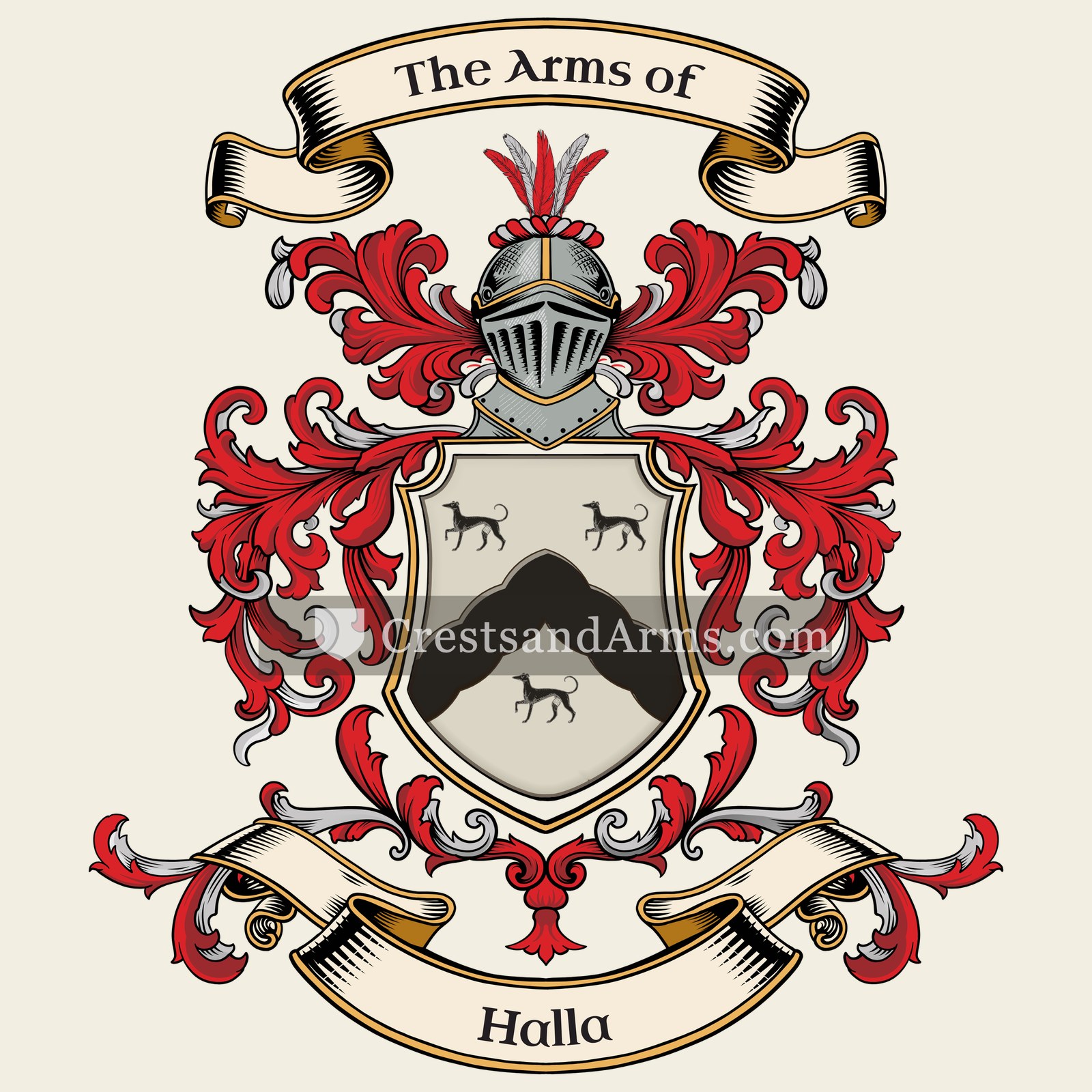
Coat of Arms & Family Crest Details
Symbols on this shield
fessThe military belt, and readiness to serve
greyhoundCourage, vigilance and loyalty
Colours
Silver (Argent)Means: Peace and sincerity
Black (Sable)Means: Constancy
Historical info
Source
Sir Bernard Burke, The General Armory of England, Scotland, Ireland and Wales, London: Harrison & Sons, 1884
Blazon (the actual original written record)
“Ar. a fess betw. two greyhounds courant sa”
YorkSkipton · York, c. 1568
Digital archive packCoat of arms PNG, gold border print PDF, vector SVG and the certificate of authenticity. Sent to your email in minutes.
Map of England showing where the Halla arms are recorded
The Halla arms were recorded in York, c. 1568.
Yorkshire is the largest of the English counties, and it held more gentry families than any other. Land there was split among a great many households rather than a few, so a great many of them carried arms.
This is where the arms were entered in the register. Families often moved to other parts of the country, so the same name can turn up in more than one region.
The body that granted and recorded arms in England in this period.
Elizabeth I of England
Sovereign of the period
Elizabeth I of England
1558–1603
Reigning in France when the Halla arms are first recorded.
How Arms Worked in England
English heraldry allowed arms to be shared by all legitimate descendants of the original owner. These symbols were treated as personal property that moved through the generations to all children. While the eldest son kept the original design, other family members could use the same shield without needing to change it or register their own unique versions.
Granting authority
The College of Arms in London has regulated the use of coats of arms throughout England and Wales since 1484.
How they got arms
Families typically obtained their coats of arms through a formal grant from the Crown or by proving their ancient right to them.
Where arms were recorded
All official coats of arms are recorded in the registers kept at the College of Arms, which date back to the fifteenth century.
The family's standing
Recorded among the armigerous families of York.
Origin & History of the Halla Family in England
The history of the Halla name in England is deeply rooted in the northern city of York, where records confirm the family was established by at least 1568. During the sixteenth century, York served as a vital hub for trade and administration, placing the Halla family at the center of a bustling urban society. The name likely originated as a topographical descriptor, referring to individuals who lived near a large hall or a prominent communal building. As the family became part of the local community, they participated in the daily life of the city, navigating the social and economic shifts of the Elizabethan era. By settling in such a significant historical center, the early members of the Halla family contributed to the long-standing narrative of northern English life, leaving behind a legacy that is preserved in the city’s parish registers and administrative documents.
Coat of Arms & Family Crest Details
Symbols on this shield
chevronProtection, and faithful service completed
greyhoundCourage, vigilance and loyalty
Colours
Silver (Argent)Means: Peace and sincerity
Black (Sable)Means: Constancy
Historical info
Source
Sir Bernard Burke, The General Armory of England, Scotland, Ireland and Wales, London: Harrison & Sons, 1884
Blazon (the actual original written record)
“Ar. a chev. engr. betw. three talbots' heads erased sa”
DownNarrow Water · Down, c. 1645
Digital archive packCoat of arms PNG, gold border print PDF, vector SVG and the certificate of authenticity. Sent to your email in minutes.
Map of Ireland showing where the Halla arms are recorded
The Halla arms were recorded in Down, c. 1645.
Down was north-eastern Irish country settled from Scotland in the seventeenth century. The new landowners took grants and had them recorded, which is why so many Down families carry documented shields.
This is where the arms were entered in the register. Families often moved to other parts of the country, so the same name can turn up in more than one region.
The body that granted and recorded arms in Ireland in this period.
Charles I of England
Sovereign of the period
Charles I of England
1625–1649
Reigning in France when the Halla arms are first recorded.
How Arms Worked in Ireland
The Ulster King of Arms granted coats of arms to individuals who proved their social standing and good character. These symbols were typically inherited by all legitimate descendants of the original holder. If a family branch wanted a unique look, they could apply for a specific change to their design through the office to ensure their identity remained distinct.
Granting authority
The Ulster King of Arms acted as the official body that regulated and issued all coats of arms throughout Ireland.
How they got arms
Families obtained their arms through formal grants issued by the office after proving their eligibility and paying the required fees.
Where arms were recorded
All official grants were recorded in the registers held by the Ulster King of Arms starting from the year 1552.
The family's standing
Recorded among the armigerous families of Down.
Origin & History of the Halla Family in Ireland
The history of the Halla name in Ireland is deeply rooted in the landscape of County Down, where records confirm the family was established by 1645. During this period, the region was undergoing significant social and political changes, often involving the movement of families across the Irish Sea. While the name is sometimes associated with broader European origins, its presence in Down suggests that these early settlers were part of the shifting demographics of the seventeenth century. These families likely integrated into the local agricultural or mercantile communities, contributing to the development of the area over several generations. By settling in this specific coastal region, the Halla family became part of the complex tapestry of Irish history, surviving through eras of transition and local growth.
Related Branches & Arms
Root word
Halle
A medieval term referring to a large hall or covered market area.
This name
HallaA topographic name for someone who lived near a large hall or marketplace.
also spelled
Halle
Hallee
Halleh
Haul
Hale
Documented Sources
J. B. Rietstap, Armorial Général, Gouda: G. B. van Goor Zonen, 1884–87
Archives départementales du Bas-Rhin, Registres paroissiaux de l'état civil, 1663
Grasser, Jean-Paul, Histoire de l'Alsace, 1988
Livet, Georges, L'Intendance d'Alsace sous Louis XIV, 1956
Digital archive packCoat of arms PNG, gold border print PDF, vector SVG and the certificate of authenticity. Sent to your email in minutes.


 wheelFortune's turning, and the carter's trade
 wheelFortune's turning, and the carter's trade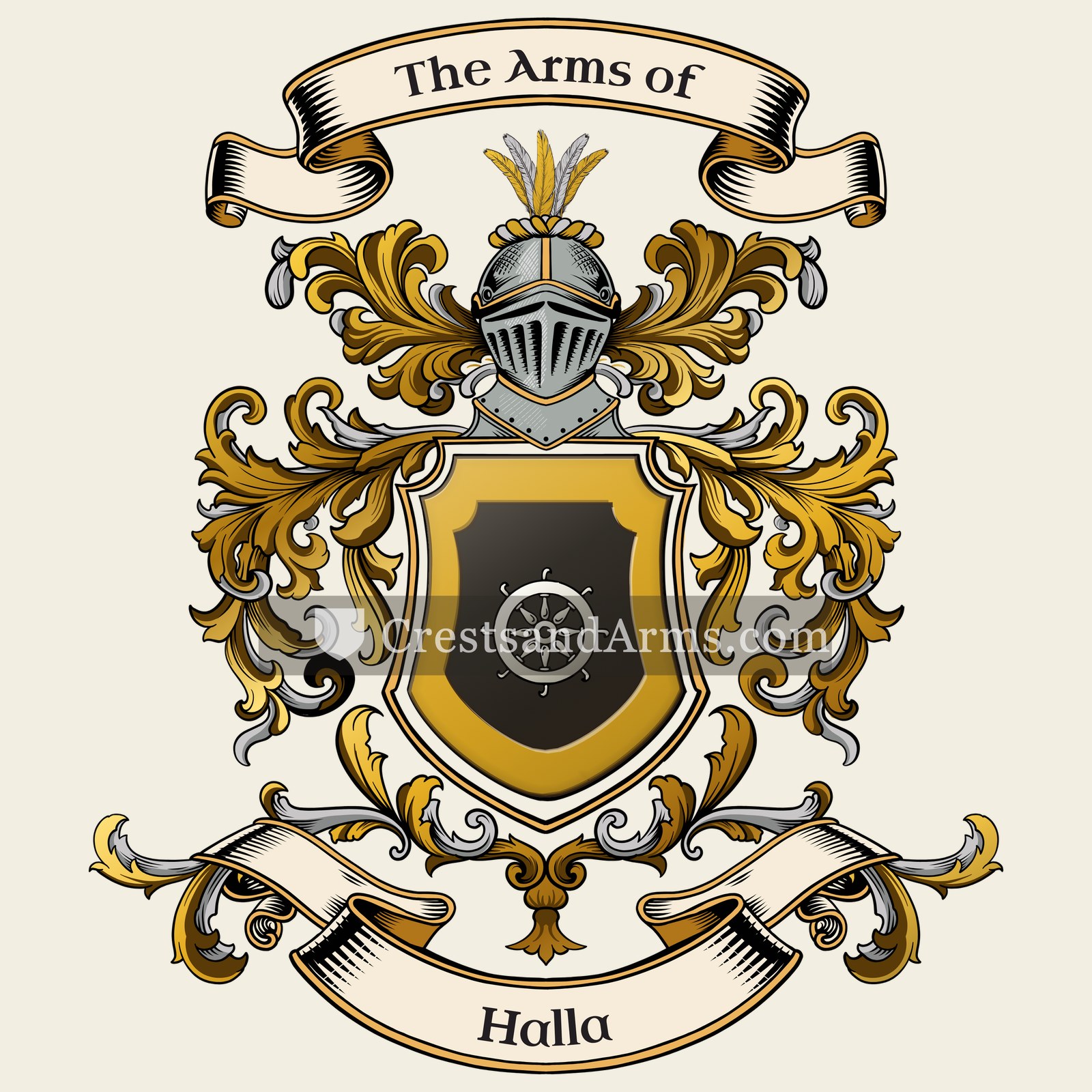


 fessThe military belt, and readiness to serve
 greyhoundCourage, vigilance and loyalty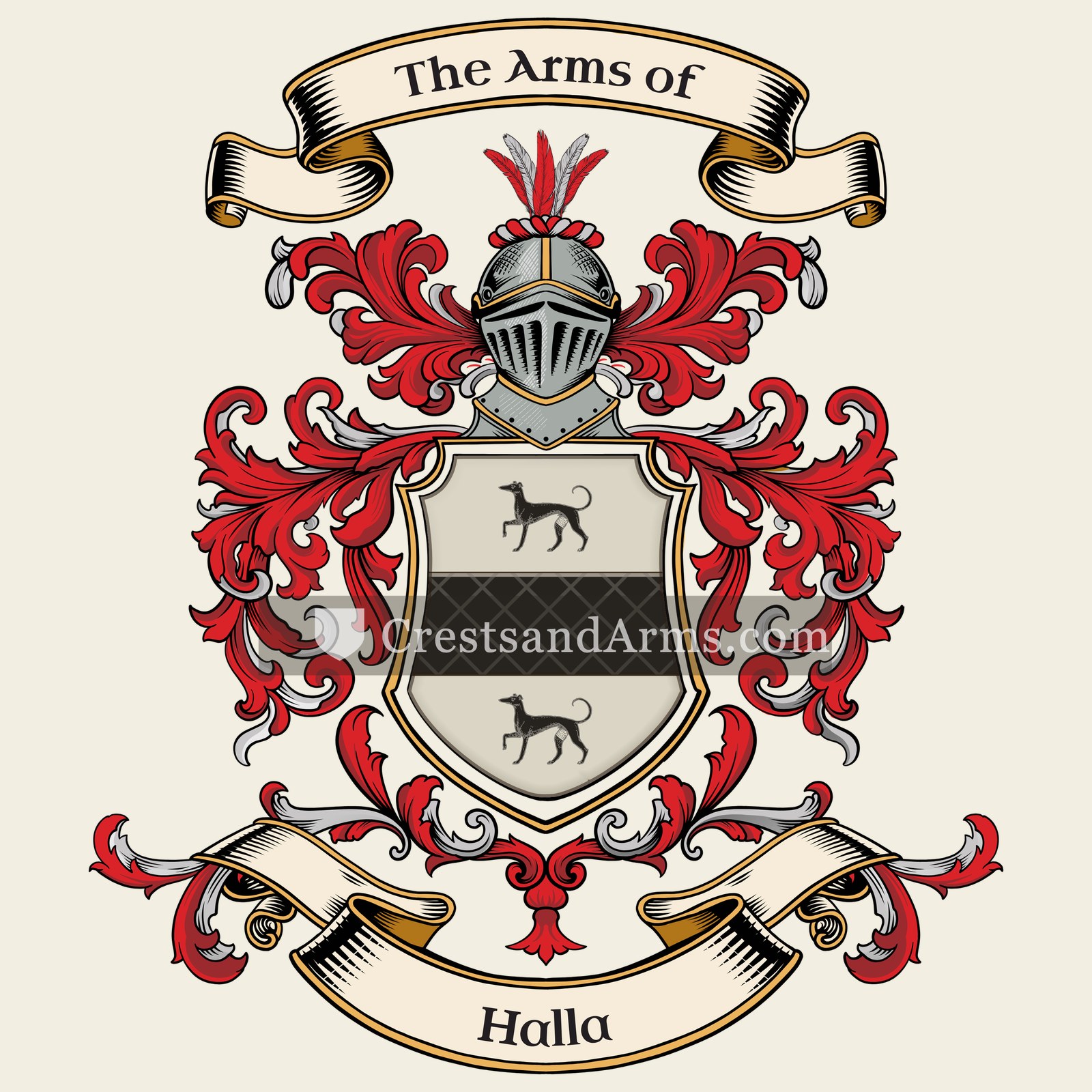


 chevronProtection, and faithful service completed