Map of England showing where the Halladay arms are recorded
The Halladay arms were recorded in Somerset, c. 1620.
Somerset was rich farming country with a thick scattering of manor houses. Its gentry were numerous and long-settled, and a settled landed family almost always ended up with arms.
This is where the arms were entered in the register. Families often moved to other parts of the country, so the same name can turn up in more than one region.
The body that granted and recorded arms in England in this period.
James VI and I
Sovereign of the period
James VI and I
1603–1625
Reigning in England when the Halladay arms are first recorded.
How Arms Worked in England
English heraldry allowed arms to be shared by all legitimate descendants of the original owner. These symbols were treated as personal property that moved through the generations to all children. While the eldest son kept the original design, other family members could use the same shield without needing to change it or register their own unique versions.
Granting authority
The College of Arms in London has regulated the use of coats of arms throughout England and Wales since 1484.
How they got arms
Families typically obtained their coats of arms through a formal grant from the Crown or by proving their ancient right to them.
Where arms were recorded
All official coats of arms are recorded in the registers kept at the College of Arms, which date back to the fifteenth century.
The family's standing
Recorded among the armigerous families of Somerset.
Origin & History of the Halladay Family in England
The surname Halladay is a locative or descriptive name that likely originated in medieval England to identify people who traveled or celebrated on holy days. By the early 17th century, the family had established a notable presence in the county of Somerset. Records confirm that members of the Halladay family were living in this region by 1620, where they were often involved in local agriculture and community governance. During this period, the name appeared in various parish registers and legal documents, reflecting a family that was well-integrated into the social fabric of the West Country. As the family grew, their influence spread through the local economy, and they became a recognized part of the historical landscape of Somerset long before many members eventually migrated to the American colonies.
Meaning of the Halladay family crest colors & symbols
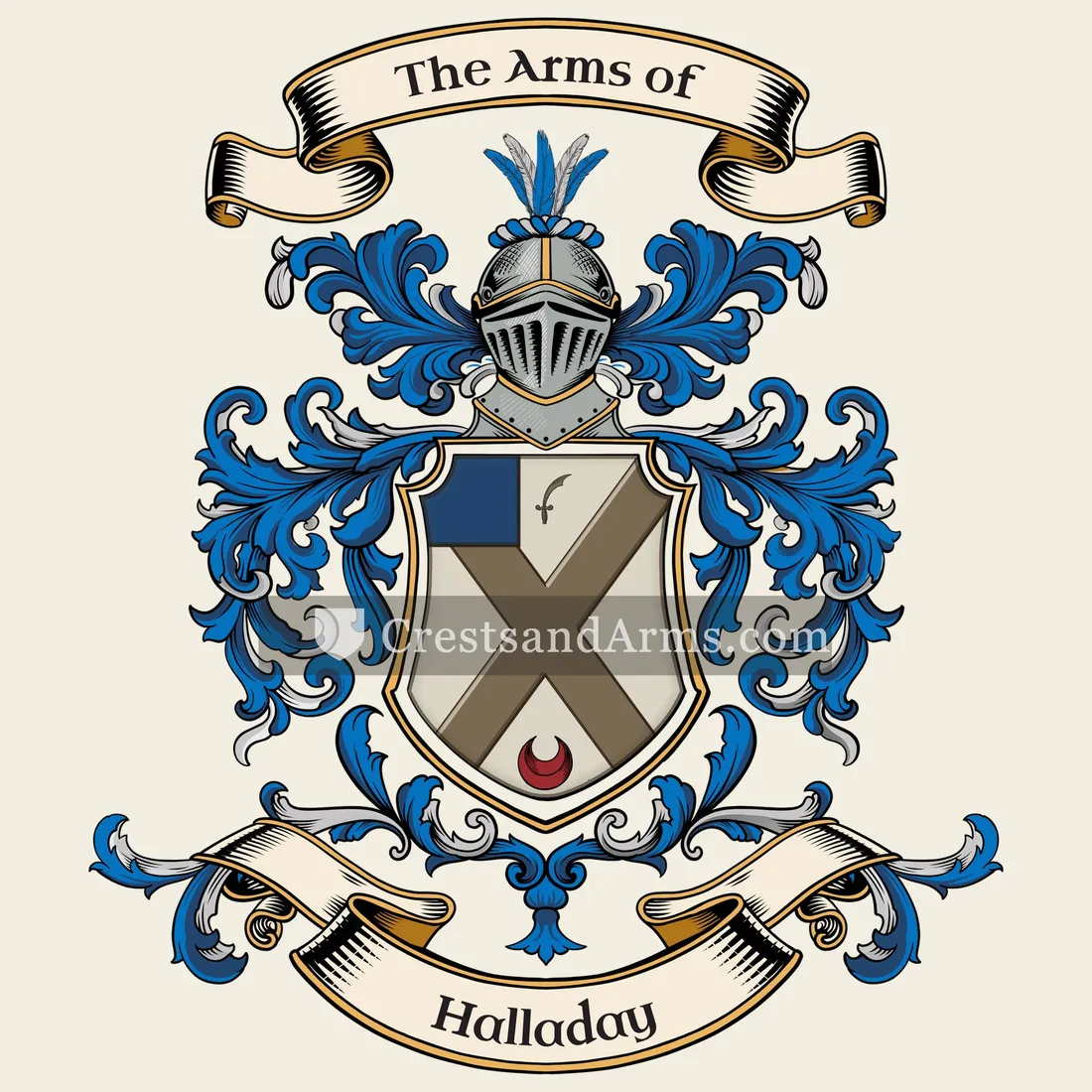
Symbols on this shield
cantonA mark of honour granted by the sovereign
saltireResolution, and St Andrew's cross
swordJustice, and military honour
crescentHonour by the sovereign, and the second son
Colours
Silver (Argent)Means: Peace and sincerity
Blue (Azure)Means: Loyalty and truth
Red (Gules)Means: Military strength
Historical info
Source
Sir Bernard Burke, The General Armory of England, Scotland, Ireland and Wales, London: Harrison & Sons, 1884
Blazon (the actual original written record)
“Ar. a sword erected in pale ppr. hilted and pommelled or, the pommel within a crescent, in base gu. a canton az. charged with a saltire of the first”
KinrossTullibole · Kinross, c. 1748
Digital archive packCoat of arms PNG, gold border print PDF, vector SVG and the certificate of authenticity. Sent to your email in minutes.
Map of Scotland showing where the Halladay arms are recorded
The Halladay arms were recorded in Kinross, c. 1748.
Kinross was the second smallest Scottish county, farming country around a loch. Its few landed families held their ground for centuries, and long holding is what fills a register.
This is where the arms were entered in the register. Families often moved to other parts of the country, so the same name can turn up in more than one region.
The body that granted and recorded arms in Scotland in this period.
George II of Great Britain
Sovereign of the period
George II of Great Britain
1727–1760
Reigning in England when the Halladay arms are first recorded.
How Arms Worked in Scotland
Scottish heraldry is unique because it treats a coat of arms as a piece of personal property protected by law. Only one person can own a specific design at any given time. When a family grows, the head keeps the original shield while other relatives must apply for their own distinct version with slight changes to prove their specific identity.
Granting authority
The Court of the Lord Lyon acts as the official body that regulates and controls all heraldic matters throughout Scotland.
How they got arms
Individuals obtain a legal right to their arms through a formal petition process that confirms their identity and family connection.
Where arms were recorded
All valid coats of arms are officially entered into the Public Register of All Arms and Bearings starting from 1672.
The family's standing
Recorded among the armigerous families of Kinross.
Origin & History of the Halladay Family in Scotland
The name Halladay is deeply rooted in the history of the Scottish Lowlands, where it functioned as a topographical surname for people who lived near a holy day site or a place associated with religious festivals. By the mid-eighteenth century, the family had established a clear presence in the county of Kinross. Records from 1748 show that these early ancestors were integrated into the local community, likely working as tenant farmers or tradespeople during a time of significant agricultural change in Scotland. Life in Kinross during this era was defined by the parish system, where families were closely tied to the local kirk for both their spiritual life and the recording of vital events like births and marriages. Because the name was often spelled in various ways depending on the local clerk, it reflects the linguistic shifts of the region as people moved between rural villages and growing market towns. These early Halladays were part of the backbone of Scottish society, contributing to the local economy and the social fabric of the Kinross area long before the industrial shifts of the following century.
Halladay Meaning & Related Branches
Root word
Halig daeg
Old English words for holy and day.
This name
HalladayA nickname for someone born on a holy day or a festival.
also spelled
Halyday
Documented Sources
Sir Bernard Burke, The General Armory of England, Scotland, Ireland and Wales, London: Harrison & Sons, 1884
Britton, John. The Beauties of England and Wales, or, Delineations, topographical, historical, and descriptive, of each county. 1813
Collinson, John. The History and Antiquities of the County of Somerset. 1791
The National Archives. Records of the Prerogative Court of Canterbury, Will Registers. PROB 11
Digital archive packCoat of arms PNG, gold border print PDF, vector SVG and the certificate of authenticity. Sent to your email in minutes.


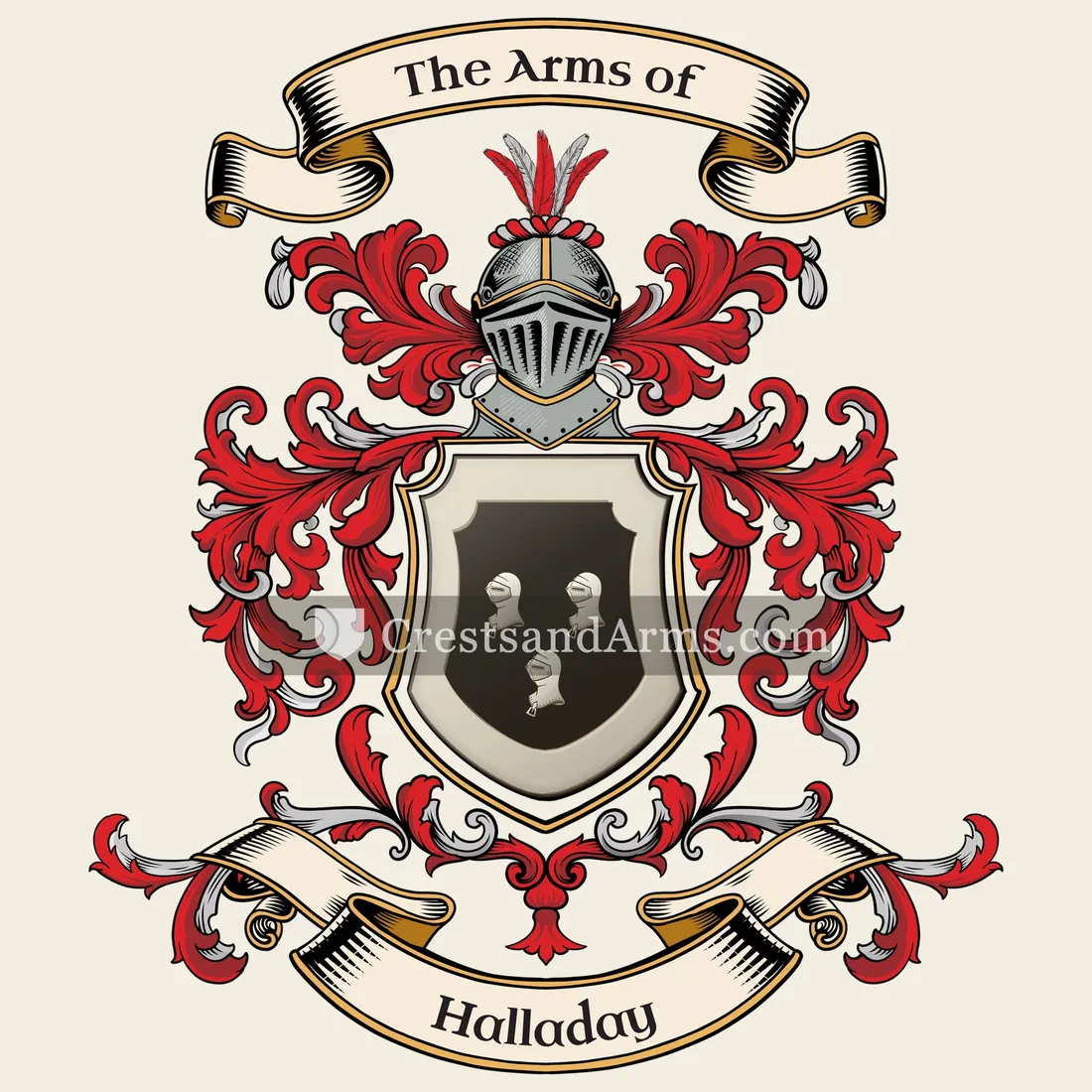
 bordureA difference between branches of one family
 helmetWisdom and security in defence
 bordureA difference between branches of one family
 helmetWisdom and security in defence


 cantonA mark of honour granted by the sovereign
 saltireResolution, and St Andrew's cross
 swordJustice, and military honour
 crescentHonour by the sovereign, and the second son