A record of documented arms, meaning and origin, researched for the Haller family lines. Documented in 3 countries.
Reg. 2759 · German, G–I
Coat of Arms & Family Crest Details
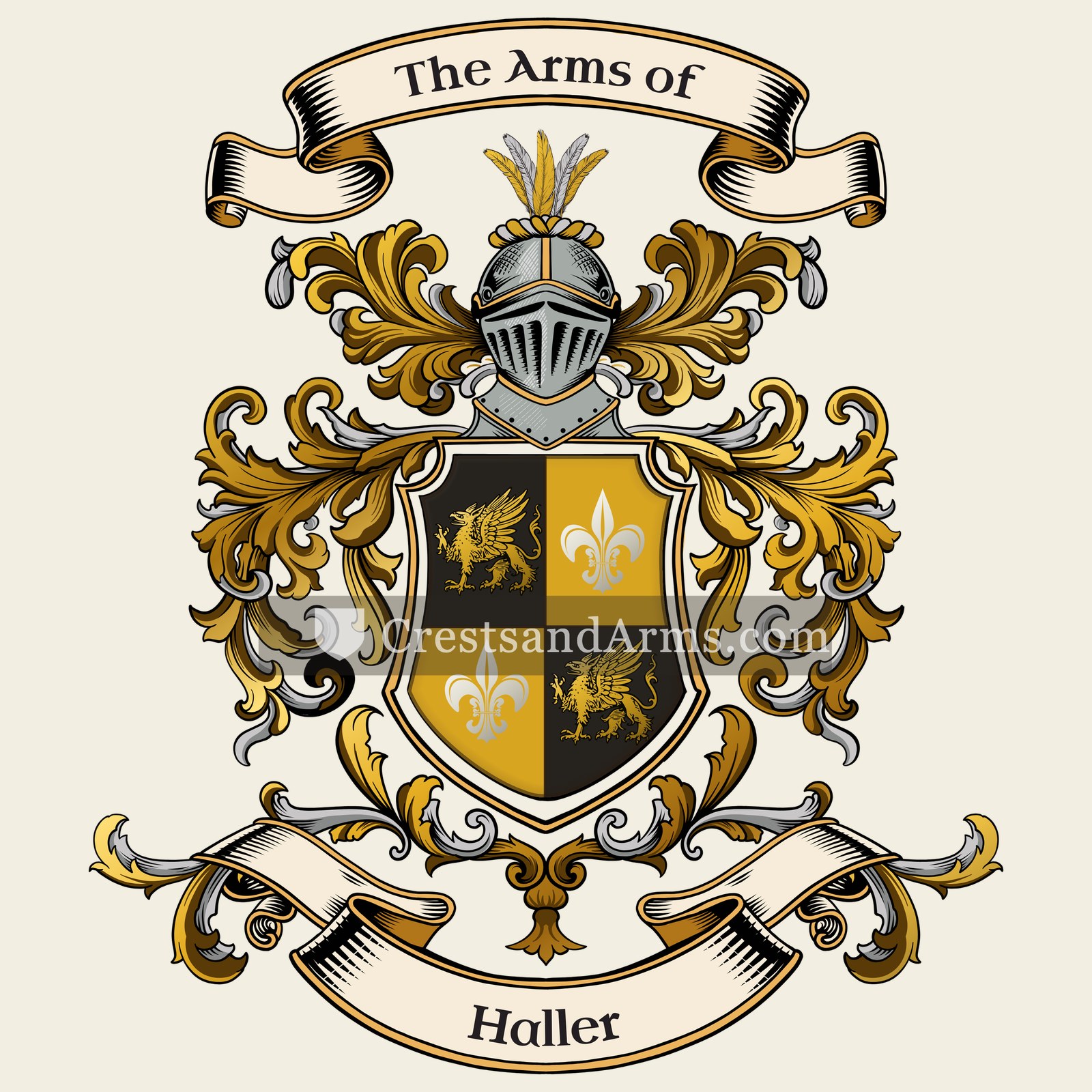
Symbols on this shield
griffinValour and vigilance, guarding great treasure
fleur de lisPurity, light, and the sixth son
Colours
Black (Sable)Means: Constancy
Gold (Or)Means: Generosity
Silver (Argent)Means: Peace and sincerity
Historical info
Source
J. B. Rietstap, Armorial Général, Gouda: G. B. van Goor Zonen, 1884–87
Blazon (the actual original written record)
“Ec.: aux 1 et 4 de sa. à un griffon d'or; aux 2 et 3 d'or à une fleur-de-lis d'arg. Cq. cour. C.: le griffon iss., tenant entre ses pattes la fleur-de-lis. L. d'or et de sa.”
Germanyc. 1765
Where the Haller Arms Were Recorded
Bavaria
Map of Germany showing where the Haller arms are recorded
The Haller arms were recorded in Germany, c. 1765.
Arms such as these were typically recorded in Bavaria.
Bavaria was a country of old landed families and walled market towns. Estates passed down the same line for centuries, and both the landowners and the leading townsmen kept arms, which is why so many Bavarian names sit in the registers.
This is where the arms were entered in the register. Families often moved to other parts of the country, so the same name can turn up in more than one region.
The body that granted and recorded arms in Germany in this period.
Francis I, Holy Roman Emperor
Sovereign of the period
Francis I, Holy Roman Emperor
1745–1765
Reigning in Germany when the Haller arms are first recorded.
How Arms Worked in Germany
In the Holy Roman Empire, coats of arms were often granted to individuals by the Emperor or his representatives. These arms were then passed down through the generations to all legitimate descendants of the original holder. Younger branches of a family usually kept the same shield design without needing to change it, as the arms belonged to the entire lineage.
Granting authority
The Holy Roman Emperor held the sole power to grant new coats of arms throughout his vast imperial territories.
How they got arms
Families typically obtained their coats of arms through a formal imperial grant or by proving their noble status to the authorities.
Where arms were recorded
These grants were officially recorded in the Imperial Chancery registers, which began keeping formal records of such honors during the Middle Ages.
The family's standing
Recorded among the armigerous families of Germany.
Origin & History of the Haller Family in Germany
The surname Haller is a classic example of a topographic name, which means it was originally used to describe where a person lived or worked. In the German language, the root word refers to someone who lived near a salt mine or worked in the salt trade, as the term "Hall" was an ancient designation for salt production sites. By the time members of the Haller family were documented in Bavaria in 1765, the name had already been established for centuries across various German-speaking regions. These early families were often part of the rising middle class, working as merchants, craftsmen, or local officials who helped manage the resources of their towns. Because salt was a highly valuable commodity in the eighteenth century, families associated with the trade often held positions of stability and influence within their local communities. As the family grew, they became deeply integrated into the social and economic fabric of the Bavarian countryside, leaving behind records of their daily lives, property ownership, and contributions to the local economy.
Coat of Arms & Family Crest Details
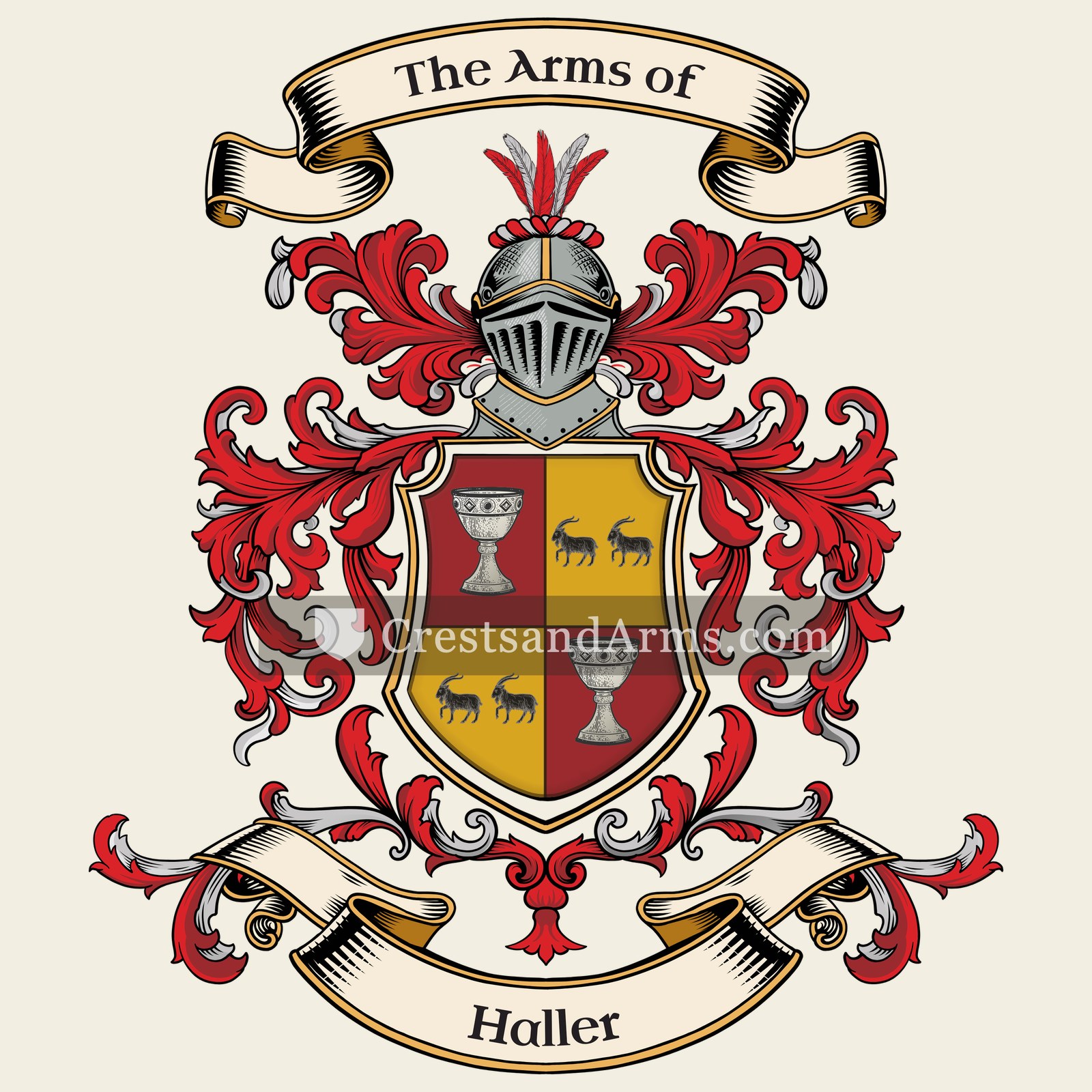
Symbols on this shield
cupFaith, office, and a trust discharged
goatOne who wins by diplomacy rather than force
Colours
Red (Gules)Means: Military strength
Gold (Or)Means: Generosity
Silver (Argent)Means: Peace and sincerity
Black (Sable)Means: Constancy
Historical info
Source
J. B. Rietstap, Armorial Général, Gouda: G. B. van Goor Zonen, 1884–87
Blazon (the actual original written record)
“Ec.: aux 1 et 4 de gu. à un bassin d'arg., vu de face; aux 2 et 3 d'or à deux cornes de bouquetin adossées de sa. Deux cq. cour. C.: 1° le bassin de l'écu; l. d'arg. et de gu.; 2° une colonne d'arg., sommée d'une couronne d'or, de laquelle sortent trois pl. d'aut., une d'arg. entre deux de gu.; le tout entre deux cornes de bouquetin adossées de sa.; l. d'or et de sa.”
Austriac. 1699
Where the Haller Arms Were Recorded
Tyrol
Map of Austria showing where the Haller arms are recorded
The Haller arms were recorded in Austria, c. 1699.
Arms such as these were typically recorded in Tyrol.
Tyrol was mountain country in western Austria, where the valleys were held by families who had been there a very long time. Old tenure counted for more than money, and old families carried arms.
This is where the arms were entered in the register. Families often moved to other parts of the country, so the same name can turn up in more than one region.
Region
Tyrol
First recorded
1699
Granting Authority for the Haller Arms
Imperial and Royal chancery
Sodacan · CC BY-SA 3.0
The body that granted and recorded arms in Austria in this period.
Leopold I, Holy Roman Emperor
Sovereign of the period
Leopold I, Holy Roman Emperor
1658–1705
Reigning in Germany when the Haller arms are first recorded.
How Arms Worked in Austria
Austrian coats of arms were often linked directly to noble titles granted by the Emperor. These symbols belonged to the entire family line rather than just one individual. When a family grew, new branches kept the original design without needing to change it. This system allowed all members of a noble house to share the same identity across many generations.
Granting authority
The Imperial and Royal chancery managed all heraldic matters and controlled the official granting of arms throughout the Austrian lands.
How they got arms
Families typically received their arms through a formal imperial decree that often accompanied the elevation of a person to noble status.
Where arms were recorded
Official records of these grants were kept in the Imperial Register of Nobility which began its formal documentation process in 1453.
The family's standing
Recorded among the armigerous families of Austria.
Origin & History of the Haller Family in Austria
The surname Haller has deep roots in the mountainous landscape of Tyrol, where the family established a notable presence by the late 17th century. The name itself is derived from the Middle High German word "hal," which refers to salt, suggesting that early ancestors may have been involved in the vital salt mining industry that defined the regional economy of the Alps. By 1699, records indicate that members of the Haller family were active participants in the social and economic life of the Tyrolean region. During this era, families often settled in specific valleys to manage trade routes or agricultural lands, and the Hallers became well-integrated into the local community structures. Their history reflects the broader movement of families who helped build the infrastructure of the Austrian territories through hard work and local governance. As the family grew, they remained closely tied to the rugged terrain of Tyrol, which shaped both their livelihoods and their lasting connection to the Austrian landscape.
Coat of Arms & Family Crest Details
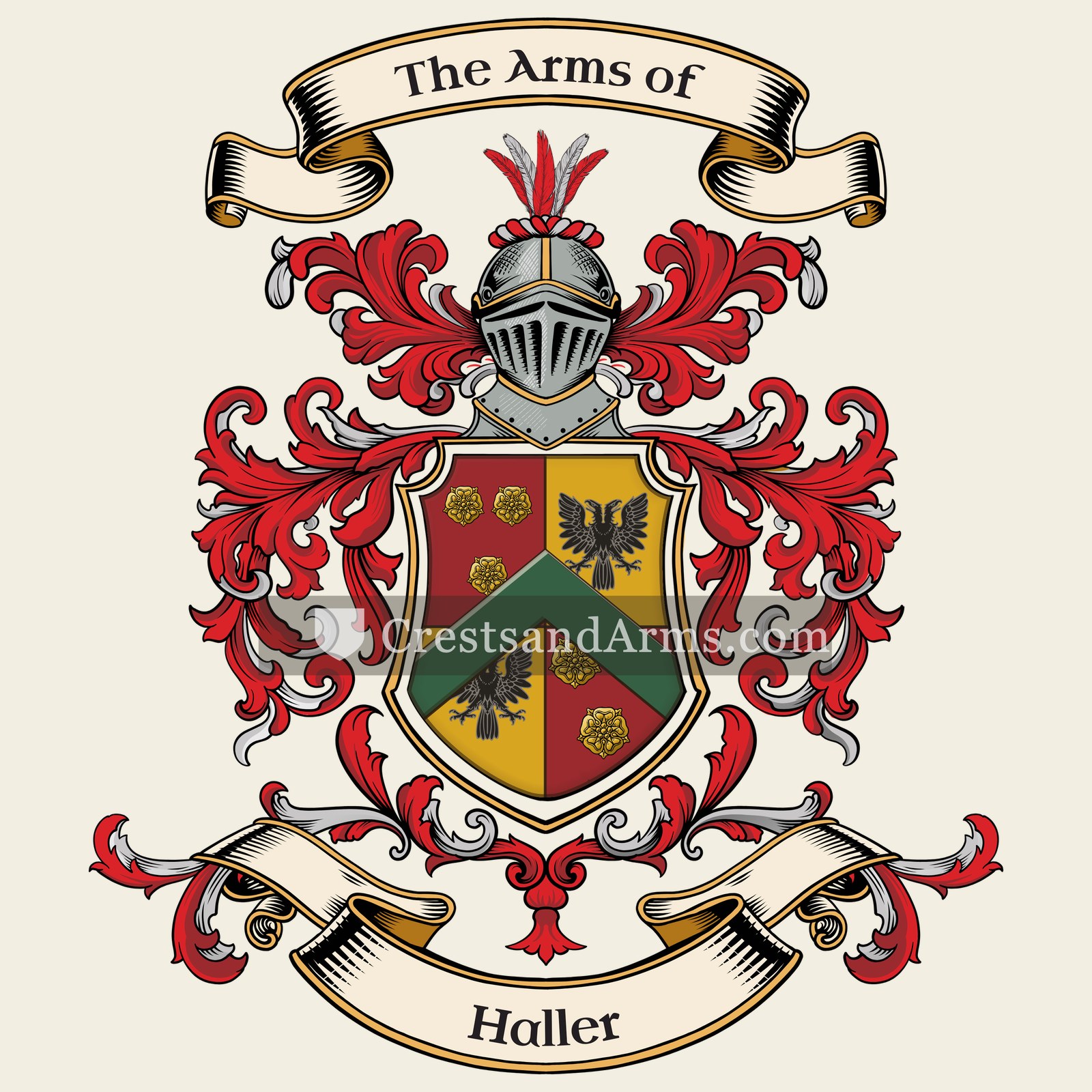
Symbols on this shield
chevronProtection, and faithful service completed
roseThe seventh son, and beauty with grace
eagleNobility, strength and a keen mind
Colours
Red (Gules)Means: Military strength
Gold (Or)Means: Generosity
Green (Vert)Means: Hope
Black (Sable)Means: Constancy
Historical info
Source
J. B. Rietstap, Armorial Général, Gouda: G. B. van Goor Zonen, 1884–87
Blazon (the actual original written record)
“Ec.: aux 1 et 4 de gu. au chev. de sin., acc. de trois roses d'or; aux 2 et 3 d'or à la demi-aigle de sa., bq. et cour. d'or, mouv. du parti. Cq. cour. C.: une aigle iss. de sa., bq. et cour. d'or. L.: à dextre de gu. et de sin., à sen. d'or et de sa.”
SwitzerlandBâle, c. 1745
Where the Haller Arms Were Recorded
Bâle
Map of Switzerland showing where the Haller arms are recorded
The Haller arms were recorded in Bâle, c. 1745.
This is where the arms were entered in the register. Families often moved to other parts of the country, so the same name can turn up in more than one region.
The body that granted and recorded arms in Switzerland in this period.
How Arms Worked in Switzerland
In Switzerland, coats of arms were not restricted to the nobility and were often adopted by common citizens and families. These symbols were passed down through generations to show family identity. When branches of a family grew, they often changed small details of the design to distinguish their own line from the original group.
Granting authority
Cantonal and civic authorities managed the use of coats of arms within their specific regions and local jurisdictions.
How they got arms
Families typically assumed their own coats of arms based on local custom rather than receiving them from a central monarch.
Where arms were recorded
Arms were recorded in various cantonal and civic registers starting from the fourteenth century throughout the Swiss region.
The family's standing
Recorded among the armigerous families of Switzerland.
Origin & History of the Haller Family in Switzerland
The surname Haller is deeply rooted in the history of the Swiss Confederation, emerging as a topographic name that identified people living near a salt mine or a specific type of storage building. By the time the family established a documented presence in Basel in 1745, they were already part of a long tradition of Swiss citizens who held significant roles in local administration and trade. The name itself reflects the medieval German word for a salt worker, suggesting that the earliest ancestors were likely laborers or merchants involved in the essential salt industry that drove the economy of the Alpine regions. As the family settled into urban centers like Basel, they transitioned from rural origins into the professional classes, contributing to the growth of the city as a hub for commerce and scholarship. Their movement through Swiss history mirrors the broader development of the region, where families often relocated to growing cities to seek new opportunities in banking, law, and civic governance.
Related Branches & Arms
Root word
Hal
A Middle High German term referring to salt or a salt mine.
This name
HallerAn occupational name for a person who worked at a salt mine or salt works.
also spelled
Hallere
Hallerh
Hallerr
Documented Sources
J. B. Rietstap, Armorial Général, Gouda: G. B. van Goor Zonen, 1884–87
Bahlow, Hans, Deutsches Namenlexikon: Familien- und Vornamen nach Ursprung und Sinn erklärt, 1967
Heintze, Albert, Die deutschen Familien-Namen: geschichtlich, geographisch, sprachlich, 1903


 griffinValour and vigilance, guarding great treasure
 fleur de lisPurity, light, and the sixth son
 griffinValour and vigilance, guarding great treasure
 fleur de lisPurity, light, and the sixth son

 cupFaith, office, and a trust discharged
 goatOne who wins by diplomacy rather than force

 chevronProtection, and faithful service completed
 roseThe seventh son, and beauty with grace
 eagleNobility, strength and a keen mind