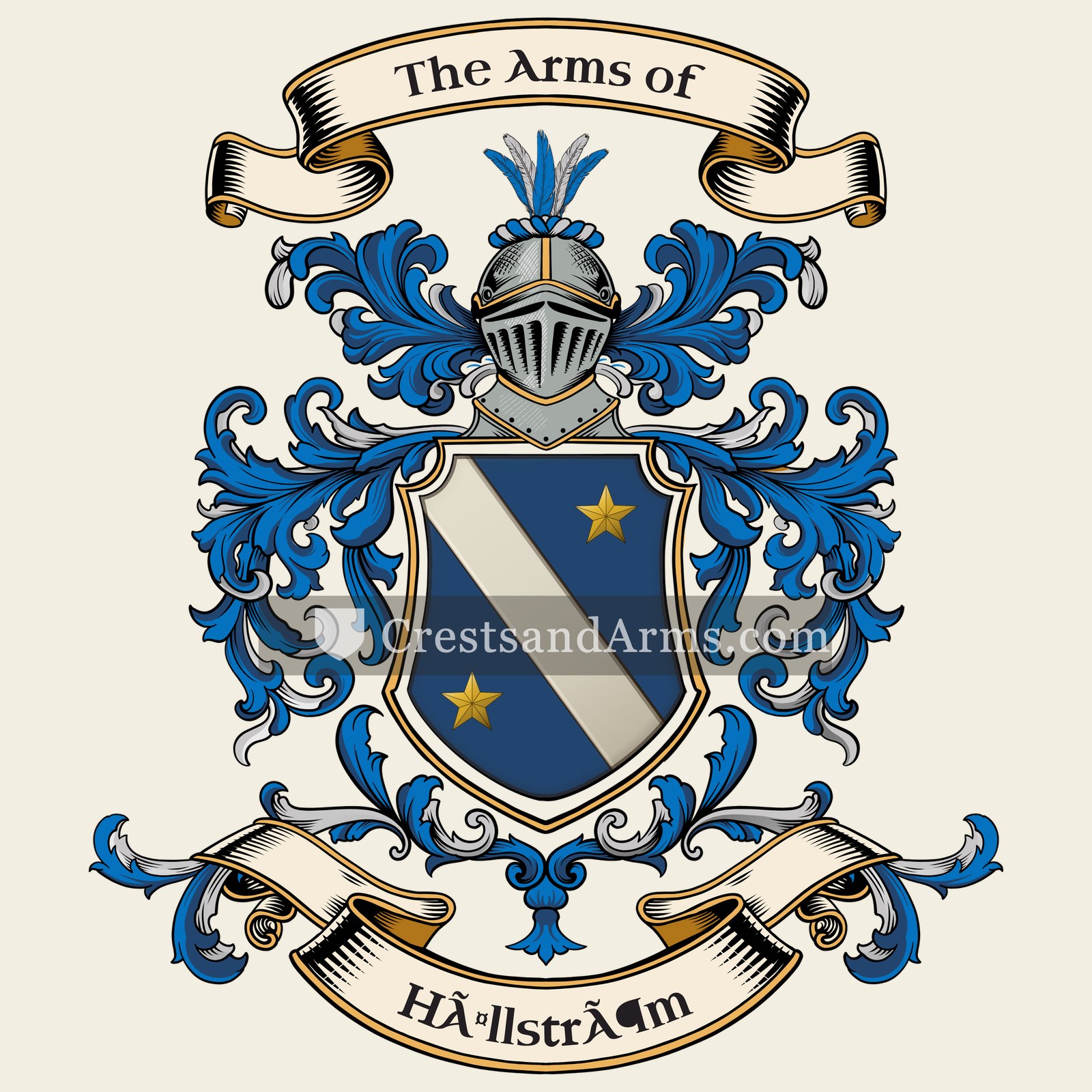
A record of documented arms, meaning and origin, researched for the Hällström family of Finland.
Reg. 3463 · Finnish, G–I
Coat of Arms & Family Crest Details
Symbols on this shield
bendDefence, and the scarf of a commander
cross symbolChristian faith and service
mulletThe third son, and a divine quality from above
Colours
Blue (Azure)Means: Loyalty and truth
Silver (Argent)Means: Peace and sincerity
Gold (Or)Means: Generosity
Historical info
Source
J. B. Rietstap, Armorial Général, Gouda: G. B. van Goor Zonen, 1884–87
Blazon (the actual original written record)
“D'azur à la bande ondée d'arg., acc. de deux étoiles d'or; à un papyrus enroulé en haut et en bas, au nat., br. sur la bande, et un sistre (antique instrument de musique en forme de raquette), le manche en bas, au nat., br. sur le papyrus. C.: une croix latine de sa., bordée d'or; entre deux pl. d'aut., coupées alt. d'arg. et d'azur.”
Finlandc. 1830
Digital archive packCoat of arms PNG, gold border print PDF, vector SVG and the certificate of authenticity. Sent to your email in minutes.
Map of Finland showing where the Hällström arms are recorded
The Hällström arms were recorded in Finland, c. 1830.
Arms such as these were typically recorded in Uusimaa.
Uusimaa was the Finnish coast facing Sweden, and the part of the country most closely tied to Stockholm. Its landowners and officers served the Swedish crown, and that service is what put their arms on record.
This is where the arms were entered in the register. Families often moved to other parts of the country, so the same name can turn up in more than one region.
The body that granted and recorded arms in Finland in this period.
How Arms Worked in Finland
Nobility in Finland held the exclusive right to register their coats of arms with the House of Nobility. These symbols were tied to the family name and were inherited by all members of the noble house. If a family branch moved or changed status, they kept their original design to maintain their identity within the official records.
Granting authority
The Finnish House of Nobility served as the official body that managed and protected all noble coats of arms.
How they got arms
Families received their arms through formal letters of nobility or by having their existing ancestral symbols confirmed by the House.
Where arms were recorded
All approved coats of arms were officially recorded in the Finnish House of Nobility Armorial starting in 1818.
The family's standing
Recorded among the armigerous families of Finland.
Origin & History of the Hällström Family in Finland
The surname Hällström is a classic example of the Swedish-language naming traditions that were common in Finland during the nineteenth century. The name is a compound word formed by combining the Swedish terms "häll," which refers to a flat rock or a stone slab, and "ström," which means a stream or a current. This type of nature-inspired name was frequently adopted by families in the Uusimaa region as they moved away from older patronymic naming systems, where children were simply named after their father. By the year 1830, the Hällström family was well-established in the coastal areas of Southern Finland. During this period, the name served as a way to identify the family with the rugged, rocky landscape and the flowing waterways that defined their local environment. These names were often chosen by people who wanted to signify a new beginning or a connection to a specific geographic landmark near their home.
Related Branches & Arms
Root word
häll and ström
Swedish words for flat rock or slab and a flowing river stream.
This name
HällströmA topographical surname referring to someone who lived near a rocky river stream.
also spelled
Halstrom
Documented Sources
J. B. Rietstap, Armorial Général, Gouda: G. B. van Goor Zonen, 1884–87
Pirjo Mikkonen and Sirkka Paikkala, Sukunimet, 2000
National Archives of Finland, Kirkonarkistot (Church Records), Uusimaa region
Digital archive packCoat of arms PNG, gold border print PDF, vector SVG and the certificate of authenticity. Sent to your email in minutes.


 bendDefence, and the scarf of a commander
 cross symbolChristian faith and service
 mulletThe third son, and a divine quality from above
 bendDefence, and the scarf of a commander
 cross symbolChristian faith and service
 mulletThe third son, and a divine quality from above