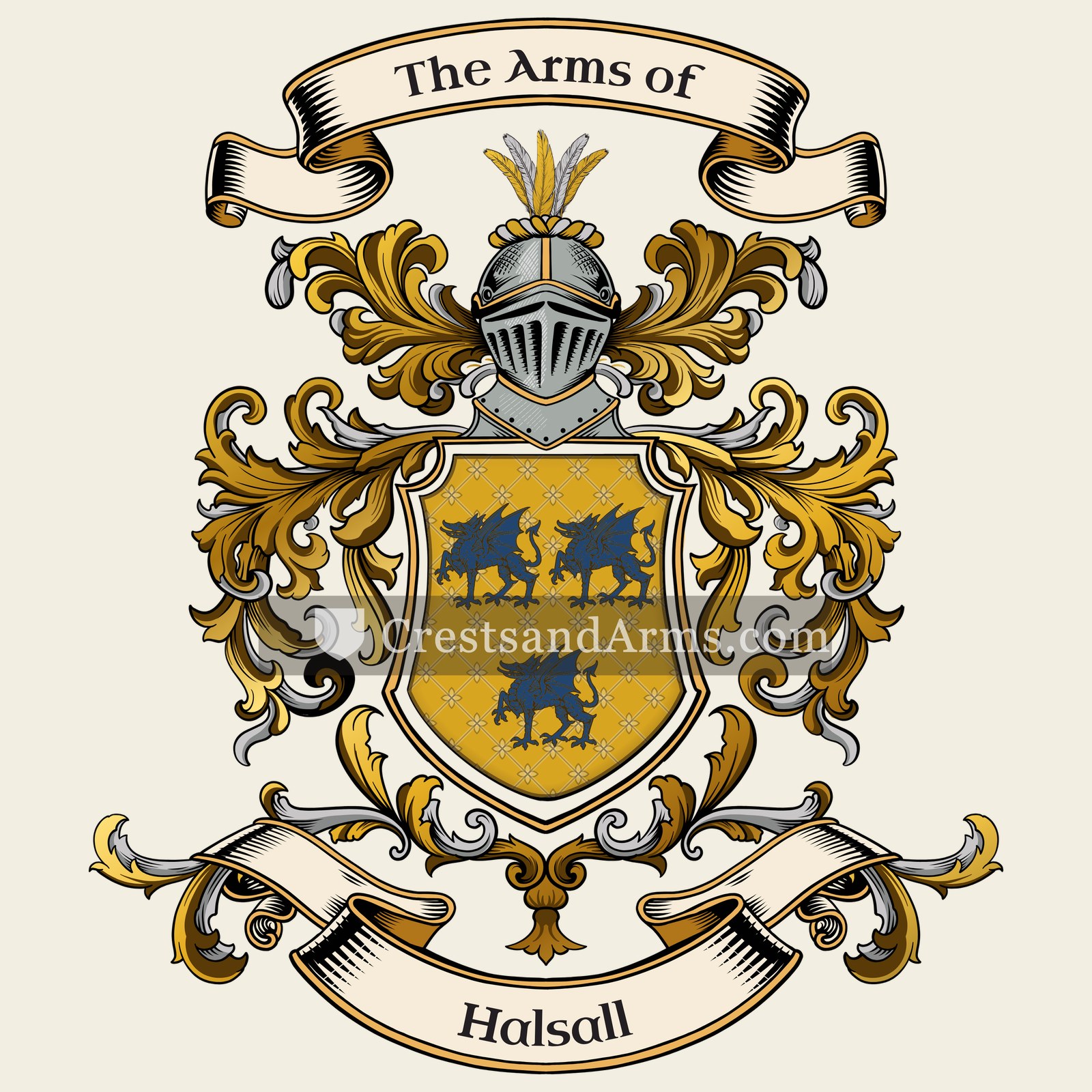
A record of documented arms, meaning and origin, researched for the Halsall family of England.
Reg. 6946 · English, G–I
Coat of Arms & Family Crest Details
Symbols on this shield
dragonA most valiant defender of treasure
Colours
Gold (Or)Means: Generosity
Blue (Azure)Means: Loyalty and truth
Historical info
Source
Sir Bernard Burke, The General Armory of England, Scotland, Ireland and Wales, London: Harrison & Sons, 1884
Blazon (the actual original written record)
“Or, three dragons' heads erased az”
LancasterHalsall · Lancaster, c. 1567
Where the Halsall Arms Were Recorded
Lancaster
Map of England showing where the Halsall arms are recorded
The Halsall arms were recorded in Lancaster, c. 1567.
Lancashire was divided among a great many small landed families, more than most northern counties. Estates were passed down whole rather than split up, so the same names hold the same ground for centuries in the records.
This is where the arms were entered in the register. Families often moved to other parts of the country, so the same name can turn up in more than one region.
The body that granted and recorded arms in England in this period.
Elizabeth I of England
Sovereign of the period
Elizabeth I of England
1558–1603
Reigning in England when the Halsall arms are first recorded.
How Arms Worked in England
English heraldry allowed arms to be shared by all legitimate descendants of the original owner. These symbols were treated as personal property that moved through the generations to all children. While the eldest son kept the original design, other family members could use the same shield without needing to change it or register their own unique versions.
Granting authority
The College of Arms in London has regulated the use of coats of arms throughout England and Wales since 1484.
How they got arms
Families typically obtained their coats of arms through a formal grant from the Crown or by proving their ancient right to them.
Where arms were recorded
All official coats of arms are recorded in the registers kept at the College of Arms, which date back to the fifteenth century.
The family's standing
Recorded among the armigerous families of Lancaster.
Origin & History of the Halsall Family in England
The family name Halsall originates from a small village of the same name located in the historic county of Lancashire in North West England. The name is derived from Old English words that describe a nook or a corner of land belonging to a man named Healsige. By the time the family was firmly established in the Lancaster area during the late sixteenth century, they had already become deeply rooted in the local landscape. Members of the family were often involved in the agricultural and civic life of the region, which was common for families living in the rural parishes of Lancashire during the Elizabethan era. As the centuries progressed, the name remained closely tied to the geography of the North West, reflecting the way many English surnames were formed by connecting a specific family to their ancestral place of residence.
Related Branches & Arms
Root word
Halh-halh
Old English terms for a nook or corner of land.
This name
HalsallRefers to a person who lived in a secluded nook or corner of land.
also spelled
Halsale
Related arms
Halsellvariant spelling
Halshallvariant spelling
Holsallvariant spelling
Documented Sources
Sir Bernard Burke, The General Armory of England, Scotland, Ireland and Wales, London: Harrison & Sons, 1884
Ekwall, Eilert, The Place-Names of Lancashire, 1922
Lancashire Archives, Records of the Diocese of Chester: Wills and Inventories, 1567
Mills, Anthony David, A Dictionary of English Place-Names, 1991
Digital archive packCoat of arms PNG, gold border print PDF, vector SVG and the certificate of authenticity. Sent to your email in minutes.


 dragonA most valiant defender of treasure
 dragonA most valiant defender of treasure