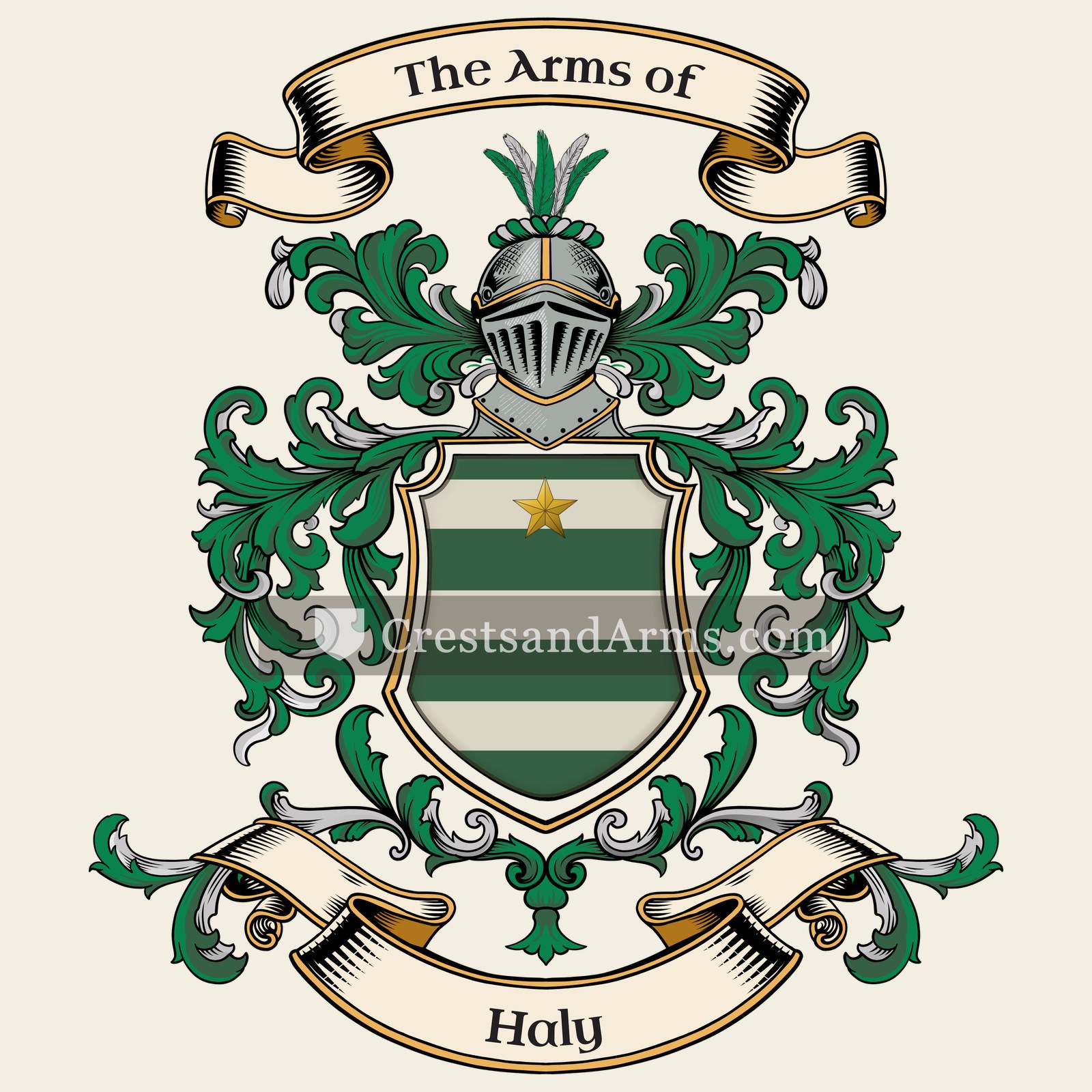
A record of documented arms, meaning and origin, researched for the Haly family of Ireland.
Reg. 8828 · Irish, G–I
Coat of Arms & Family Crest Details
Symbols on this shield
mulletThe third son, and a divine quality from above
Colours
Green (Vert)Means: Hope
Silver (Argent)Means: Peace and sincerity
Gold (Or)Means: Generosity
Historical info
Source
Sir Bernard Burke, The General Armory of England, Scotland, Ireland and Wales, London: Harrison & Sons, 1884
Blazon (the actual original written record)
“Vert three bars wavy ar. in chief a mullet pierced or”
CorkBallyhally · Cork, c. 1775
Where the Haly Arms Were Recorded
Cork
Map of Ireland showing where the Haly arms are recorded
The Haly arms were recorded in Cork, c. 1775.
Cork was the largest county in Ireland, with a great harbour and a wide farming hinterland. Both English settlers and older Irish families held land there, and holding land is what brought a family into the records.
This is where the arms were entered in the register. Families often moved to other parts of the country, so the same name can turn up in more than one region.
The body that granted and recorded arms in Ireland in this period.
George III of Great Britain
Sovereign of the period
George III of Great Britain
1760–1801
Reigning in Ireland when the Haly arms are first recorded.
How Arms Worked in Ireland
The Ulster King of Arms granted coats of arms to individuals who proved their social standing and good character. These symbols were typically inherited by all legitimate descendants of the original holder. If a family branch wanted a unique look, they could apply for a specific change to their design through the office to ensure their identity remained distinct.
Granting authority
The Ulster King of Arms acted as the official body that regulated and issued all coats of arms throughout Ireland.
How they got arms
Families obtained their arms through formal grants issued by the office after proving their eligibility and paying the required fees.
Where arms were recorded
All official grants were recorded in the registers held by the Ulster King of Arms starting from the year 1552.
The family's standing
Recorded among the armigerous families of Cork.
Origin & History of the Haly Family in Ireland
The family name Haly has deep roots in the southern region of Ireland, particularly within County Cork. Historical records confirm that members of the Haly family were established residents in this area by 1775. The name is often considered a variant of the Gaelic surname Ó hAilche, which suggests that the family belonged to the native Irish population long before the eighteenth century. During this period, families in Cork were often deeply connected to the local land and the trade networks of the city. As the eighteenth century progressed, the Haly family became part of the social and economic fabric of the region, participating in the daily life and development of the Munster province. Their presence in official documents from the late 1700s highlights their role as a settled and enduring part of the Cork community.
Related Branches & Arms
Root word
O hAilche
Derived from the Gaelic word for a clever or ingenious person.
This name
HalyA surname of Irish origin meaning descendant of the ingenious or clever one.
also spelled
Haley
Hallis
Hallys
Related arms
Haleyvariant spelling
Hallisvariant spelling
Hallysvariant spelling
Documented Sources
Sir Bernard Burke, The General Armory of England, Scotland, Ireland and Wales, London: Harrison & Sons, 1884
O'Hart, John, Irish Pedigrees; or, The Origin and Stem of the Irish Nation, 1892
National Archives of Ireland, Exchequer Inquisitions, 16th–18th Century
Cork City and County Archives, Registry of Deeds Records, 1775
Digital archive packCoat of arms PNG, gold border print PDF, vector SVG and the certificate of authenticity. Sent to your email in minutes.


 mulletThe third son, and a divine quality from above
 mulletThe third son, and a divine quality from above