Map of Belgium showing where the Hamid arms are recorded
The Hamid arms were recorded in Hainaut, c. 1732.
Hainaut sat on the border between France and the Low Countries and was fought over for centuries. Families there held their land under arms and expected to defend it, so a shield was a working thing.
This is where the arms were entered in the register. Families often moved to other parts of the country, so the same name can turn up in more than one region.
The body that granted and recorded arms in Belgium in this period.
Charles VI, Holy Roman Emperor
Sovereign of the period
Charles VI, Holy Roman Emperor
1711–1740
Reigning in Belgium when the Hamid arms are first recorded.
How Arms Worked in Belgium
In Belgium, a coat of arms is considered personal property that is passed down through the male line to legitimate descendants. Families often use the same shield design across generations to show their shared heritage. If a branch of the family wants to change the design, they must apply for an official update to their specific version of the arms.
Granting authority
The Conseil héraldique is the official body that regulates and approves all coats of arms in Belgium.
How they got arms
Families obtain their coats of arms through formal royal grants or by confirming their historical right to use existing designs.
Where arms were recorded
All approved coats of arms are officially recorded in the public registers of the Conseil héraldique since 1844.
The family's standing
Recorded among the armigerous families of Hainaut.
Origin & History of the Hamid Family in Belgium
The family name Hamid carries a deep history that spans across different cultures and regions. While the name is often associated with Arabic origins meaning the praised one, its presence in the historical records of Hainaut by 1732 suggests a fascinating journey of migration and integration. During the eighteenth century, Hainaut was a crossroads for trade and movement within Europe. Families moving into this region often adapted their surnames to fit local linguistic patterns while maintaining their ancestral identity. By the early 1700s, individuals bearing this name were already established members of the local community, participating in the daily economic and social life of the province. This early documentation serves as a vital link, showing how the family name became part of the long-standing cultural fabric of the area.
Related Branches & Arms
Root word
Hamd
The Arabic triliteral root meaning to praise or commend.
This name
HamidDerived from Arabic, it signifies one who is praiseworthy or full of gratitude.
also spelled
Hamade
Documented Sources
J. B. Rietstap, Armorial Général, Gouda: G. B. van Goor Zonen, 1884–87
Archives de l'État à Mons, Registres paroissiaux du Hainaut (1700-1750)
Dion, Michel, Histoire du Hainaut, 1998
Lefèvre, Joseph, L'administration provinciale sous l'Ancien Régime dans les Pays-Bas autrichiens, 1942
Digital archive packCoat of arms PNG, gold border print PDF, vector SVG and the certificate of authenticity. Sent to your email in minutes.


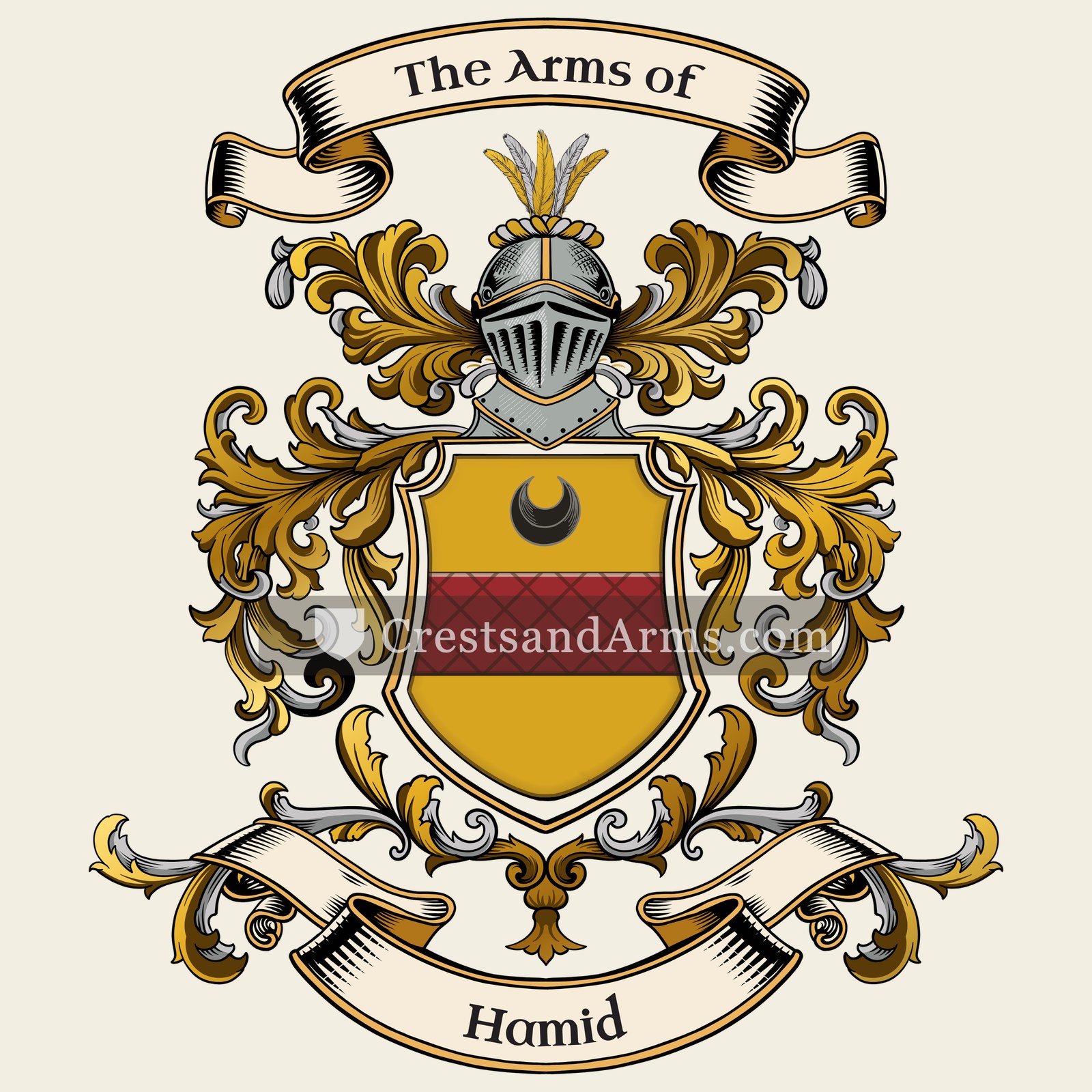
 crescentHonour by the sovereign, and the second son
 crescentHonour by the sovereign, and the second son