Map of Belgium showing where the Hamideh arms are recorded
The Hamideh arms were recorded in Hainaut, c. 1732.
Hainaut sat on the border between France and the Low Countries and was fought over for centuries. Families there held their land under arms and expected to defend it, so a shield was a working thing.
This is where the arms were entered in the register. Families often moved to other parts of the country, so the same name can turn up in more than one region.
The body that granted and recorded arms in Belgium in this period.
Charles VI, Holy Roman Emperor
Sovereign of the period
Charles VI, Holy Roman Emperor
1711–1740
Reigning in Belgium when the Hamideh arms are first recorded.
How Arms Worked in Belgium
In Belgium, a coat of arms is considered personal property that is passed down through the male line to legitimate descendants. Families often use the same shield design across generations to show their shared heritage. If a branch of the family wants to change the design, they must apply for an official update to their specific version of the arms.
Granting authority
The Conseil héraldique is the official body that regulates and approves all coats of arms in Belgium.
How they got arms
Families obtain their coats of arms through formal royal grants or by confirming their historical right to use existing designs.
Where arms were recorded
All approved coats of arms are officially recorded in the public registers of the Conseil héraldique since 1844.
The family's standing
Recorded among the armigerous families of Hainaut.
Origin & History of the Hamideh Family in Belgium
The history of the Hamideh family name is deeply rooted in the cultural landscape of the Hainaut region, where records confirm the family’s presence as early as 1732. During this period, Hainaut was a crossroads of European influence, situated within the shifting borders of the Austrian Netherlands. Families living in this area often navigated complex social changes as the region transitioned between different ruling powers. The name likely emerged from the linguistic traditions of the local population, reflecting the naming customs common to the rural and urban centers of the eighteenth-century Low Countries. By establishing themselves in Hainaut during the early 1700s, the Hamideh ancestors became part of a long tradition of families who contributed to the agricultural and social development of the province. Their continued presence in the region suggests a stable lineage that successfully adapted to the economic and political shifts of the eighteenth and nineteenth centuries.
Related Branches & Arms
Root word
Hamid
Derived from the Arabic root meaning to praise or commend.
This name
HamidehA feminine form signifying one who is praiseworthy or commendable.
also spelled
Hamade
Documented Sources
J. B. Rietstap, Armorial Général, Gouda: G. B. van Goor Zonen, 1884–87
Archives de l'État à Mons, État civil et registres paroissiaux du Hainaut
Duvosquel, Jean-Marie, Histoire du Hainaut, 1987
Lottin, Alain, Histoire des provinces françaises du Nord, 2001
Digital archive packCoat of arms PNG, gold border print PDF, vector SVG and the certificate of authenticity. Sent to your email in minutes.


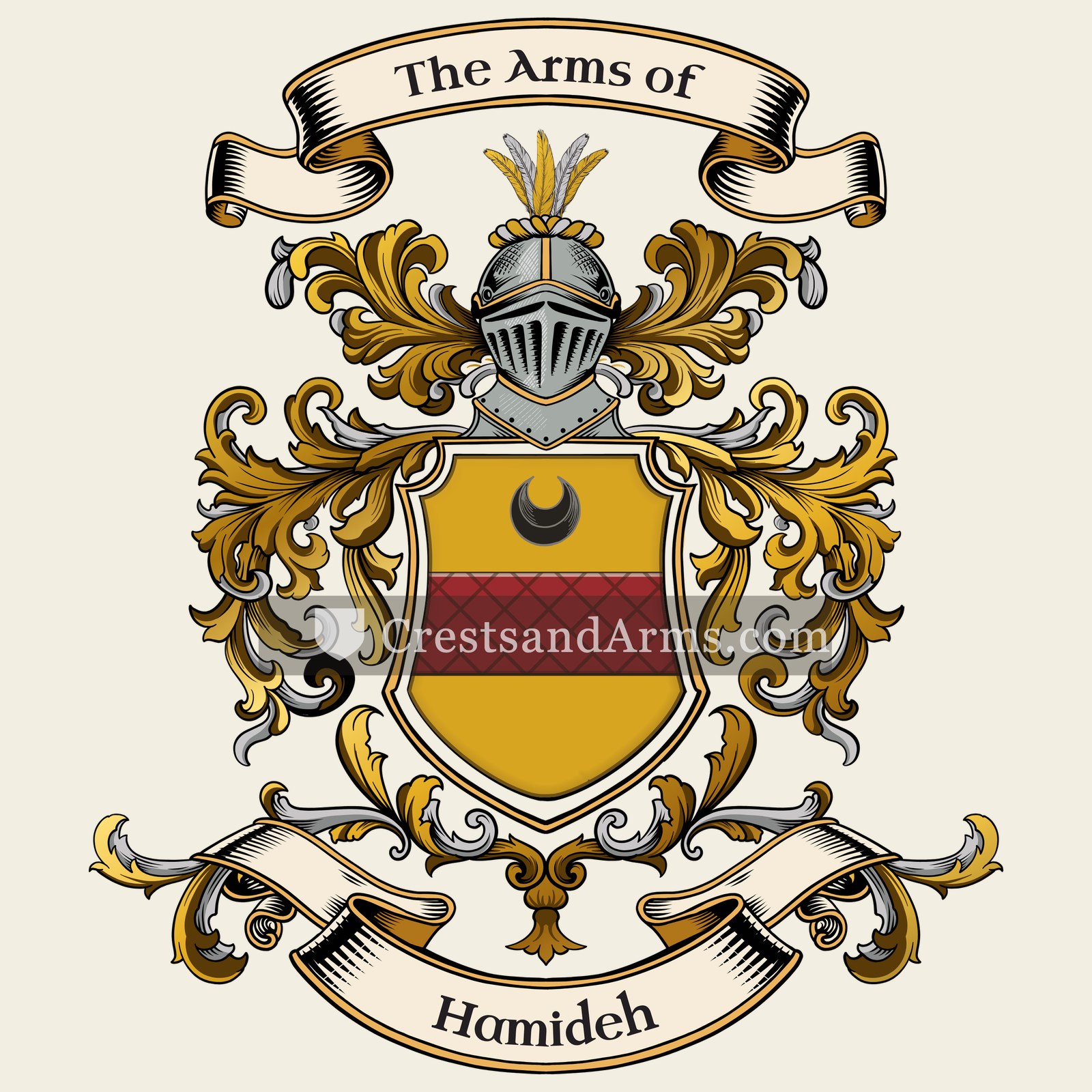
 crescentHonour by the sovereign, and the second son
 crescentHonour by the sovereign, and the second son