Map of Germany showing where the Hamm arms are recorded
The Hamm arms were recorded in Germany, c. 1765.
Arms such as these were typically recorded in Bavaria.
Bavaria was a country of old landed families and walled market towns. Estates passed down the same line for centuries, and both the landowners and the leading townsmen kept arms, which is why so many Bavarian names sit in the registers.
This is where the arms were entered in the register. Families often moved to other parts of the country, so the same name can turn up in more than one region.
The body that granted and recorded arms in Germany in this period.
Francis I, Holy Roman Emperor
Sovereign of the period
Francis I, Holy Roman Emperor
1745–1765
Reigning in Germany when the Hamm arms are first recorded.
How Arms Worked in Germany
In the Holy Roman Empire, coats of arms were often granted to individuals by the Emperor or his representatives. These arms were then passed down through the generations to all legitimate descendants of the original holder. Younger branches of a family usually kept the same shield design without needing to change it, as the arms belonged to the entire lineage.
Granting authority
The Holy Roman Emperor held the sole power to grant new coats of arms throughout his vast imperial territories.
How they got arms
Families typically obtained their coats of arms through a formal imperial grant or by proving their noble status to the authorities.
Where arms were recorded
These grants were officially recorded in the Imperial Chancery registers, which began keeping formal records of such honors during the Middle Ages.
The family's standing
Recorded among the armigerous families of Germany.
Origin & History of the Hamm Family in Germany
The surname Hamm is a locational name that originated in the German-speaking regions of Europe. It is derived from the Middle High German word "ham," which refers to a piece of land situated in a river bend or a low-lying meadow near a stream. Families who took this name often lived on such fertile plots of land, which were highly valued for farming and grazing livestock. By the time records place your ancestors in Bavaria in 1765, the name was already well-established across various German states. During this period, families with this name were typically part of the agrarian society that formed the backbone of the Bavarian economy. Because the name describes a specific type of geography, it likely emerged independently in several different regions as people began to adopt permanent surnames to distinguish themselves from their neighbors.
Coat of Arms & Family Crest Details
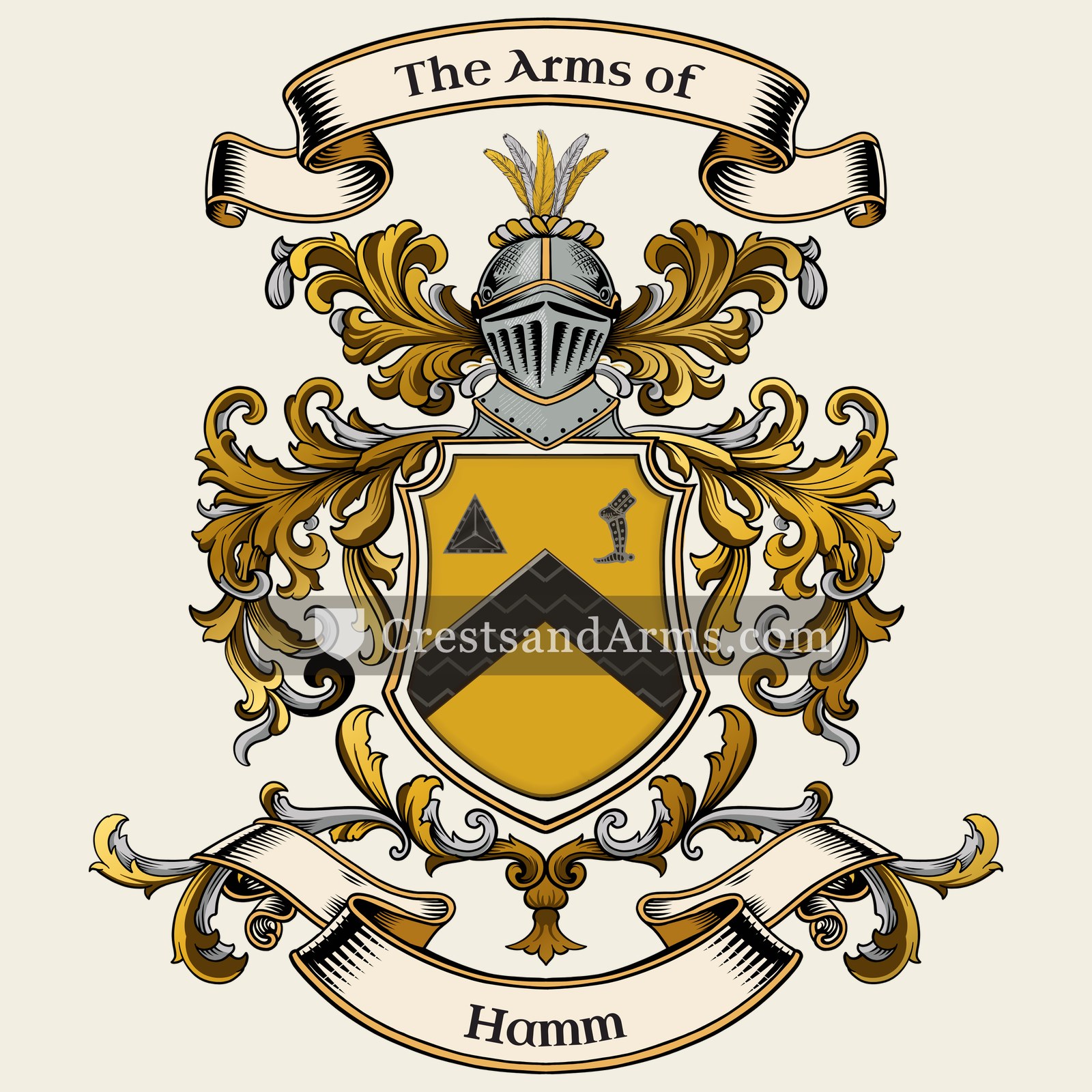
Symbols on this shield
chevronProtection, and faithful service completed
triangleThe Trinity, and stability
legStrength and swiftness
Colours
Gold (Or)Means: Generosity
Black (Sable)Means: Constancy
Historical info
Source
J. B. Rietstap, Armorial Général, Gouda: G. B. van Goor Zonen, 1884–87
Blazon (the actual original written record)
“D'or à un triangle vidé de sa. et un chev. alésé du même, posé à sen., la jambe dextre mouv. du flanc sen. du triangle. C.: un écusson des armes, tenu à dextre par un lion d'or et à sen. par un griffon du même, la partie supérieure du corps et les deux pattes de sa. S.: à dextre un lion d'or, à sen. un griffon de sa.”
Polandc. 1852
Digital archive packCoat of arms PNG, gold border print PDF, vector SVG and the certificate of authenticity. Sent to your email in minutes.
Map of Poland showing where the Hamm arms are recorded
The Hamm arms were recorded in Poland, c. 1852.
Arms such as these were typically recorded in Mazovia.
Mazovia held Warsaw, the Polish court and the assemblies where the szlachta met. Poland's nobles were unusually numerous and every one of them bore arms, and Warsaw is where those arms were argued over and recorded.
This is where the arms were entered in the register. Families often moved to other parts of the country, so the same name can turn up in more than one region.
Region
Mazovia
First recorded
1852
Granting Authority for the Hamm Arms
Ennoblement by the Sejm
Author: Olek Remesz · CC BY-SA 3.0
The body that granted and recorded arms in Poland in this period.
How Arms Worked in Poland
Polish noble families shared a single coat of arms across many different surnames, creating large clans rather than individual designs. These symbols were held collectively by all members of the clan regardless of their specific family name. When a new family joined the nobility, they were adopted into an existing clan and began using that group's established shield.
Granting authority
The Sejm, which was the Polish parliament, held the power to grant noble status and the right to bear arms.
How they got arms
Families typically received their coat of arms through a formal act of ennoblement granted by the Sejm for distinguished service.
Where arms were recorded
These grants were officially recorded in the Crown Metrica, which served as the central archive for state documents starting in the sixteenth century.
The family's standing
Recorded among the armigerous families of Poland.
Origin & History of the Hamm Family in Poland
The history of the Hamm family in Poland is deeply rooted in the cultural landscape of the Mazovia region during the nineteenth century. By 1852, records confirm that members of the family were established residents of this central Polish province, a time when the area was undergoing significant social and economic shifts under the influence of the Congress Kingdom of Poland. The name itself likely arrived in the region through the movement of skilled laborers or merchants who migrated from German-speaking lands to participate in the growing industrial and agricultural sectors of the Vistula basin. As these families integrated into the local community, they adopted the traditions and administrative practices of their new home while maintaining the distinct identity associated with their surname. Over time, the Hamm family became a part of the local fabric in Mazovia, contributing to the diverse demographic history that defined the region during the mid-1800s.
Related Branches & Arms
Root word
Ham
A Middle High German term for a meadow or enclosed land.
This name
HammA topographic name for someone who lived near a river meadow or an enclosed pasture.
also spelled
Ham
Related arms
Hamvariant spelling
Documented Sources
J. B. Rietstap, Armorial Général, Gouda: G. B. van Goor Zonen, 1884–87
Bahlow, Hans. Deutsches Namenlexikon: Familien- und Vornamen nach Ursprung und Sinn erklärt. 1967


 ringFidelity, and a promise kept
 ringFidelity, and a promise kept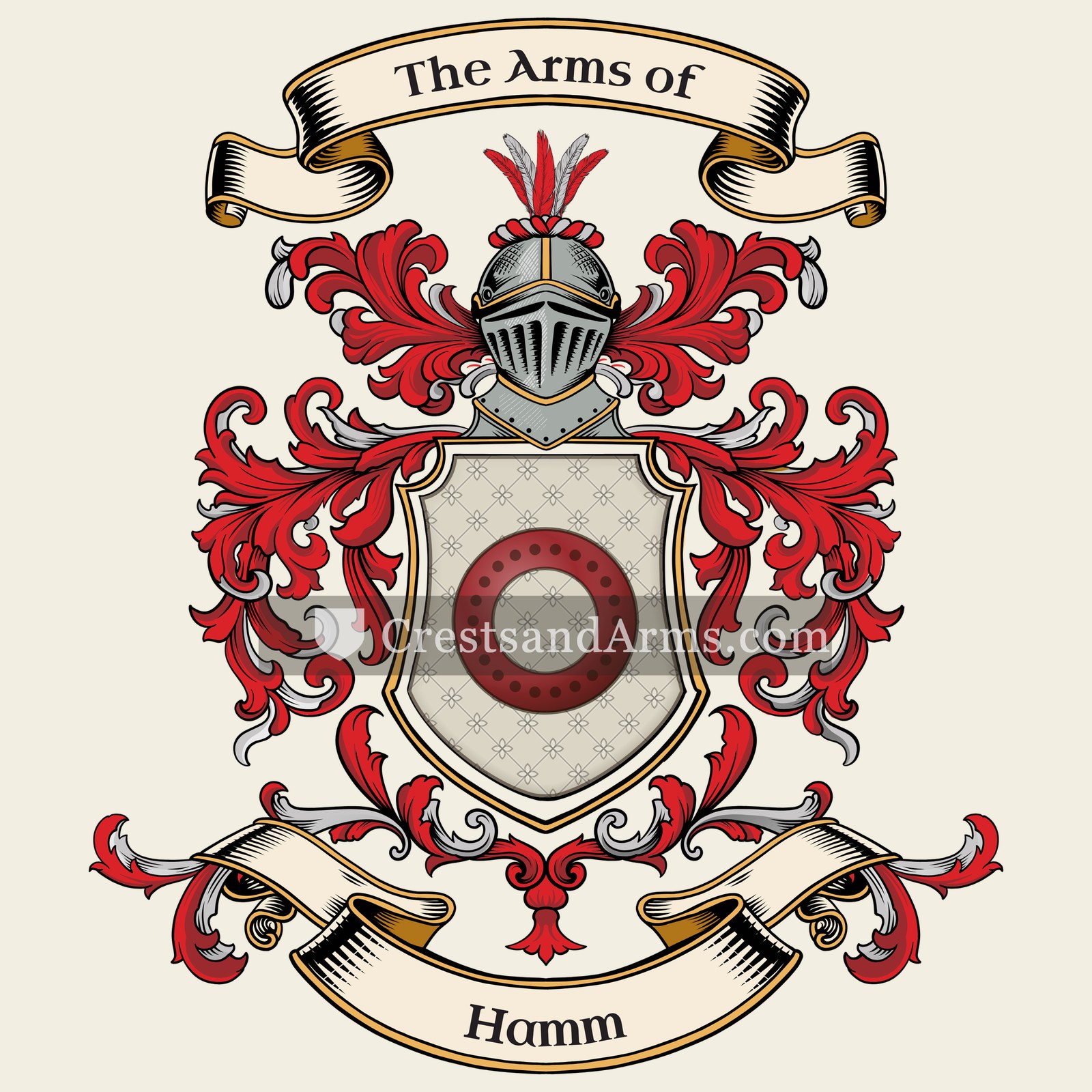


 chevronProtection, and faithful service completed
 triangleThe Trinity, and stability
 legStrength and swiftness