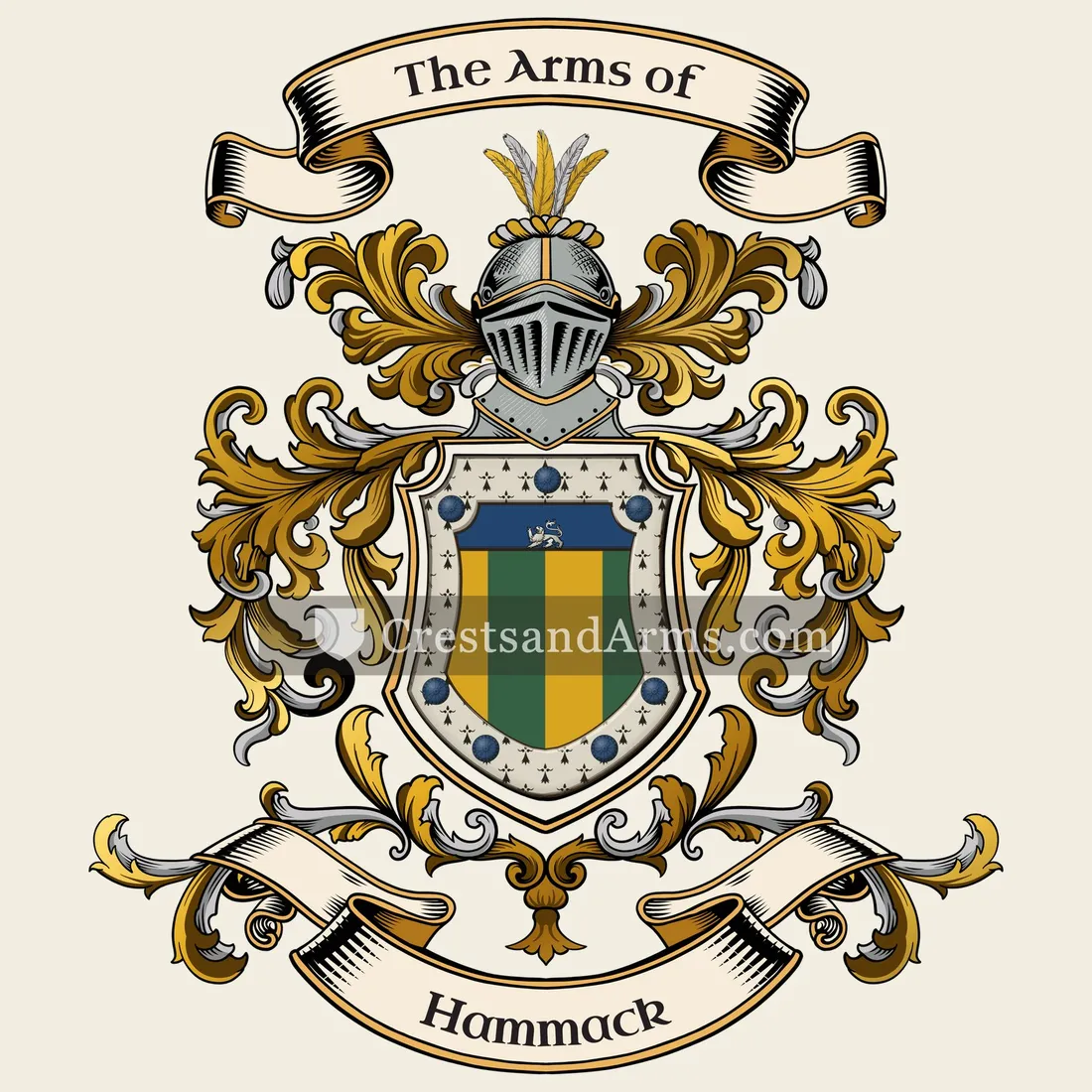
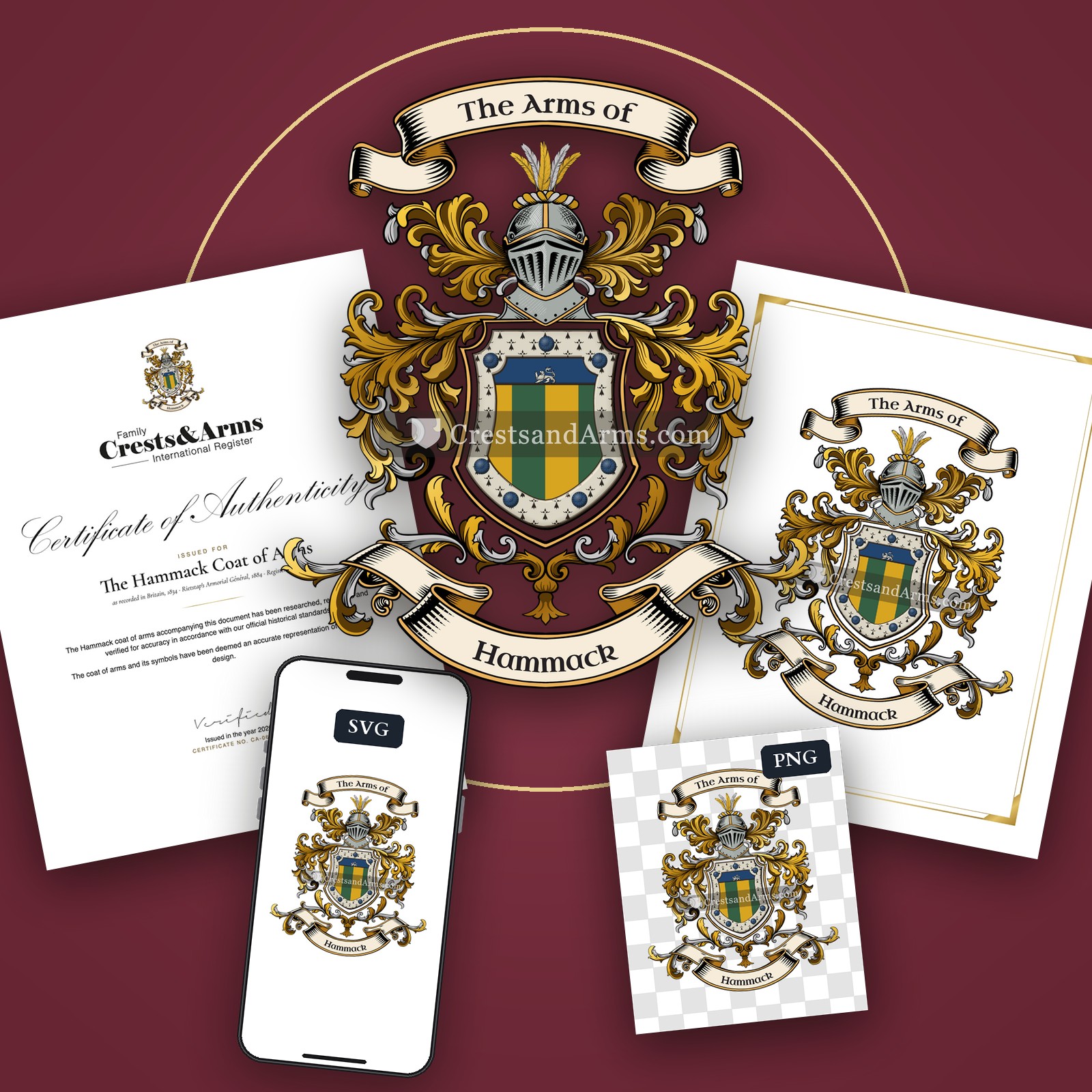
A record of documented arms, meaning and origin, researched for the Hammack family lines. Documented in 2 countries.
Reg. 0636 · Britain, G–I
Meaning of the Hammack family crest colors & symbols
Symbols on this shield
paleMilitary strength, and a fortified defence
chiefAuthority, wisdom and dominion
lionCourage, strength and royalty
roundelA coin, and one who has been to the crusades
Colours
Gold (Or)Means: Generosity
Blue (Azure)Means: Loyalty and truth
ErmineMeans: Dignity
Silver (Argent)Means: Peace and sincerity
Green (Vert)Means: Hope
Historical info
Source
J. B. Rietstap, Armorial Général, Gouda: G. B. van Goor Zonen, 1884–87
Blazon (the actual original written record)
“Palé d'or et de sin., de quatre pièces; au chef d'azur, ch. d'un lion léopardé d'arg. L'écu entouré d'une bord. d'herm., ch. de sept tourt. d'azur, 3 à chaque flanc et 1 en p. C.: un lion iss., parti d'or et de sin., tenant entre ses pattes une escarboucle d'or. D.: LAUDARI A LAUDATO.”
BritainLondres, c. 1834
Digital archive packCoat of arms PNG, gold border print PDF, vector SVG and the certificate of authenticity. Sent to your email in minutes.
Map of Britain showing where the Hammack arms are recorded
The Hammack arms were recorded in Londres, c. 1834.
Arms such as these were typically recorded in Kent.
Kent sits between London and the short crossing to Europe, and the trade passing through made it wealthy. Merchant families bought land with that money, and it was landowners who took coats of arms.
This is where the arms were entered in the register. Families often moved to other parts of the country, so the same name can turn up in more than one region.
The body that granted and recorded arms in Britain in this period.
William IV
Sovereign of the period
William IV
1830–1837
Reigning in Britain when the Hammack arms are first recorded.
How Arms Worked in Britain
English heraldry allowed arms to be shared by all legitimate descendants of the original owner. These symbols were treated as personal property that moved through the generations to all children. While the eldest son kept the original design, other family members could use the same shield without needing to change it or register their own unique versions.
Granting authority
The College of Arms in London has regulated the use of coats of arms throughout England and Wales since 1484.
How they got arms
Families typically obtained their coats of arms through a formal grant from the Crown or by proving their ancient right to them.
Where arms were recorded
All official coats of arms are recorded in the registers kept at the College of Arms, which date back to the fifteenth century.
The family's standing
Recorded among the armigerous families of Britain.
Origin & History of the Hammack Family in Britain
The surname Hammack is believed to have roots in the southeastern region of England, specifically within the county of Kent. Historical records confirm that members of the family were well-established in this area by the early 19th century. The name itself is thought to be a variation of older English topographic names, which were often used to describe the specific landscape where a family lived or worked. During the 1800s, Kent was a hub of agricultural activity and trade, and families like the Hammacks were often deeply connected to the local parish communities. By studying regional census data and parish registers from this time, historians can trace how these families moved through the local villages and contributed to the development of the Kentish countryside. While the name is not as common as others, its presence in Kent provides a clear starting point for understanding how the family integrated into the social and economic life of 19th-century Britain.
Meaning of the Hammack family crest colors & symbols
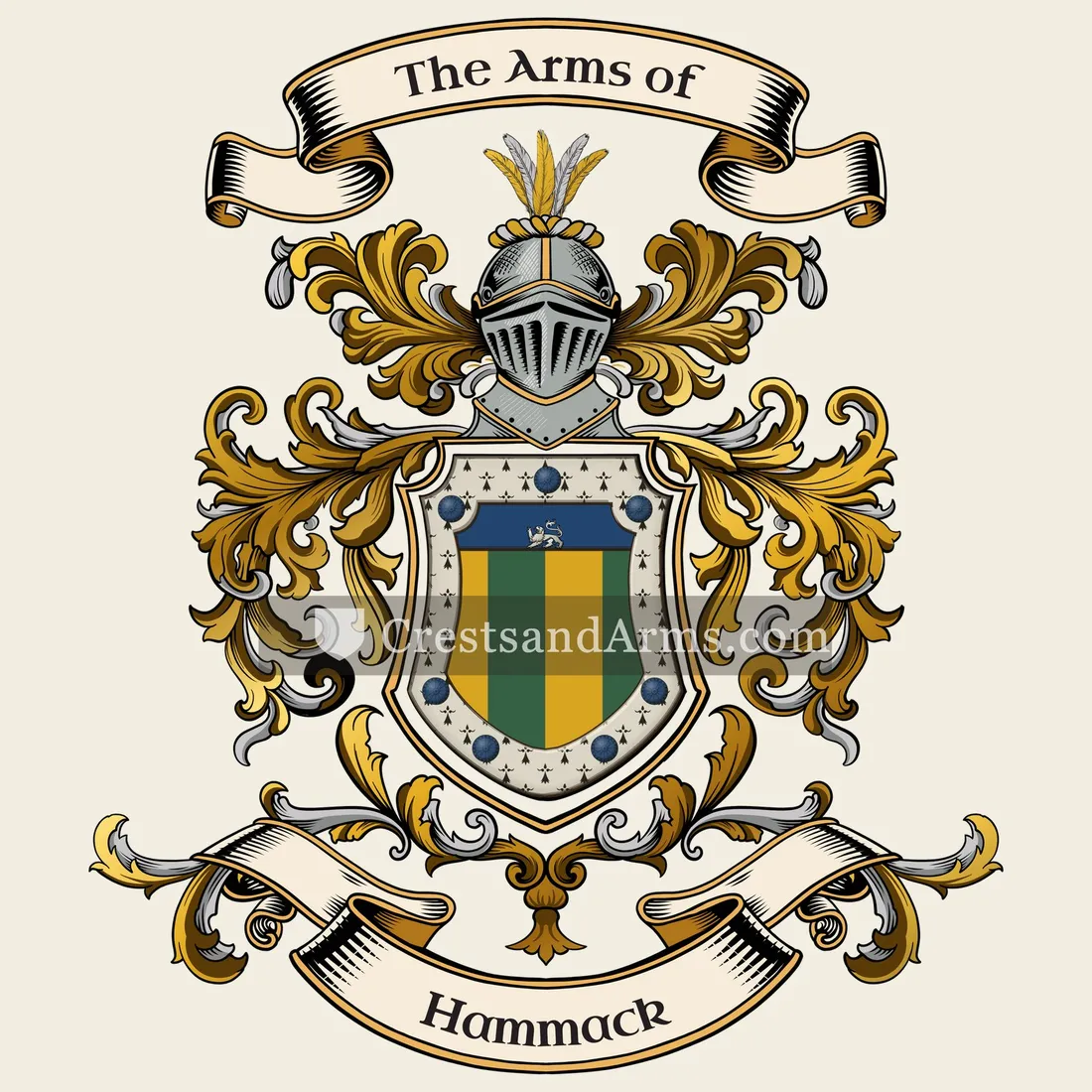
Symbols on this shield
bordureA difference between branches of one family
chiefAuthority, wisdom and dominion
roundelA coin, and one who has been to the crusades
lionCourage, strength and royalty
Colours
Gold (Or)Means: Generosity
Blue (Azure)Means: Loyalty and truth
ErmineMeans: Dignity
Silver (Argent)Means: Peace and sincerity
Green (Vert)Means: Hope
Historical info
Source
Sir Bernard Burke, The General Armory of England, Scotland, Ireland and Wales, London: Harrison & Sons, 1884
Blazon (the actual original written record)
“Paly of four or and vert, a bordure erm. charged with seven hurts, on a chief az. a lion pass. ar”
EnglandCavendish Square, c. 1620
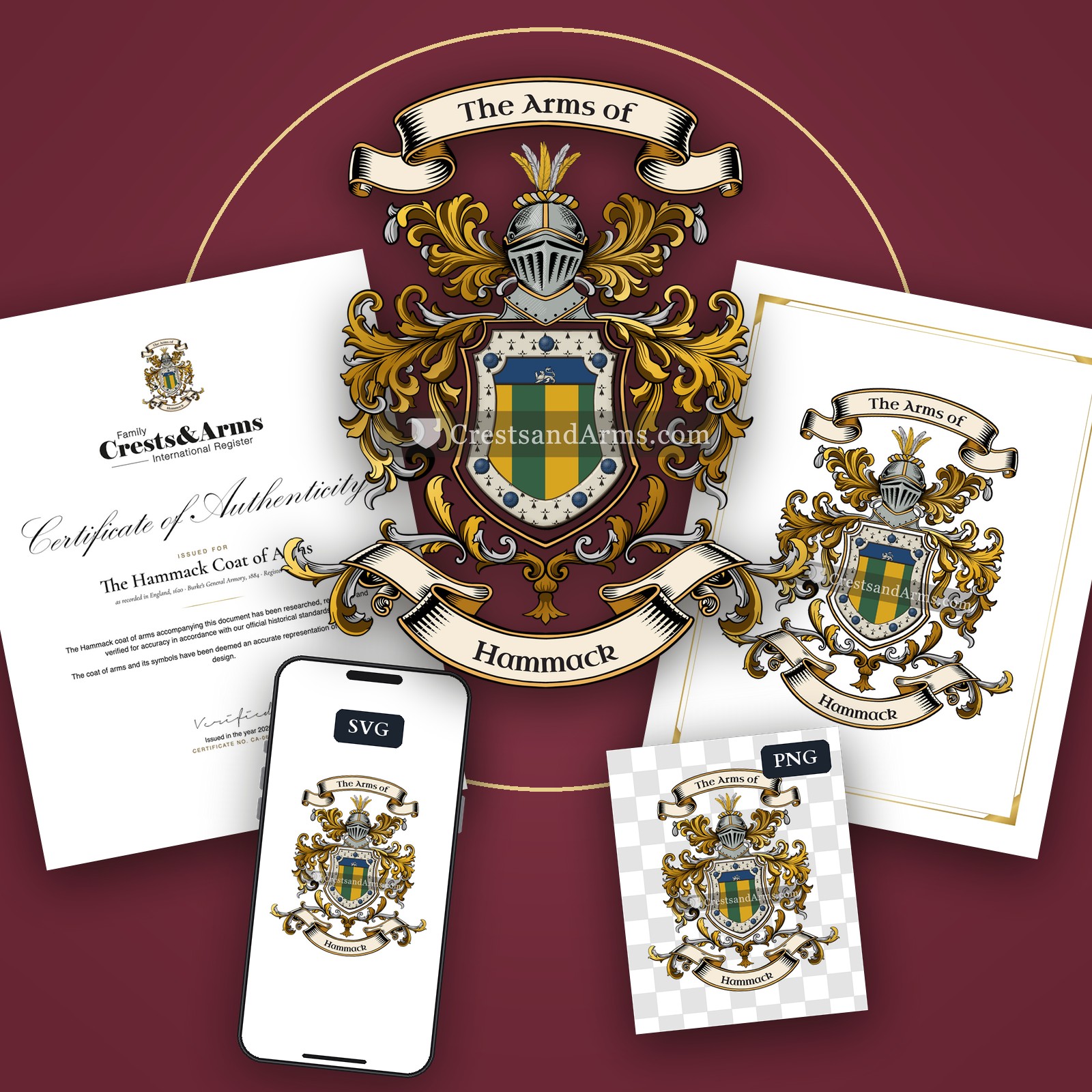
Digital archive packCoat of arms PNG, gold border print PDF, vector SVG and the certificate of authenticity. Sent to your email in minutes.
Map of England showing where the Hammack arms are recorded
The Hammack arms were recorded in Cavendish Square, c. 1620.
Arms such as these were typically recorded in York.
Yorkshire is the largest of the English counties, and it held more gentry families than any other. Land there was split among a great many households rather than a few, so a great many of them carried arms.
This is where the arms were entered in the register. Families often moved to other parts of the country, so the same name can turn up in more than one region.
The body that granted and recorded arms in England in this period.
James VI and I
Sovereign of the period
James VI and I
1603–1625
Reigning in Britain when the Hammack arms are first recorded.
How Arms Worked in England
English heraldry allowed arms to be shared by all legitimate descendants of the original owner. These symbols were treated as personal property that moved through the generations to all children. While the eldest son kept the original design, other family members could use the same shield without needing to change it or register their own unique versions.
Granting authority
The College of Arms in London has regulated the use of coats of arms throughout England and Wales since 1484.
How they got arms
Families typically obtained their coats of arms through a formal grant from the Crown or by proving their ancient right to them.
Where arms were recorded
All official coats of arms are recorded in the registers kept at the College of Arms, which date back to the fifteenth century.
The family's standing
Recorded among the armigerous families of England.
Origin & History of the Hammack Family in England
The family name Hammack has deep roots tied to the northern regions of England, with documented evidence placing members of the family in the city of York by the year 1620. During the early seventeenth century, York was a bustling center of trade and religious activity, serving as a critical hub for families navigating the social shifts of the Stuart era. The name likely evolved from regional dialects and local place names, reflecting the way surnames were often adopted based on where a person lived or the specific work they performed. As these early ancestors established themselves in the historic streets of York, they became part of the local fabric of the city, contributing to the community life that defined northern English society at the time. This period was marked by significant migration and economic change, and the presence of the Hammack family in such a prominent city suggests they were active participants in the evolving landscape of seventeenth-century England.
Hammack Meaning & Related Branches
Root word
Ham
A Germanic personal name meaning home or homestead.
This name
HammackA locational surname referring to someone who lived near a home or enclosed settlement.
also spelled
Hamyck
Hammik
Hamik
Hamick
Hameck
Documented Sources
J. B. Rietstap, Armorial Général, Gouda: G. B. van Goor Zonen, 1884–87
Bardsley, Charles Wareing, A Dictionary of English and Welsh Surnames, 1901
The National Archives, Census Returns of England and Wales, 1841, HO 107
Reaney, P.H., A Dictionary of British Surnames, 1958
Digital archive packCoat of arms PNG, gold border print PDF, vector SVG and the certificate of authenticity. Sent to your email in minutes.


 paleMilitary strength, and a fortified defence
 chiefAuthority, wisdom and dominion
 lionCourage, strength and royalty
 roundelA coin, and one who has been to the crusades
 paleMilitary strength, and a fortified defence
 chiefAuthority, wisdom and dominion
 lionCourage, strength and royalty
 roundelA coin, and one who has been to the crusades


 bordureA difference between branches of one family