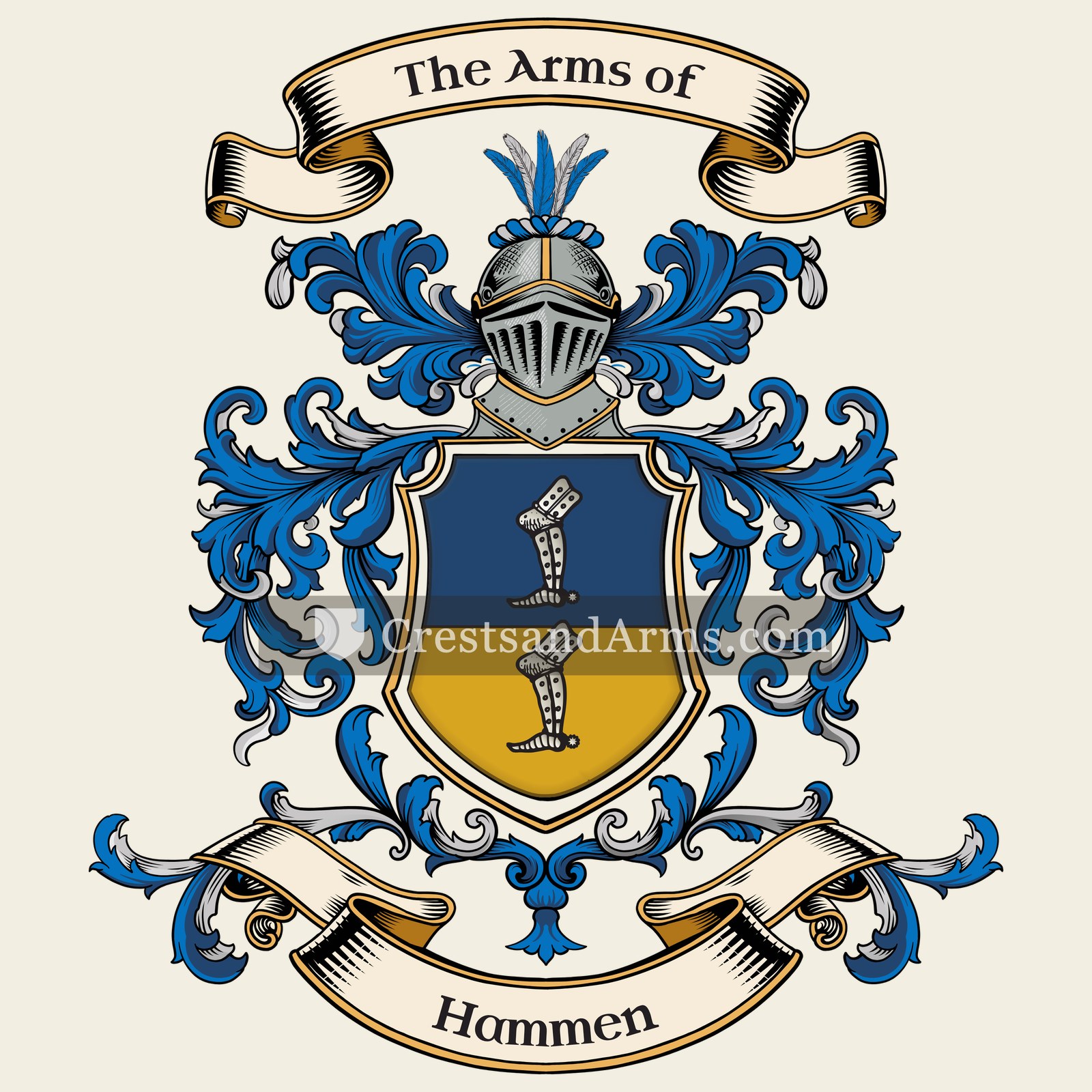
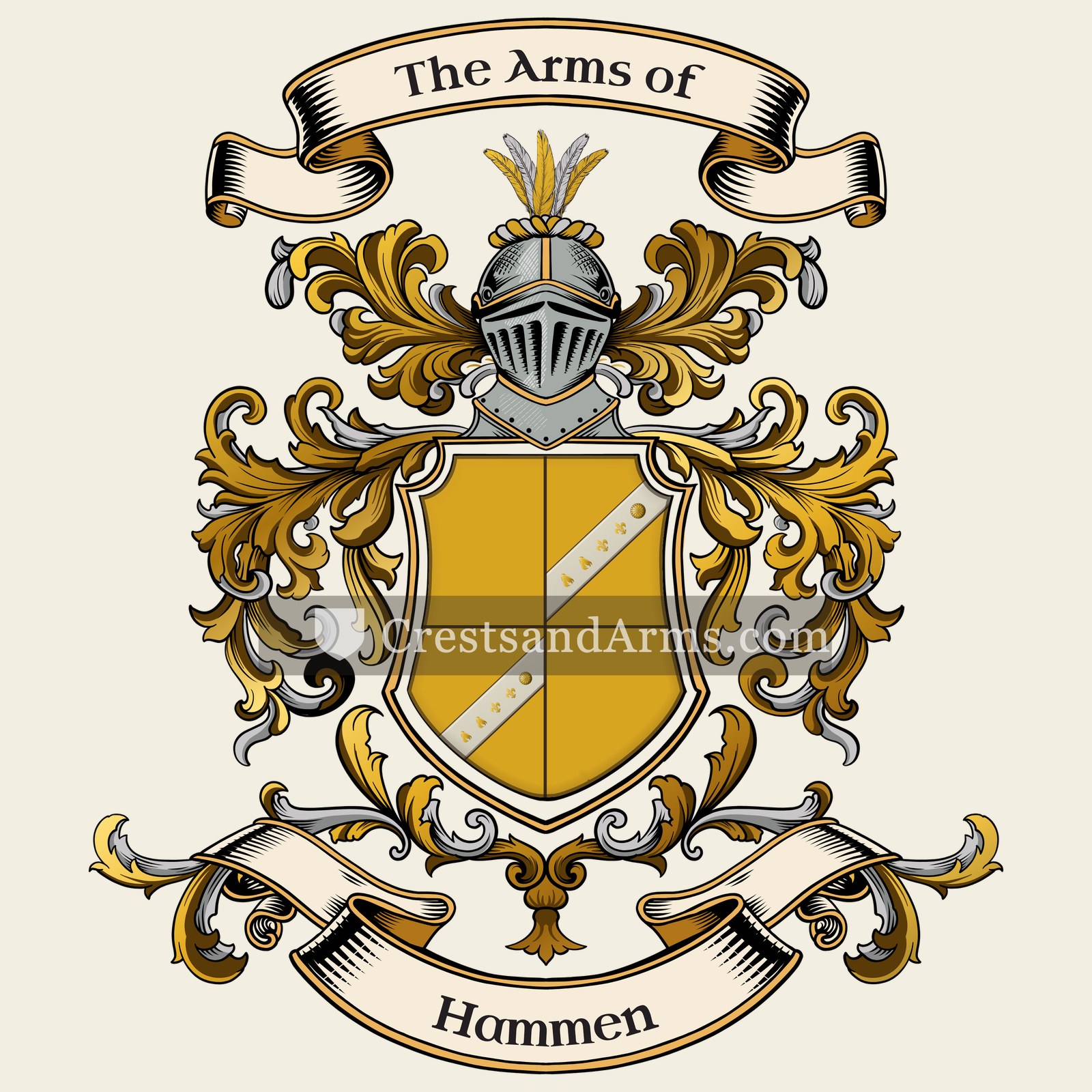
A record of documented arms, meaning and origin, researched for the Hammen family lines. Documented in 2 countries.
Reg. 1186 · German, G–I
Coat of Arms & Family Crest Details
Symbols on this shield
legStrength and swiftness
Colours
Blue (Azure)Means: Loyalty and truth
Gold (Or)Means: Generosity
Historical info
Source
J. B. Rietstap, Armorial Général, Gouda: G. B. van Goor Zonen, 1884–87
Blazon (the actual original written record)
“Coupé d'azur sur or; à une jambe de derrière d'un porc au nat., en pal, coupé de gu., le pied en bas, le genou à sen. Cq. cour. C.: un homme iss., hab. d'azur à brandebourgs d'or, au rabat du même, la tête environnée d'un brl. d'arg. et coiffé d'un chapeau piramidal d'azur, retr. de gu., sommé d'une boule d'or portant trois pl. d'aut. d'arg. L. d'or et d'azur.”
GermanyMunich, c. 1725
Where the Hammen Arms Were Recorded
Munich
Map of Germany showing where the Hammen arms are recorded
The Hammen arms were recorded in Munich, c. 1725.
This is where the arms were entered in the register. Families often moved to other parts of the country, so the same name can turn up in more than one region.
The body that granted and recorded arms in Germany in this period.
Charles VI, Holy Roman Emperor
Sovereign of the period
Charles VI, Holy Roman Emperor
1711–1740
Reigning in Germany when the Hammen arms are first recorded.
How Arms Worked in Germany
In the Holy Roman Empire, coats of arms were often granted to individuals by the Emperor or his representatives. These arms were then passed down through the generations to all legitimate descendants of the original holder. Younger branches of a family usually kept the same shield design without needing to change it, as the arms belonged to the entire lineage.
Granting authority
The Holy Roman Emperor held the sole power to grant new coats of arms throughout his vast imperial territories.
How they got arms
Families typically obtained their coats of arms through a formal imperial grant or by proving their noble status to the authorities.
Where arms were recorded
These grants were officially recorded in the Imperial Chancery registers, which began keeping formal records of such honors during the Middle Ages.
The family's standing
Recorded among the armigerous families of Germany.
Origin & History of the Hammen Family in Germany
The surname Hammen is deeply rooted in the historical landscape of southern Germany, particularly within the region of Bavaria. By the early 18th century, the family had established a notable presence in Munich, as evidenced by records dating back to 1725. The name itself likely evolved from older Germanic naming traditions, potentially serving as a descriptive term for individuals who lived near specific geographic features or worked in particular trades common to the Bavarian countryside. During this period, Munich was a growing center of culture and commerce, which suggests that the Hammen family were likely integrated into the urban fabric of the city as artisans, merchants, or skilled laborers. As the family navigated the social and economic shifts of the 1700s, they contributed to the local demographic tapestry that defined the city long before the industrial transformations of the following century. Their presence in the city archives during this era highlights a stable lineage that was well-positioned within the community of the Holy Roman Empire.
Coat of Arms & Family Crest Details
Symbols on this shield
roundelA coin, and one who has been to the crusades
fleur de lisPurity, light, and the sixth son
fireZeal and purification
Colours
Gold (Or)Means: Generosity
Silver (Argent)Means: Peace and sincerity
Historical info
Source
J. B. Rietstap, Armorial Général, Gouda: G. B. van Goor Zonen, 1884–87
Blazon (the actual original written record)
“Ec.: aux 1 et 4 les armes de 1549; aux 2 et 3 d'or à une barre d'arg., ch. d'un bes. d'or bordé de sa. et de deux fleurs-de-lis d'or posées dans le sens de la barre; ladite barre ch. en outre de flammes d'or, iss. de ses angles en haut et en bas. Cq. cour. C.: celui de 1549.”
Francec. 1673
Where the Hammen Arms Were Recorded
Bretagne
Map of France showing where the Hammen arms are recorded
The Hammen arms were recorded in France, c. 1673.
Arms such as these were typically recorded in Bretagne.
More families held coats of arms in Bretagne than anywhere else in France. The land was divided into many small estates rather than a few large ones, so far more households counted as gentry, and each needed a shield of its own to be told apart.
This is where the arms were entered in the register. Families often moved to other parts of the country, so the same name can turn up in more than one region.
The body that granted and recorded arms in France in this period.
Louis XIV of France
Sovereign of the period
Louis XIV of France
1643–1715
Reigning in Germany when the Hammen arms are first recorded.
How Arms Worked in France
In France, a coat of arms was a mark of honor that passed down through the male line to all legitimate descendants. Families often used the same shield without changes to show their shared heritage. If a branch wanted to stand out, they could add a small mark to their shield to show their specific place in the family tree.
Granting authority
The Juge d'armes de France acted as the official authority that regulated and verified coats of arms across the country.
How they got arms
Families typically inherited their arms from ancestors, though they could also receive them through royal grants or by proving their noble status.
Where arms were recorded
Coats of arms were officially recorded in the Armorial Général de France, which began its main collection in the year 1696.
The family's standing
Recorded among the armigerous families of France.
Origin & History of the Hammen Family in France
The history of the Hammen family in France is deeply rooted in the rugged landscape of Bretagne, where records confirm their presence as early as 1673. During the seventeenth century, this region was a distinct province with its own unique customs and strong ties to the sea. Families living in Bretagne at this time often relied on local agriculture or maritime trade to sustain their households. The name likely emerged as a way to identify individuals based on their specific village or their role within the local community. By living in this coastal area, the early members of the Hammen family were part of a society that valued tradition and close family bonds. These ancestors helped shape the local culture of their parishes, leaving behind a legacy that has persisted for centuries. Their presence in the historical records of the era provides a clear link to the social fabric of rural France long before the modern age.
Related Branches & Arms
Root word
Ham
A Germanic term referring to a meadow or a river bend.
This name
HammenA topographic name for someone who lived near a meadow or enclosed land.
also spelled
Haman
Hammen
Documented Sources
J. B. Rietstap, Armorial Général, Gouda: G. B. van Goor Zonen, 1884–87
Stadtarchiv München, Bürgerrechts- und Zunftprotokolle
Bahlow, Hans, Deutsches Namenlexikon: Familien- und Vornamen nach Ursprung und Sinn erklärt, 1967
Heintze, Albert, Die deutschen Familiennamen: geschichtlich, geographisch, sprachlich, 1903
Digital archive packCoat of arms PNG, gold border print PDF, vector SVG and the certificate of authenticity. Sent to your email in minutes.


 legStrength and swiftness
 legStrength and swiftness

 roundelA coin, and one who has been to the crusades
 fleur de lisPurity, light, and the sixth son
 fireZeal and purification