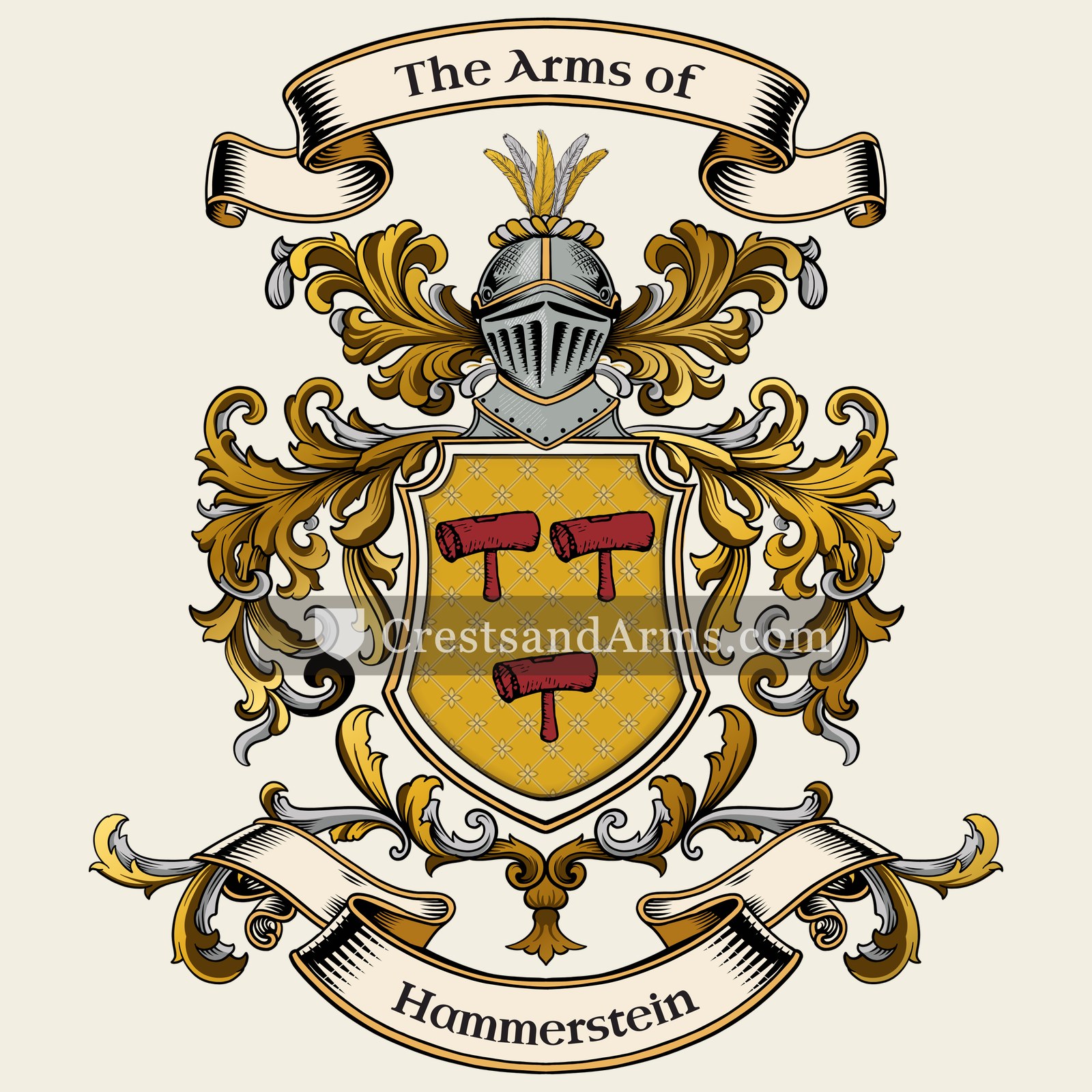
A record of documented arms, meaning and origin, researched for the Hammerstein family lines. Documented in 2 countries.
Reg. 0152 · German, G–I
Coat of Arms & Family Crest Details
Symbols on this shield
hammerHonest labour, and the smith's craft
Colours
Gold (Or)Means: Generosity
Red (Gules)Means: Military strength
Historical info
Source
J. B. Rietstap, Armorial Général, Gouda: G. B. van Goor Zonen, 1884–87
Blazon (the actual original written record)
“D'or à trois maillets de gu. C.: un vol à l'antique d'or, chaque aile ch. d'un maillet de gu.”
WestphaliaWestphalia, c. 1765
Where the Hammerstein Arms Were Recorded
Westphalia
Map of Germany showing where the Hammerstein arms are recorded
The Hammerstein arms were recorded in Westphalia, c. 1765.
Westphalia was a land of small estates and fortified farmhouses in western Germany. Its families were numerous and not especially rich, but each held its own ground, and holding ground was what brought arms.
This is where the arms were entered in the register. Families often moved to other parts of the country, so the same name can turn up in more than one region.
The body that granted and recorded arms in Germany in this period.
Francis I, Holy Roman Emperor
Sovereign of the period
Francis I, Holy Roman Emperor
1745–1765
Reigning in Germany when the Hammerstein arms are first recorded.
How Arms Worked in Germany
In the Holy Roman Empire, coats of arms were often granted to individuals by the Emperor or his representatives. These arms were then passed down through the generations to all legitimate descendants of the original holder. Younger branches of a family usually kept the same shield design without needing to change it, as the arms belonged to the entire lineage.
Granting authority
The Holy Roman Emperor held the sole power to grant new coats of arms throughout his vast imperial territories.
How they got arms
Families typically obtained their coats of arms through a formal imperial grant or by proving their noble status to the authorities.
Where arms were recorded
These grants were officially recorded in the Imperial Chancery registers, which began keeping formal records of such honors during the Middle Ages.
The family's standing
Recorded among the armigerous families of Westphalia.
Origin & History of the Hammerstein Family in Germany
The Hammerstein family name originates from the historical regions of Westphalia and the Rhineland in Germany. The name is descriptive in nature, likely derived from the German word *Hammer*, which refers to a tool used in metalworking or mining. This suggests that early ancestors were involved in the skilled trades or the management of ironworks, which were vital industries in the forested and resource-rich areas of western Germany during the eighteenth century. By 1765, records confirm that members of the family were well-established in Westphalia, where they participated in the local social and economic structures of the time. As the family grew, they integrated into the administrative and professional life of the region, reflecting the broader patterns of German middle-class development during the late Enlightenment period.
Coat of Arms & Family Crest Details
Symbols on this shield
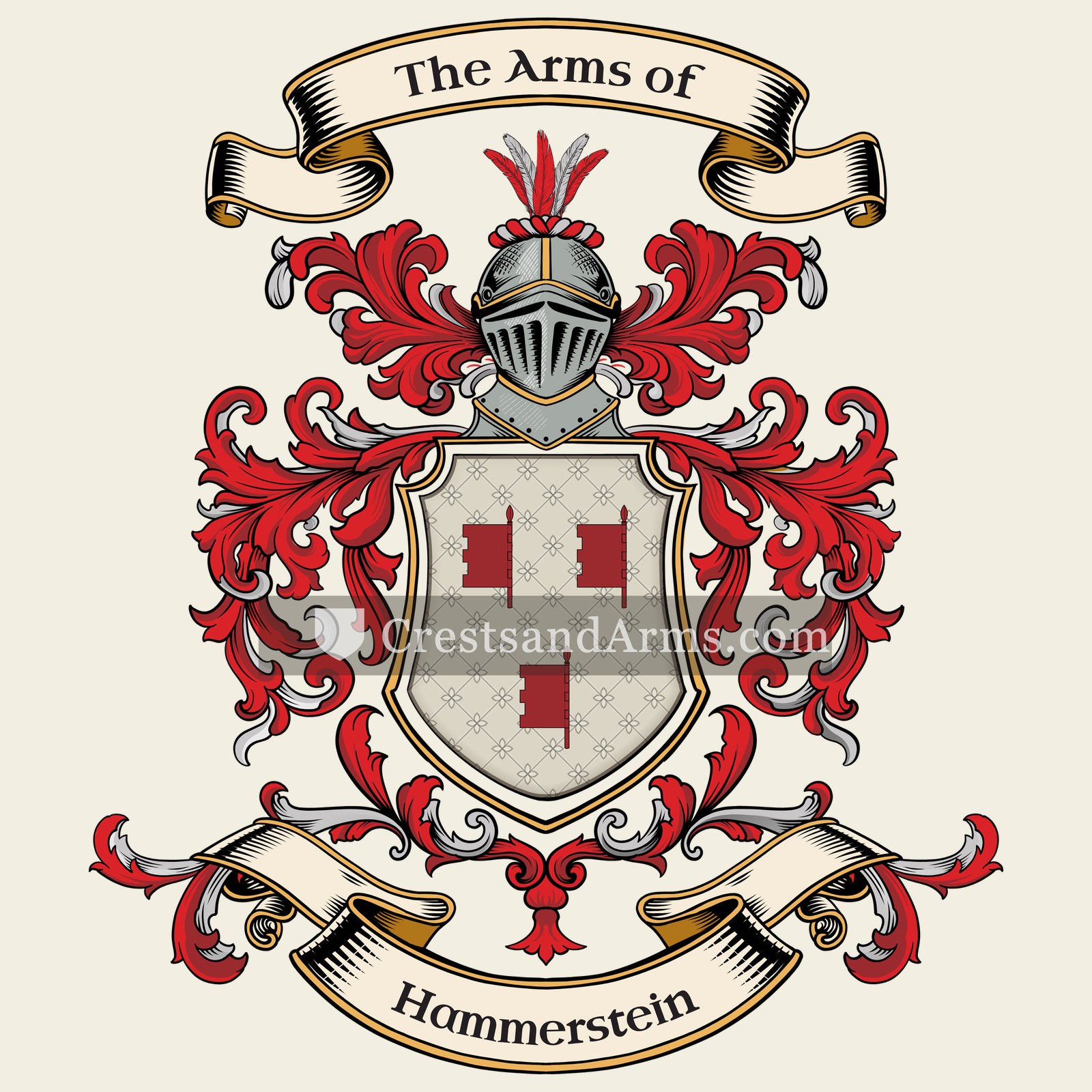
flag / pennantA command held, and a following kept
Colours
Silver (Argent)Means: Peace and sincerity
Red (Gules)Means: Military strength
Historical info
Source
J. B. Rietstap, Armorial Général, Gouda: G. B. van Goor Zonen, 1884–87
Blazon (the actual original written record)
“D'arg. à trois gonfanons de gu. C.: un bonnet de gu., retr. d'herm., supp. les gonfanons attachés à des trabes croisées d'or. S.: deux lions d'or.”
MecklenburgMecklenburg, c. 1853
Where the Hammerstein Arms Were Recorded
Map of France showing where the Hammerstein arms are recorded
The Hammerstein arms were recorded in Mecklenburg, c. 1853.
Mecklenburg was farming country in the north of Germany, held by a small number of families who kept their estates for generations. Owning land was what entitled a family to arms, so a great many Mecklenburg names ended up in the registers.
This is where the arms were entered in the register. Families often moved to other parts of the country, so the same name can turn up in more than one region.
The body that granted and recorded arms in France in this period.
Napoleon III
Sovereign of the period
Napoleon III
1852–1870
Reigning in Germany when the Hammerstein arms are first recorded.
How Arms Worked in France
In France, a coat of arms was a mark of honor that passed down through the male line to all legitimate descendants. Families often used the same shield without changes to show their shared heritage. If a branch wanted to stand out, they could add a small mark to their shield to show their specific place in the family tree.
Granting authority
The Juge d'armes de France acted as the official authority that regulated and verified coats of arms across the country.
How they got arms
Families typically inherited their arms from ancestors, though they could also receive them through royal grants or by proving their noble status.
Where arms were recorded
Coats of arms were officially recorded in the Armorial Général de France, which began its main collection in the year 1696.
The family's standing
Recorded among the armigerous families of Mecklenburg.
Origin & History of the Hammerstein Family in France
The Hammerstein family name originates from the German-speaking regions of Central Europe, specifically tied to the ancient castle of Hammerstein on the Rhine. While the family is famously documented in Mecklenburg by 1853, their historical footprint in France is primarily defined by the movement of noble families during periods of political and military upheaval. During the seventeenth and eighteenth centuries, members of the German nobility often served as officers in foreign armies or acted as diplomats within the French royal court. As these individuals traveled across borders, the name became associated with the shifting alliances of the Holy Roman Empire and the French monarchy. This cross-border presence reflects a time when aristocratic families maintained influence by serving various European powers, allowing the Hammerstein name to appear in historical records related to military service and administrative roles within French territories.
Related Branches & Arms
Root word
Hammer and Stein
A tool for striking and a hard mineral or rock.
This name
HammersteinA topographic name for someone living near a rocky outcrop or a blacksmith's workshop.
also spelled
Hamerstein
Hammersteyn
Related arms
Hamersteinvariant spelling
Documented Sources
J. B. Rietstap, Armorial Général, Gouda: G. B. van Goor Zonen, 1884–87
Bahlow, Hans, Deutsches Namenlexikon: Familien- und Vornamen nach Ursprung und Sinn erklärt, 1967
Heintze, Albert, Die deutschen Familien-Namen: geschichtlich, geographisch, sprachlich, 1903
Landesarchiv Nordrhein-Westfalen, Abteilung Westfalen, Personenstandsregister und Kirchenbücher
Digital archive packCoat of arms PNG, gold border print PDF, vector SVG and the certificate of authenticity. Sent to your email in minutes.


 hammerHonest labour, and the smith's craft
 hammerHonest labour, and the smith's craft

 flag / pennantA command held, and a following kept