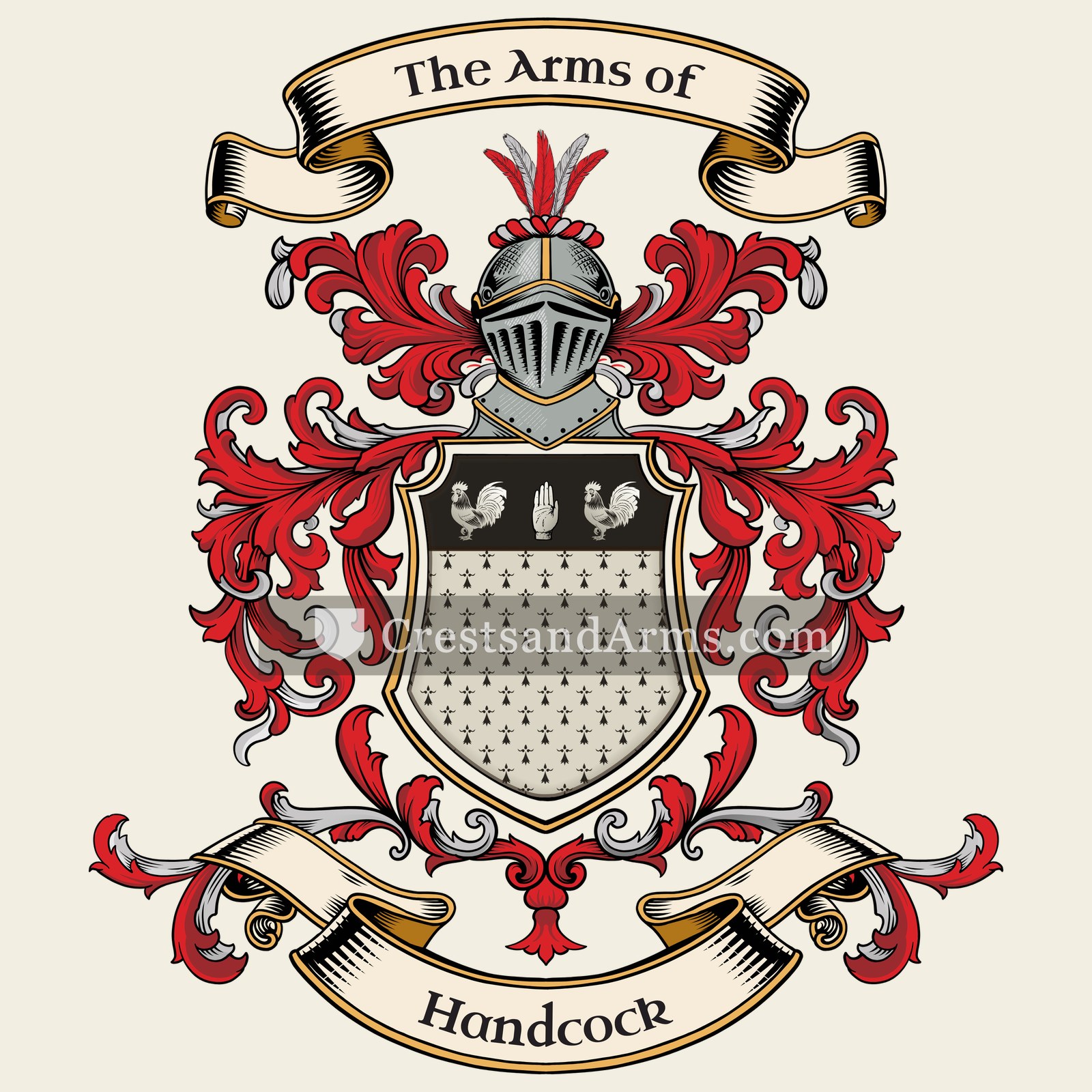
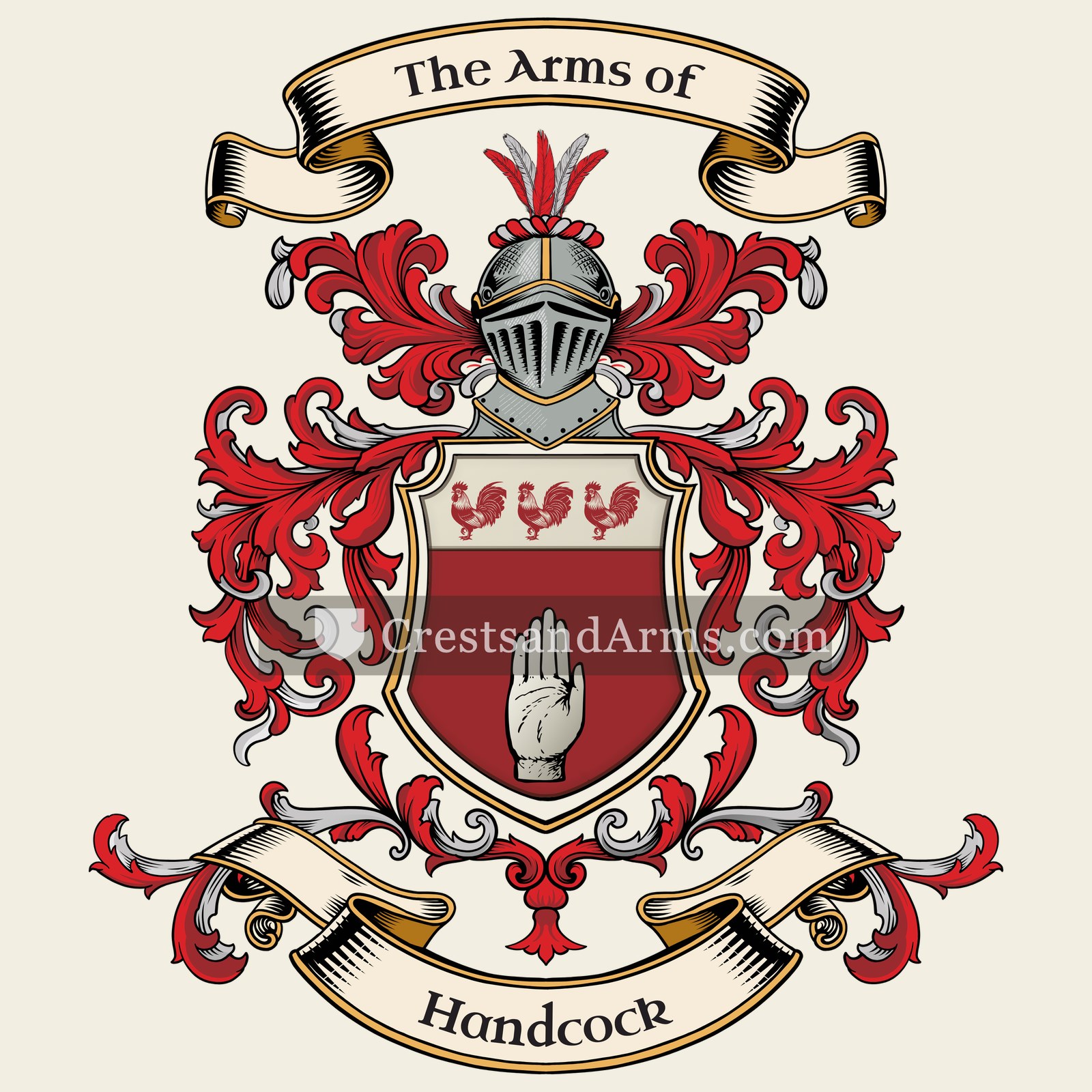
A record of documented arms, meaning and origin, researched for the Handcock family lines. Documented in 2 countries.
Reg. 7766 · Britain, G–I
Coat of Arms & Family Crest Details
Symbols on this shield
chiefAuthority, wisdom and dominion
handFaith, sincerity and justice
cockCourage, vigilance and readiness for battle
Colours
ErmineMeans: Dignity
Black (Sable)Means: Constancy
Silver (Argent)Means: Peace and sincerity
Historical info
Source
J. B. Rietstap, Armorial Général, Gouda: G. B. van Goor Zonen, 1884–87
Blazon (the actual original written record)
“D'herm.; au chef de sa., ch. d'une main dextre d'arg., posée en pal, accostée de deux coqs du même, crêtés et barbés de gu. C.: un lion iss. d'azur, tenant entre ses pattes une fusée d'arg., ch. d'un coq de gu. S.: à dextre un léopard lionné d'azur, à sen. un coq au nat. D.: VIGILATE ET ORATE.”
Britainc. 1700
Digital archive packCoat of arms PNG, gold border print PDF, vector SVG and the certificate of authenticity. Sent to your email in minutes.
Map of Britain showing where the Handcock arms are recorded
The Handcock arms were recorded in Britain, c. 1700.
Arms such as these were typically recorded in Kent.
Kent sits between London and the short crossing to Europe, and the trade passing through made it wealthy. Merchant families bought land with that money, and it was landowners who took coats of arms.
This is where the arms were entered in the register. Families often moved to other parts of the country, so the same name can turn up in more than one region.
The body that granted and recorded arms in Britain in this period.
William III of England
Sovereign of the period
William III of England
1694–1702
Reigning in Britain when the Handcock arms are first recorded.
How Arms Worked in Britain
English heraldry allowed arms to be shared by all legitimate descendants of the original owner. These symbols were treated as personal property that moved through the generations to all children. While the eldest son kept the original design, other family members could use the same shield without needing to change it or register their own unique versions.
Granting authority
The College of Arms in London has regulated the use of coats of arms throughout England and Wales since 1484.
How they got arms
Families typically obtained their coats of arms through a formal grant from the Crown or by proving their ancient right to them.
Where arms were recorded
All official coats of arms are recorded in the registers kept at the College of Arms, which date back to the fifteenth century.
The family's standing
Recorded among the armigerous families of Britain.
Origin & History of the Handcock Family in Britain
The surname Handcock is a variation of the name Hancock, which originated as a medieval diminutive of the name John. In the English language, the suffix "cock" was often added to personal names to denote a young or small person, effectively making the name mean "little John." By the time the family was firmly established in the county of Kent during the early 1700s, the name had already been present in Britain for several centuries. Families bearing this name were typically involved in local trade, agriculture, or skilled crafts, which were the primary ways people earned a living in rural English communities during that era. As the name spread through different regions, local dialects often caused slight changes in spelling, leading to the version used by your ancestors. These early family members were part of the backbone of English society, living through a time of significant agricultural and social change in the southeast of England.
Coat of Arms & Family Crest Details
Symbols on this shield
chiefAuthority, wisdom and dominion
handFaith, sincerity and justice
cockCourage, vigilance and readiness for battle
Colours
Red (Gules)Means: Military strength
Silver (Argent)Means: Peace and sincerity
Historical info
Source
Sir Bernard Burke, The General Armory of England, Scotland, Ireland and Wales, London: Harrison & Sons, 1884
Blazon (the actual original written record)
“Gu. a dexter hand couped and erect ar. on a chief of the last three cocks of the first”
DublinDublin, c. 1603
Digital archive packCoat of arms PNG, gold border print PDF, vector SVG and the certificate of authenticity. Sent to your email in minutes.
Map of Ireland showing where the Handcock arms are recorded
The Handcock arms were recorded in Dublin, c. 1603.
Dublin was the seat of government in Ireland and the place where grants were sought and recorded. Families with business at the castle or the courts settled nearby, and settling there put their arms on record.
This is where the arms were entered in the register. Families often moved to other parts of the country, so the same name can turn up in more than one region.
The body that granted and recorded arms in Ireland in this period.
Elizabeth I of England
Sovereign of the period
Elizabeth I of England
1558–1603
Reigning in Britain when the Handcock arms are first recorded.
How Arms Worked in Ireland
The Ulster King of Arms granted coats of arms to individuals who proved their social standing and good character. These symbols were typically inherited by all legitimate descendants of the original holder. If a family branch wanted a unique look, they could apply for a specific change to their design through the office to ensure their identity remained distinct.
Granting authority
The Ulster King of Arms acted as the official body that regulated and issued all coats of arms throughout Ireland.
How they got arms
Families obtained their arms through formal grants issued by the office after proving their eligibility and paying the required fees.
Where arms were recorded
All official grants were recorded in the registers held by the Ulster King of Arms starting from the year 1552.
The family's standing
Recorded among the armigerous families of Dublin.
Origin & History of the Handcock Family in Ireland
The Handcock family established a significant presence in Ireland during the early seventeenth century, with records confirming their residence in Dublin by 1603. The name is generally considered to be of English origin, likely evolving from a nickname or a descriptive term used to identify an individual. Upon arriving in Ireland, members of the family integrated into the administrative and social structures of the Pale, which was the area around Dublin under English control. They often held positions of local influence and participated in the civic life of the city as it transitioned through a period of intense political change. Over the following decades, the family expanded their reach beyond the capital, eventually securing land and establishing estates in County Westmeath. This migration reflected the broader patterns of settlement and land acquisition that defined the experiences of many families who arrived from Britain during this era.
Related Branches & Arms
Root word
Hancock
A diminutive form of the Germanic name Johannes meaning God is gracious.
This name
HandcockA patronymic surname derived from a pet form of the name John.
also spelled
Hancock
Handcok
Handkok
Handcoke
Related arms
Hancokesame arms
Handleysame arms
Documented Sources
J. B. Rietstap, Armorial Général, Gouda: G. B. van Goor Zonen, 1884–87
Bardsley, Charles Wareing, A Dictionary of English and Welsh Surnames, 1901
Reaney, Percy Hide, A Dictionary of British Surnames, 1958
The National Archives, Parish registers of Kent, 1700–1750
Kent History and Library Centre, Archdeaconry Court of Canterbury wills and administrations, 1700–1720
Digital archive packCoat of arms PNG, gold border print PDF, vector SVG and the certificate of authenticity. Sent to your email in minutes.


 chiefAuthority, wisdom and dominion
 handFaith, sincerity and justice
 cockCourage, vigilance and readiness for battle
 chiefAuthority, wisdom and dominion
 handFaith, sincerity and justice
 cockCourage, vigilance and readiness for battle