A record of documented arms, meaning and origin, researched for the Haner family lines. Documented in 3 countries.
Reg. 1832 · French, G–I
Coat of Arms & Family Crest Details
Symbols on this shield
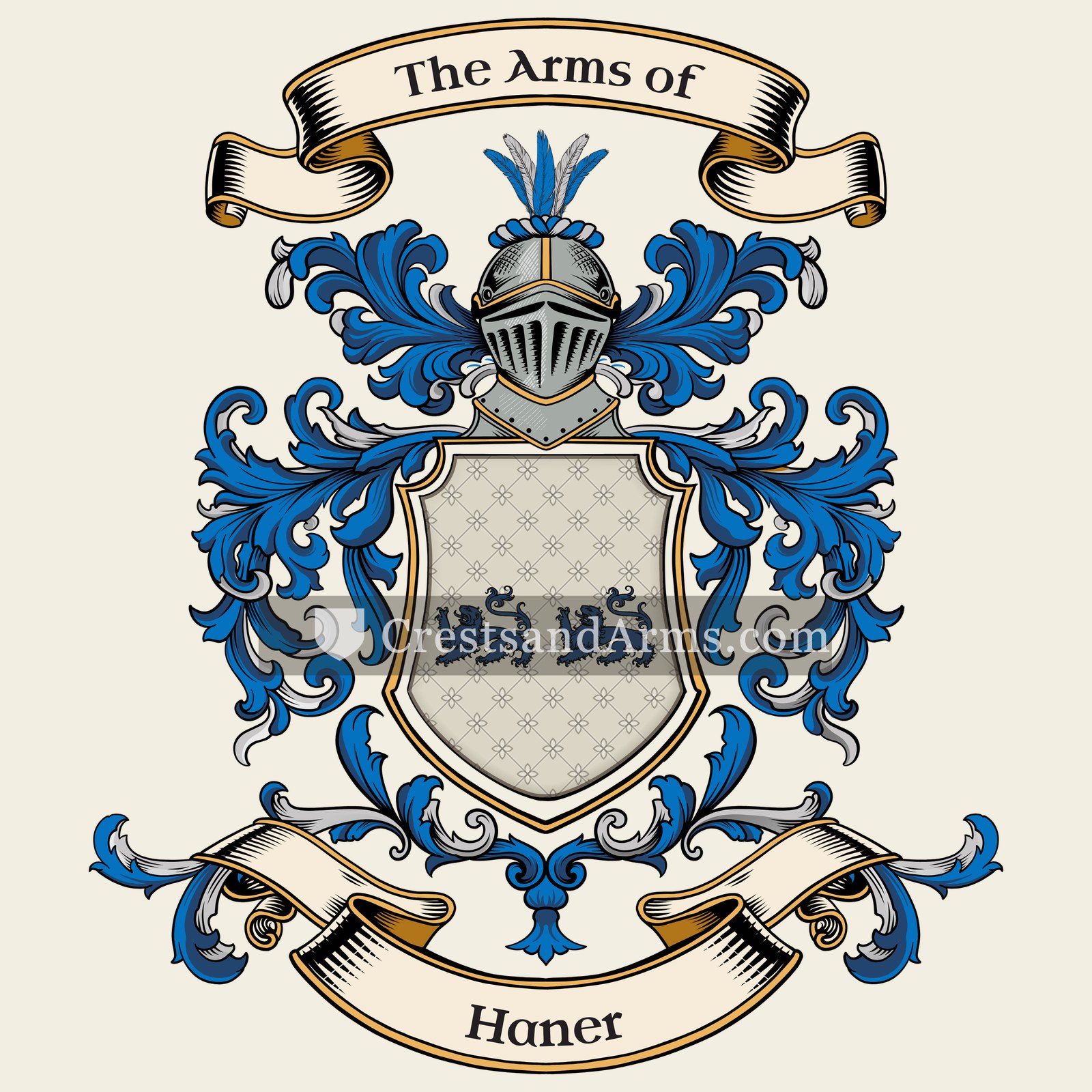
lionCourage, strength and royalty
Colours
Silver (Argent)Means: Peace and sincerity
Blue (Azure)Means: Loyalty and truth
Historical info
Source
J. B. Rietstap, Armorial Général, Gouda: G. B. van Goor Zonen, 1884–87
Blazon (the actual original written record)
“D'arg. à deux léopards d'azur, arm. et lamp. de gu., l'un sur l'autre. C.: un léopard d'arg., assis sur un chapeau de tournoi de gu., retr. d'herm. S.: à dextre un cygne d'arg. et à sen. une cigogne au nat., tenant chacun au bec une rose de gu., tigée et feuillée de sin. D.: GARDEZ L'HONNEUR.”
Francec. 1725
Digital archive packCoat of arms PNG, gold border print PDF, vector SVG and the certificate of authenticity. Sent to your email in minutes.
Map of France showing where the Haner arms are recorded
The Haner arms were recorded in France, c. 1725.
Arms such as these were typically recorded in Bretagne.
More families held coats of arms in Bretagne than anywhere else in France. The land was divided into many small estates rather than a few large ones, so far more households counted as gentry, and each needed a shield of its own to be told apart.
This is where the arms were entered in the register. Families often moved to other parts of the country, so the same name can turn up in more than one region.
The body that granted and recorded arms in France in this period.
Louis XV of France
Sovereign of the period
Louis XV of France
1715–1774
Reigning in France when the Haner arms are first recorded.
How Arms Worked in France
In France, a coat of arms was a mark of honor that passed down through the male line to all legitimate descendants. Families often used the same shield without changes to show their shared heritage. If a branch wanted to stand out, they could add a small mark to their shield to show their specific place in the family tree.
Granting authority
The Juge d'armes de France acted as the official authority that regulated and verified coats of arms across the country.
How they got arms
Families typically inherited their arms from ancestors, though they could also receive them through royal grants or by proving their noble status.
Where arms were recorded
Coats of arms were officially recorded in the Armorial Général de France, which began its main collection in the year 1696.
The family's standing
Recorded among the armigerous families of France.
Origin & History of the Haner Family in France
The history of the Haner family in France is rooted in the rugged and culturally distinct region of Bretagne. By 1725, records confirm that members of the family were already well-established within this coastal province. During this era, Bretagne functioned with a unique sense of autonomy, and families living there often maintained strong ties to local maritime industries or agricultural traditions. The name Haner likely evolved through the blending of regional dialects and the phonetic shifts common in the eighteenth century. Because the region was a crossroads for trade and migration, the family name reflects the deep historical connection between the people of Bretagne and the broader movements of Northern Europe. These early ancestors were part of a resilient society that valued community ties and local identity, helping the family name persist through generations in the western reaches of France.
Coat of Arms & Family Crest Details
Symbols on this shield
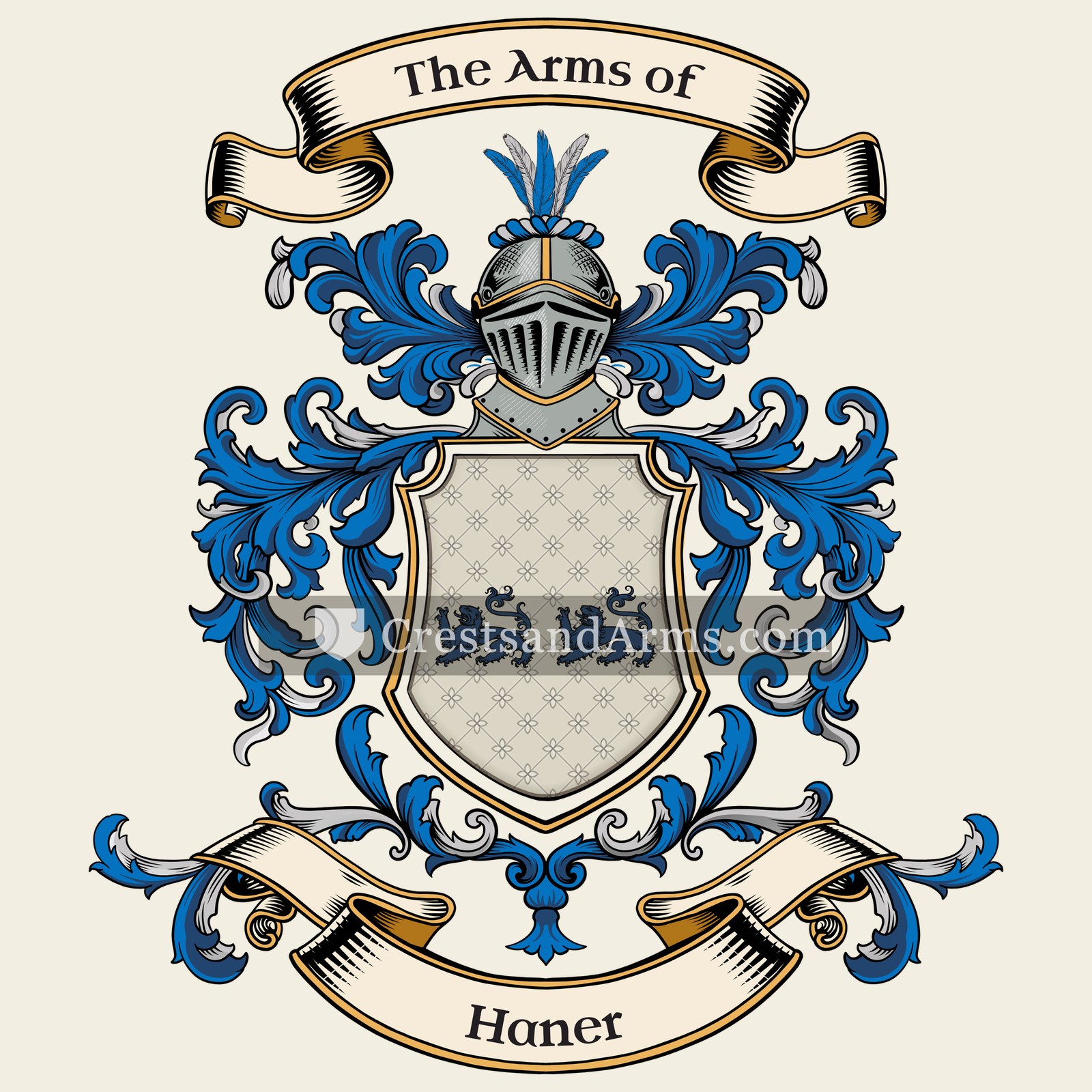
lionCourage, strength and royalty
Colours
Silver (Argent)Means: Peace and sincerity
Blue (Azure)Means: Loyalty and truth
Historical info
Source
Sir Bernard Burke, The General Armory of England, Scotland, Ireland and Wales, London: Harrison & Sons, 1884
Blazon (the actual original written record)
“Ar. two lions pass. guard. az. armed and langued gu”
Walesc. 1647
Digital archive packCoat of arms PNG, gold border print PDF, vector SVG and the certificate of authenticity. Sent to your email in minutes.
Map of Wales showing where the Haner arms are recorded
The Haner arms were recorded in Wales, c. 1647.
Arms such as these were typically recorded in Denbigh.
Denbighshire was north Welsh country of hills and small estates. Land was held by a great many families rather than a few, and each holding brought its own claim to a coat of arms.
This is where the arms were entered in the register. Families often moved to other parts of the country, so the same name can turn up in more than one region.
The body that granted and recorded arms in Wales in this period.
Charles I of England
Sovereign of the period
Charles I of England
1625–1649
Reigning in France when the Haner arms are first recorded.
How Arms Worked in Wales
English heraldry allowed arms to be shared by all legitimate descendants of the original owner. These symbols were treated as personal property that moved through the generations to all children. While the eldest son kept the original design, other family members could use the same shield without needing to change it or register their own unique versions.
Granting authority
The College of Arms in London has regulated the use of coats of arms throughout England and Wales since 1484.
How they got arms
Families typically obtained their coats of arms through a formal grant from the Crown or by proving their ancient right to them.
Where arms were recorded
All official coats of arms are recorded in the registers kept at the College of Arms, which date back to the fifteenth century.
The family's standing
Recorded among the armigerous families of Wales.
Origin & History of the Haner Family in Wales
The history of the Haner name in Wales is deeply rooted in the rugged landscape of Denbighshire. By the mid-seventeenth century, the family had established a documented presence in the town of Denbigh, a location known for its strategic importance and its medieval castle. During this period, families in North Wales often lived in tight-knit communities where surnames were still evolving from traditional patronymic naming customs. The Haners likely navigated a society transitioning from the influence of the Welsh language to the increasing administrative reach of the English legal system. Living in Denbigh in 1647 meant the family witnessed a time of great political unrest during the aftermath of the English Civil War. As local residents, they would have been part of a regional identity defined by the market towns and rural parishes that shaped the social fabric of the Vale of Clwyd for generations.
Coat of Arms & Family Crest Details
Symbols on this shield
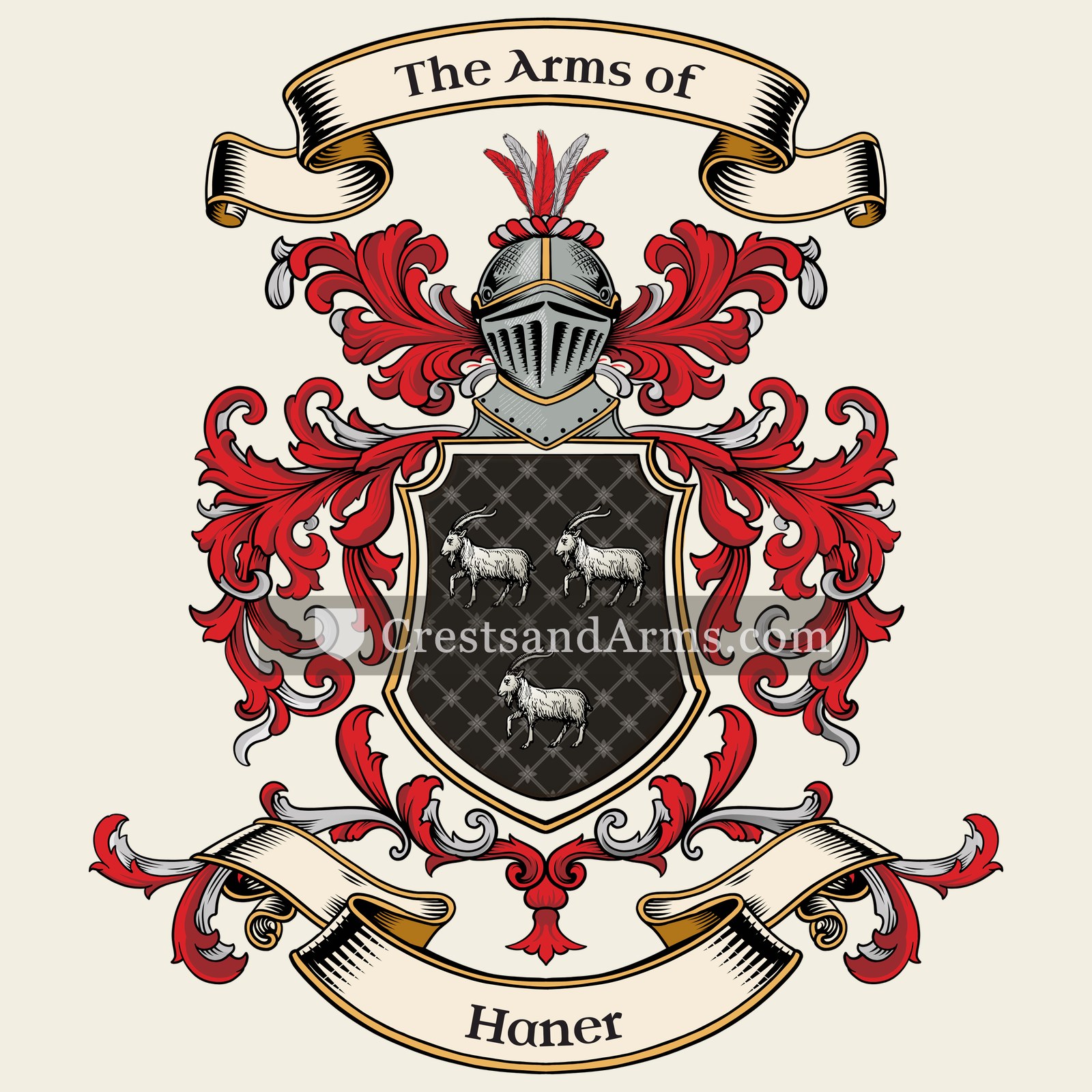
goatOne who wins by diplomacy rather than force
Colours
Black (Sable)Means: Constancy
Silver (Argent)Means: Peace and sincerity
Historical info
Source
Sir Bernard Burke, The General Armory of England, Scotland, Ireland and Wales, London: Harrison & Sons, 1884
Blazon (the actual original written record)
“Sa. three goats pass. ar”
SalopElweny Maptis · Salop, c. 1620
Digital archive packCoat of arms PNG, gold border print PDF, vector SVG and the certificate of authenticity. Sent to your email in minutes.
Map of England showing where the Haner arms are recorded
The Haner arms were recorded in Salop, c. 1620.
Shropshire lay on the Welsh border, and border country needed men who could fight. Families held their land in return for service, and service in arms is what a coat of arms was originally for.
This is where the arms were entered in the register. Families often moved to other parts of the country, so the same name can turn up in more than one region.
The body that granted and recorded arms in England in this period.
James VI and I
Sovereign of the period
James VI and I
1603–1625
Reigning in France when the Haner arms are first recorded.
How Arms Worked in England
English heraldry allowed arms to be shared by all legitimate descendants of the original owner. These symbols were treated as personal property that moved through the generations to all children. While the eldest son kept the original design, other family members could use the same shield without needing to change it or register their own unique versions.
Granting authority
The College of Arms in London has regulated the use of coats of arms throughout England and Wales since 1484.
How they got arms
Families typically obtained their coats of arms through a formal grant from the Crown or by proving their ancient right to them.
Where arms were recorded
All official coats of arms are recorded in the registers kept at the College of Arms, which date back to the fifteenth century.
The family's standing
Recorded among the armigerous families of Salop.
Origin & History of the Haner Family in England
The surname Haner first appears in the historical record of Shropshire, or Salop, during the early seventeenth century. By 1620, families bearing this name were established within the county, likely living as tenant farmers or tradespeople in the rural landscape of the English West Midlands. During this era, Shropshire served as a vital crossroads between the Welsh borderlands and the industrializing towns of central England. The name itself likely evolved as a descriptive term for a person’s occupation or their specific place of residence in the local dialect. As these early families navigated the social changes of the Stuart period, they contributed to the local economy through agriculture and small-scale craft production. Their presence in the parish registers of the time provides a clear link to the regional history of the area, marking them as part of the stable, working population that defined the character of rural Shropshire before the onset of the Industrial Revolution.
Haner Meaning & Related Branches
Root word
Hahn
Germanic word for a male chicken or rooster.
This name
HanerAn occupational surname for a person who raised or sold roosters.
also spelled
Hannmer
Hanmere
Hanmmer
Hanmar
Documented Sources
J. B. Rietstap, Armorial Général, Gouda: G. B. van Goor Zonen, 1884–87
Archives départementales du Finistère, Registres paroissiaux et d'état civil, 1725
Gautier, Hervé, Histoire de la Bretagne, 1998
Le Goff, Jean, Les noms de famille en Bretagne, 2005
Digital archive packCoat of arms PNG, gold border print PDF, vector SVG and the certificate of authenticity. Sent to your email in minutes.


 lionCourage, strength and royalty
 lionCourage, strength and royalty




 goatOne who wins by diplomacy rather than force