Map of France showing where the Hanks arms are recorded
The Hanks arms were recorded in Strasbourg, c. 1663.
This is where the arms were entered in the register. Families often moved to other parts of the country, so the same name can turn up in more than one region.
The body that granted and recorded arms in France in this period.
Louis XIV of France
Sovereign of the period
Louis XIV of France
1643–1715
Reigning in France when the Hanks arms are first recorded.
How Arms Worked in France
In France, a coat of arms was a mark of honor that passed down through the male line to all legitimate descendants. Families often used the same shield without changes to show their shared heritage. If a branch wanted to stand out, they could add a small mark to their shield to show their specific place in the family tree.
Granting authority
The Juge d'armes de France acted as the official authority that regulated and verified coats of arms across the country.
How they got arms
Families typically inherited their arms from ancestors, though they could also receive them through royal grants or by proving their noble status.
Where arms were recorded
Coats of arms were officially recorded in the Armorial Général de France, which began its main collection in the year 1696.
The family's standing
Recorded among the armigerous families of France.
Origin & History of the Hanks Family in France
The family name Hanks has roots that stretch into the complex history of the Alsace region in France. By the year 1663, records confirm that members of the family were living in Strasbourg, a city that served as a vital crossroads between French and German cultures. During this era, Strasbourg was a place of significant religious and political transition, often caught between the shifting borders of neighboring powers. Families living there during the seventeenth century frequently navigated a unique blend of linguistic and social traditions, as the region moved toward closer integration with the French crown. The presence of the Hanks name in these early civic documents suggests that the family was part of the established urban community during a time of great regional change. This historical setting highlights how the family name became embedded in the local landscape long before later migrations carried it to other parts of the world.
Coat of Arms & Family Crest Details
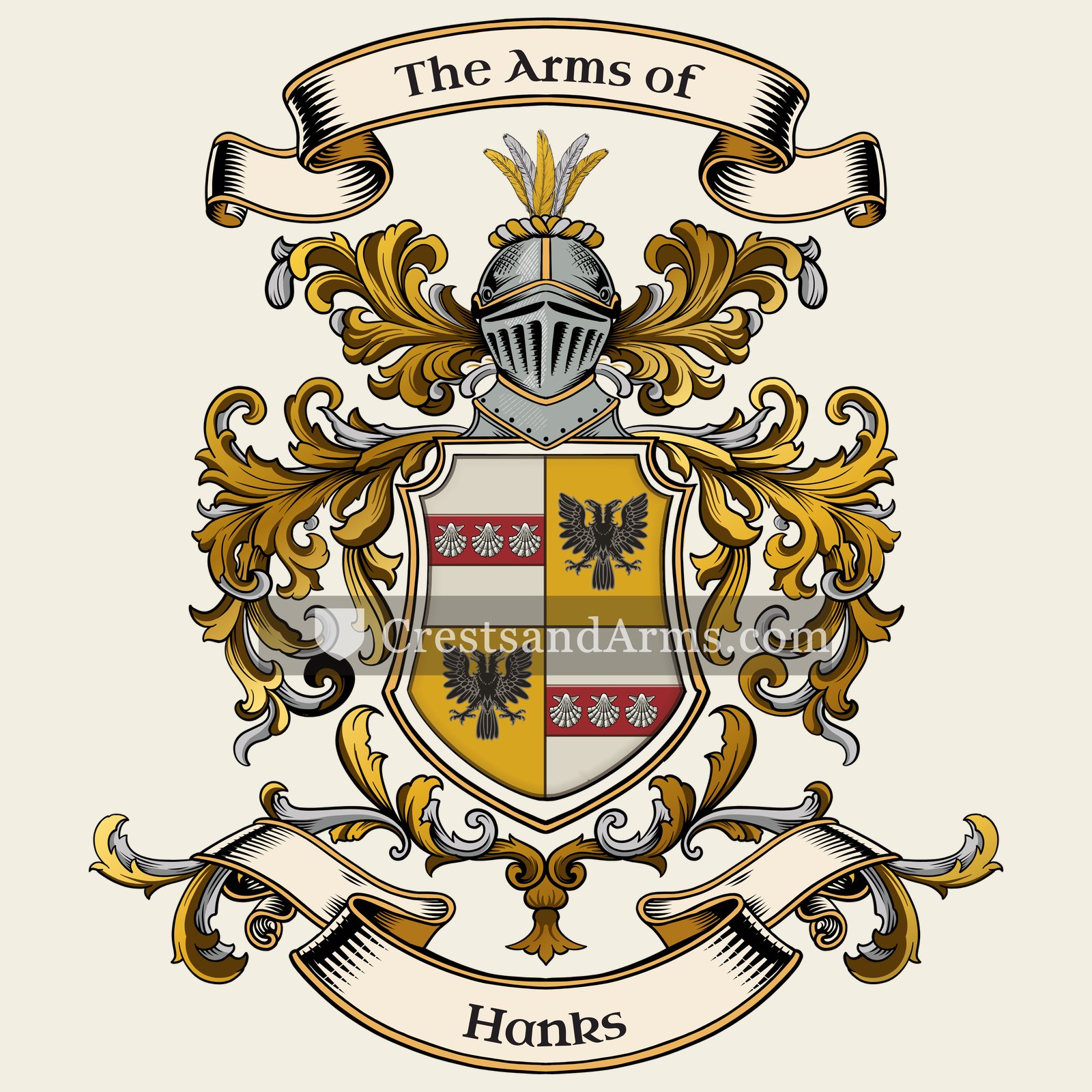
Symbols on this shield
fessThe military belt, and readiness to serve
escallopThe pilgrim's shell, and a long journey made
eagleNobility, strength and a keen mind
Colours
Silver (Argent)Means: Peace and sincerity
Gold (Or)Means: Generosity
Red (Gules)Means: Military strength
Black (Sable)Means: Constancy
Historical info
Source
J. B. Rietstap, Armorial Général, Gouda: G. B. van Goor Zonen, 1884–87
Blazon (the actual original written record)
“Éc.: aux 1 et 4 d'arg. à la fasce de gu., ch. de trois coquilles d'arg.; aux 2 et 3 d'or à la demi-aigle de sa., cour. d'or, mouv. du parti. Cq. cour. C.: une aigle de sa., cour. d'or. L.: à dextre d'arg. et de gu., à sen. d'or et de sa.”
Switzerlandc. 1745
Digital archive packCoat of arms PNG, gold border print PDF, vector SVG and the certificate of authenticity. Sent to your email in minutes.
Map of Switzerland showing where the Hanks arms are recorded
The Hanks arms were recorded in Switzerland, c. 1745.
Arms such as these were typically recorded in Bern.
Bern was the largest of the Swiss cantons and ran itself, with its own council and its own courts. Its governing families held office for generations, and office of that kind carried a shield with it.
This is where the arms were entered in the register. Families often moved to other parts of the country, so the same name can turn up in more than one region.
The body that granted and recorded arms in Switzerland in this period.
How Arms Worked in Switzerland
In Switzerland, coats of arms were not restricted to the nobility and were often adopted by common citizens and families. These symbols were passed down through generations to show family identity. When branches of a family grew, they often changed small details of the design to distinguish their own line from the original group.
Granting authority
Cantonal and civic authorities managed the use of coats of arms within their specific regions and local jurisdictions.
How they got arms
Families typically assumed their own coats of arms based on local custom rather than receiving them from a central monarch.
Where arms were recorded
Arms were recorded in various cantonal and civic registers starting from the fourteenth century throughout the Swiss region.
The family's standing
Recorded among the armigerous families of Switzerland.
Origin & History of the Hanks Family in Switzerland
The history of the Hanks family in Switzerland is deeply rooted in the social and religious landscape of the eighteenth century. By 1745, records confirm that members of the family were established in the canton of Bern, a region known for its strict administrative oversight and detailed record-keeping. During this era, families like the Hanks were often integrated into the local agricultural or craft-based economy, living under the influence of the Reformed Church which governed much of daily life. The name itself likely evolved from regional Germanic dialects, serving as a way to identify individuals within their specific village communities. As residents of Bern, these early family members navigated a society defined by communal responsibilities and the transition toward the modern era. Their presence in the city archives reflects a time when the Swiss cantons were solidifying their bureaucratic structures, ensuring that every family was accounted for in the local registries.
Related Branches & Arms
Root word
Jehan
The Hebrew name Yohanan meaning God is gracious.
This name
HanksA patronymic surname derived from a diminutive form of John, signifying son of little John.
also spelled
Hanz
Hannes
Hantz
Documented Sources
J. B. Rietstap, Armorial Général, Gouda: G. B. van Goor Zonen, 1884–87
Archives de la Ville et de l'Eurométropole de Strasbourg, Registres paroissiaux de Strasbourg (1663)
Livet, Georges, Histoire de Strasbourg des origines à nos jours, 1981
Digital archive packCoat of arms PNG, gold border print PDF, vector SVG and the certificate of authenticity. Sent to your email in minutes.


 chevronProtection, and faithful service completed
 chevronProtection, and faithful service completed


 fessThe military belt, and readiness to serve
 escallopThe pilgrim's shell, and a long journey made
 eagleNobility, strength and a keen mind