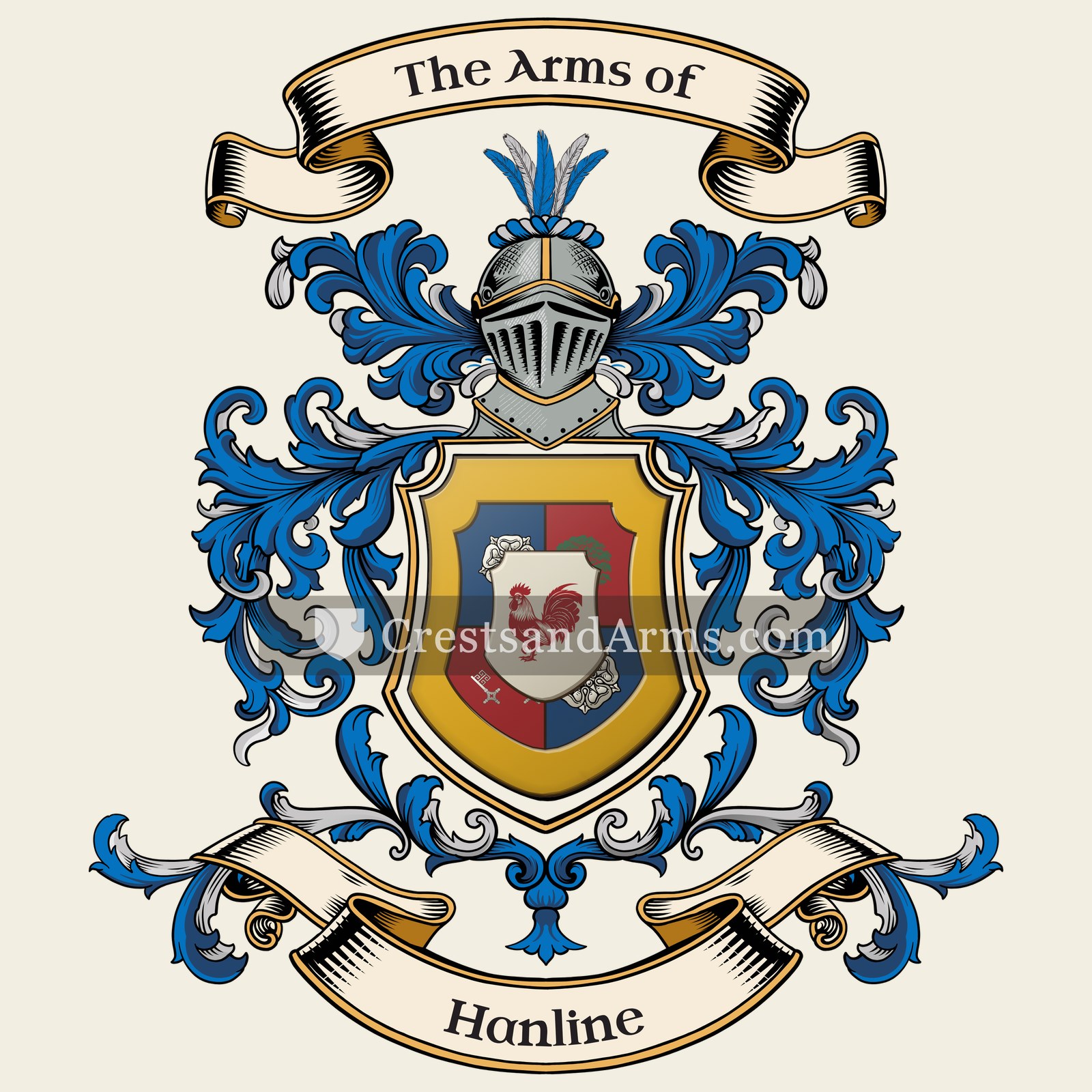
A record of documented arms, meaning and origin, researched for the Hanline family of Germany.
Reg. 2187 · German, G–I
Coat of Arms & Family Crest Details
Symbols on this shield
saltireResolution, and St Andrew's cross
cockCourage, vigilance and readiness for battle
roseThe seventh son, and beauty with grace
treeLife, endurance and deep roots
keyGuardianship, and the office of a steward
Colours
Blue (Azure)Means: Loyalty and truth
Red (Gules)Means: Military strength
Silver (Argent)Means: Peace and sincerity
Gold (Or)Means: Generosity
Green (Vert)Means: Hope
Historical info
Source
J. B. Rietstap, Armorial Général, Gouda: G. B. van Goor Zonen, 1884–87
Blazon (the actual original written record)
“Ec.: aux 1 et 4 d'azur à une rose d'arg., bout. d'or, barbée de sin.; au 2 de gu. à une branche de chêne de sin. en bande, englantée de deux pièces d'or; au 3 de gu. à deux clés d'arg., passées en saut. L'écu bordé d'or. Sur le tout d'arg. à un coq hardi et cont. de gu. C.: 1º le coq; 2º un vol de sa.”
Germanyc. 1803
Where the Hanline Arms Were Recorded
Bavaria
Map of Germany showing where the Hanline arms are recorded
The Hanline arms were recorded in Germany, c. 1803.
Arms such as these were typically recorded in Bavaria.
Bavaria was a country of old landed families and walled market towns. Estates passed down the same line for centuries, and both the landowners and the leading townsmen kept arms, which is why so many Bavarian names sit in the registers.
This is where the arms were entered in the register. Families often moved to other parts of the country, so the same name can turn up in more than one region.
The body that granted and recorded arms in Germany in this period.
Francis II, Holy Roman Emperor
Sovereign of the period
Francis II, Holy Roman Emperor
1792–1806
Reigning in Germany when the Hanline arms are first recorded.
How Arms Worked in Germany
In the Holy Roman Empire, coats of arms were often granted to individuals by the Emperor or his representatives. These arms were then passed down through the generations to all legitimate descendants of the original holder. Younger branches of a family usually kept the same shield design without needing to change it, as the arms belonged to the entire lineage.
Granting authority
The Holy Roman Emperor held the sole power to grant new coats of arms throughout his vast imperial territories.
How they got arms
Families typically obtained their coats of arms through a formal imperial grant or by proving their noble status to the authorities.
Where arms were recorded
These grants were officially recorded in the Imperial Chancery registers, which began keeping formal records of such honors during the Middle Ages.
The family's standing
Recorded among the armigerous families of Germany.
Origin & History of the Hanline Family in Germany
The family name Hanline is deeply rooted in the historical landscape of Bavaria, where records confirm the presence of family members as early as 1803. During this period, the region was undergoing significant political change as it transitioned from a collection of smaller territories into a unified kingdom. Families living in rural Bavarian districts were often tied to the land through agriculture or specialized local trades, which helped shape their social standing and community identity. As the Napoleonic Wars reshaped Europe, the Hanline ancestors lived through a time of intense administrative reform that required more formal record-keeping by local parishes and government offices. This shift in documentation helped solidify the spelling and recognition of the name within the region. By remaining in the Bavarian heartland during these formative years, the early Hanline family became part of the enduring cultural fabric of Southern Germany before many individuals eventually sought new opportunities abroad.
Related Branches & Arms
Root word
Johannes
God is gracious
This name
HanlineA diminutive form referring to a descendant or follower of John
also spelled
Haenleine
Hanline
Henline
Documented Sources
J. B. Rietstap, Armorial Général, Gouda: G. B. van Goor Zonen, 1884–87


 saltireResolution, and St Andrew's cross
 cockCourage, vigilance and readiness for battle
 roseThe seventh son, and beauty with grace
 treeLife, endurance and deep roots
 keyGuardianship, and the office of a steward
 saltireResolution, and St Andrew's cross
 cockCourage, vigilance and readiness for battle
 roseThe seventh son, and beauty with grace
 treeLife, endurance and deep roots
 keyGuardianship, and the office of a steward