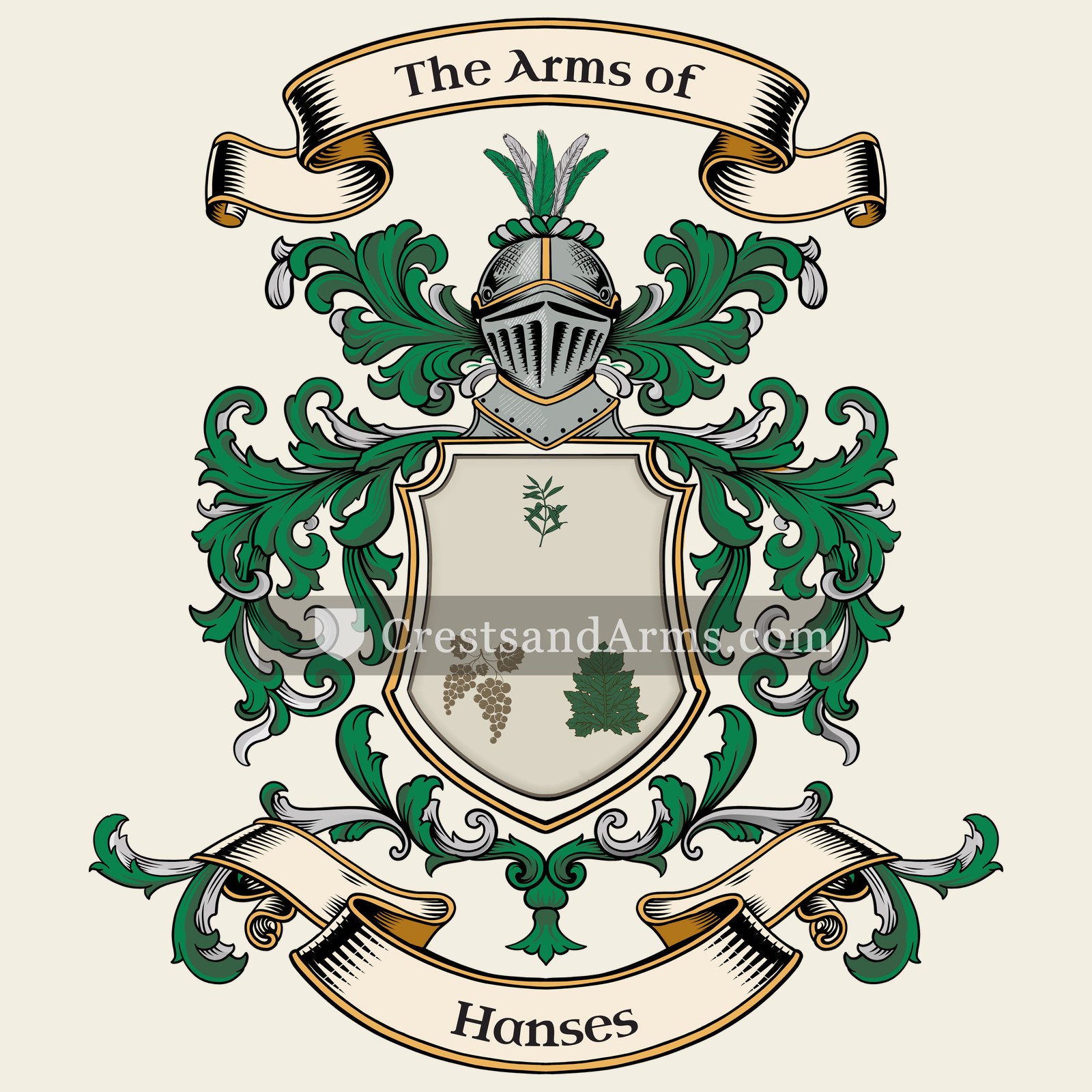
A record of documented arms, meaning and origin, researched for the Hanses family of Germany.
Reg. 4924 · German, G–I
Coat of Arms & Family Crest Details
Symbols on this shield
grapesPlenty, and the labour of the vine
leafHappiness and abundance
branchPeace, and new growth
Colours
Silver (Argent)Means: Peace and sincerity
Green (Vert)Means: Hope
Historical info
Source
J. B. Rietstap, Armorial Général, Gouda: G. B. van Goor Zonen, 1884–87
Blazon (the actual original written record)
“D'arg. à une grappe de raisins au nat., pamprée d'une seule pièce de sin. à dextre, suspendue à un chicot de sin., en chef, posé en fasce. C.: les meubles de l'écu, renversés. L.: d'arg. et de gu.”
GermanyHambourg, c. 1690
Where the Hanses Arms Were Recorded
Hambourg
Map of Germany showing where the Hanses arms are recorded
The Hanses arms were recorded in Hambourg, c. 1690.
This is where the arms were entered in the register. Families often moved to other parts of the country, so the same name can turn up in more than one region.
The body that granted and recorded arms in Germany in this period.
Leopold I, Holy Roman Emperor
Sovereign of the period
Leopold I, Holy Roman Emperor
1658–1705
Reigning in Germany when the Hanses arms are first recorded.
How Arms Worked in Germany
In the Holy Roman Empire, coats of arms were often granted to individuals by the Emperor or his representatives. These arms were then passed down through the generations to all legitimate descendants of the original holder. Younger branches of a family usually kept the same shield design without needing to change it, as the arms belonged to the entire lineage.
Granting authority
The Holy Roman Emperor held the sole power to grant new coats of arms throughout his vast imperial territories.
How they got arms
Families typically obtained their coats of arms through a formal imperial grant or by proving their noble status to the authorities.
Where arms were recorded
These grants were officially recorded in the Imperial Chancery registers, which began keeping formal records of such honors during the Middle Ages.
The family's standing
Recorded among the armigerous families of Germany.
Origin & History of the Hanses Family in Germany
The surname Hanses is a patronymic name, which means it originated from a shortened version of the given name Johannes. By the late 17th century, the name was well-established in the bustling port city of Hamburg. In 1690, families bearing this name were active participants in the city’s vibrant merchant culture, benefiting from Hamburg’s status as a major hub for trade across Northern Europe. Because Hamburg was a center for international commerce, individuals named Hanses likely worked in industries related to shipping, banking, or the craft guilds that defined the city’s economy. Over time, the name evolved from a simple reference to a father named Hans into a permanent family identifier that was passed down through generations as these families settled into the social and economic life of the region.
Related Branches & Arms
Root word
Johannes
Hebrew origin meaning Yahweh is gracious.
This name
HansesA patronymic form derived from the diminutive Hans, signifying son of John.
also spelled
Hansess
Hansese
Documented Sources
J. B. Rietstap, Armorial Général, Gouda: G. B. van Goor Zonen, 1884–87
Staatsarchiv Hamburg, Kirchenbücher der Hamburger Gemeinden (1690)
Brepohl, Wilhelm, Der Aufbau der hamburgischen Bevölkerung, 1938
Zoder, Rudolf, Familiennamen in Ostfalen, 1968
Digital archive packCoat of arms PNG, gold border print PDF, vector SVG and the certificate of authenticity. Sent to your email in minutes.


 grapesPlenty, and the labour of the vine
 leafHappiness and abundance
 branchPeace, and new growth
 grapesPlenty, and the labour of the vine
 leafHappiness and abundance
 branchPeace, and new growth