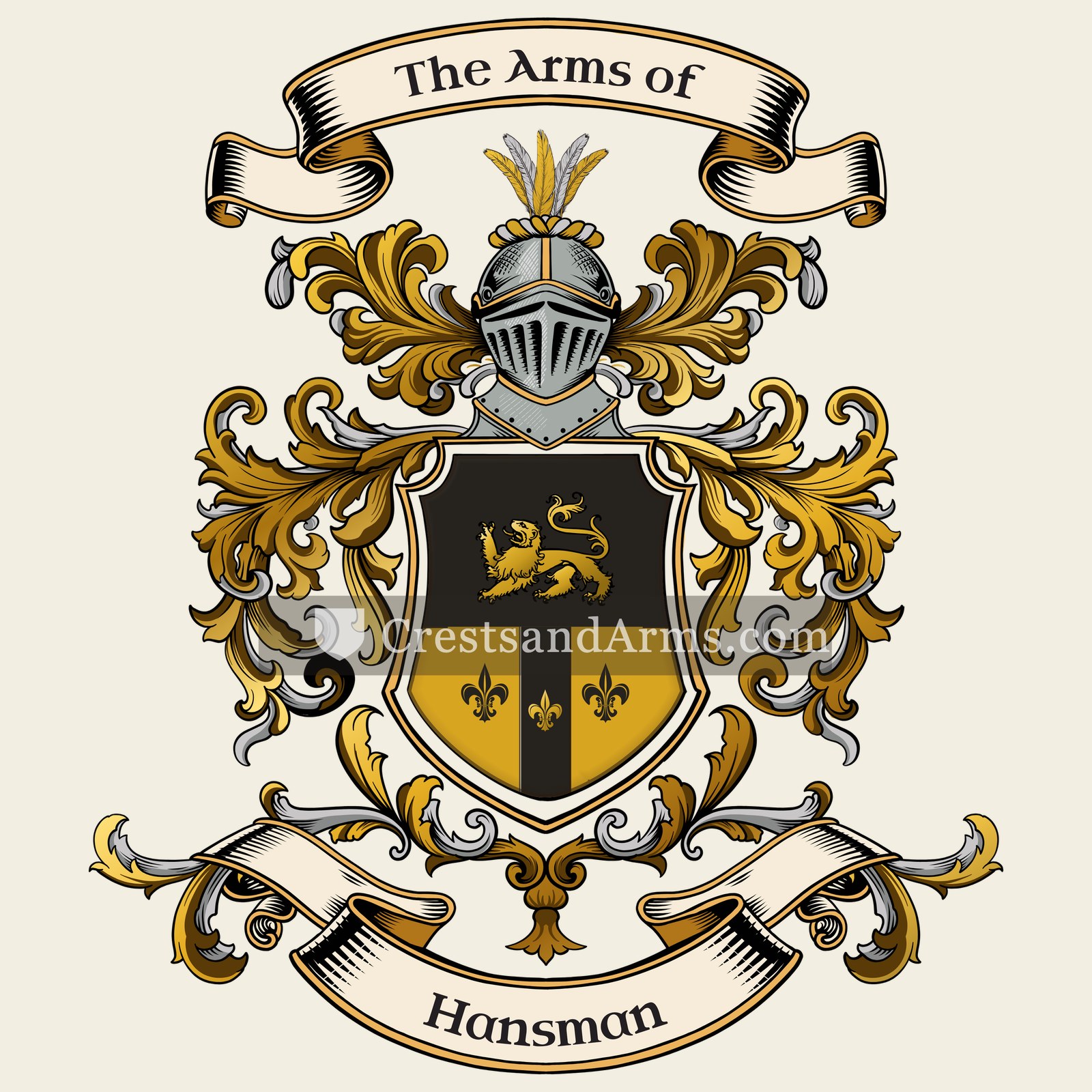
A record of documented arms, meaning and origin, researched for the Hansman family of Germany.
Reg. 9851 · German, G–I
Coat of Arms & Family Crest Details
Symbols on this shield
paleMilitary strength, and a fortified defence
fessThe military belt, and readiness to serve
lionCourage, strength and royalty
fleur de lisPurity, light, and the sixth son
Colours
Black (Sable)Means: Constancy
Gold (Or)Means: Generosity
Historical info
Source
J. B. Rietstap, Armorial Général, Gouda: G. B. van Goor Zonen, 1884–87
Blazon (the actual original written record)
“Coupé: au 1 de sa. au lion léopardé d'or, tenant une fleur-de-lis du même; au 2 d'or au pal de sa., ch. d'une fleur-de-lis du champ et accosté de deux fleurs-de-lis du sec. Cq. cour. C.: un sauvage iss. de carn., cour. d'or, ceint de lierre, tenant de sa main dextre une fleur-de-lis héraldique d'arg., tigée du même, et de sa sen. un drapeau de sa., ch. de deux fasces d'or.”
GermanyRatisbonne, c. 1654
Where the Hansman Arms Were Recorded
Ratisbonne
Map of Germany showing where the Hansman arms are recorded
The Hansman arms were recorded in Ratisbonne, c. 1654.
This is where the arms were entered in the register. Families often moved to other parts of the country, so the same name can turn up in more than one region.
The body that granted and recorded arms in Germany in this period.
Ferdinand III, Holy Roman Emperor
Sovereign of the period
Ferdinand III, Holy Roman Emperor
1637–1657
Reigning in Germany when the Hansman arms are first recorded.
How Arms Worked in Germany
In the Holy Roman Empire, coats of arms were often granted to individuals by the Emperor or his representatives. These arms were then passed down through the generations to all legitimate descendants of the original holder. Younger branches of a family usually kept the same shield design without needing to change it, as the arms belonged to the entire lineage.
Granting authority
The Holy Roman Emperor held the sole power to grant new coats of arms throughout his vast imperial territories.
How they got arms
Families typically obtained their coats of arms through a formal imperial grant or by proving their noble status to the authorities.
Where arms were recorded
These grants were officially recorded in the Imperial Chancery registers, which began keeping formal records of such honors during the Middle Ages.
The family's standing
Recorded among the armigerous families of Germany.
Origin & History of the Hansman Family in Germany
The family name Hansman traces its roots to the Germanic regions of Central Europe, where it functioned as a patronymic surname derived from the common name Hans. In the mid-seventeenth century, the family established a notable presence in the city of Ratisbonne, which is known today as Regensburg. During the year 1654, this city served as the site of the Perpetual Diet of the Holy Roman Empire, a major political assembly that drew diplomats and officials from across the continent. Living in such a significant urban center suggests that early members of the Hansman family were likely integrated into the professional or merchant classes that supported the city’s administrative functions. As the name spread through the region, it evolved alongside the local dialects, eventually becoming a distinct identifier for families who maintained deep ties to the cultural and political life of the Bavarian territories.
Related Branches & Arms
Root word
Johannes
God is gracious
This name
HansmanA person who served or worked for a man named Hans
also spelled
Hansemann
Hansemann von Lowmansegg
Hansman
Hansemann de Lovmanseg
Documented Sources
J. B. Rietstap, Armorial Général, Gouda: G. B. van Goor Zonen, 1884–87
Bayerisches Hauptstaatsarchiv, Reichstagsakten von 1654
Hofmann, Hanns Hubert, Quellen zur Geschichte des Reichstages in Regensburg, 1964
Stadtarchiv Regensburg, Bürgerbücher der Stadt Regensburg, 1650–1660
Digital archive packCoat of arms PNG, gold border print PDF, vector SVG and the certificate of authenticity. Sent to your email in minutes.


 paleMilitary strength, and a fortified defence
 fessThe military belt, and readiness to serve
 lionCourage, strength and royalty
 fleur de lisPurity, light, and the sixth son
 paleMilitary strength, and a fortified defence
 fessThe military belt, and readiness to serve
 lionCourage, strength and royalty
 fleur de lisPurity, light, and the sixth son