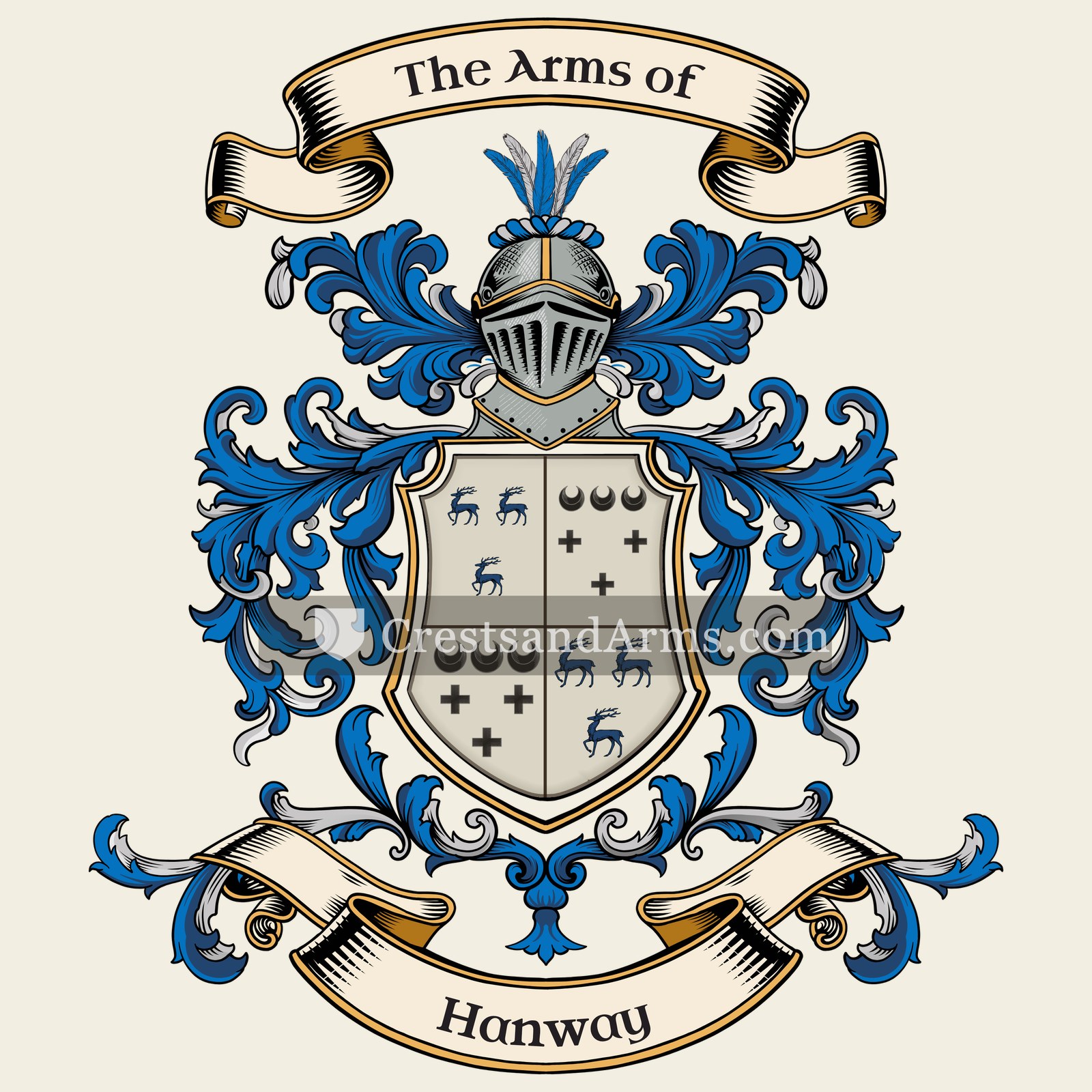
A record of documented arms, meaning and origin, researched for the Hanway family of Scotland.
Reg. 0340 · Scottish, G–I
Coat of Arms & Family Crest Details
Symbols on this shield
cross symbolChristian faith and service
stagPeace and harmony, and one who will not fight unprovoked
crescentHonour by the sovereign, and the second son
Colours
Silver (Argent)Means: Peace and sincerity
Blue (Azure)Means: Loyalty and truth
Black (Sable)Means: Constancy
Historical info
Source
Sir Bernard Burke, The General Armory of England, Scotland, Ireland and Wales, London: Harrison & Sons, 1884
Blazon (the actual original written record)
“Quarterly, 1st and 4th, ar. three roebucks' heads erased az. attired or; 2nd and 3rd, ar. three crescents sa. issuant from each a cross crosslet fitchée of the last”
ScotlandCharles, c. 1661
Where the Hanway Arms Were Recorded
Edinburgh
Map of Scotland showing where the Hanway arms are recorded
The Hanway arms were recorded in Charles, c. 1661.
Arms such as these were typically recorded in Edinburgh.
Edinburgh was the seat of Scotland's government, its courts and its heralds. Families with business there settled nearby, and being close to where arms were recorded is exactly why so many of them appear.
This is where the arms were entered in the register. Families often moved to other parts of the country, so the same name can turn up in more than one region.
The body that granted and recorded arms in Scotland in this period.
Charles II of England
Sovereign of the period
Charles II of England
1660–1685
Reigning in Scotland when the Hanway arms are first recorded.
How Arms Worked in Scotland
Scottish heraldry is unique because it treats a coat of arms as a piece of personal property protected by law. Only one person can own a specific design at any given time. When a family grows, the head keeps the original shield while other relatives must apply for their own distinct version with slight changes to prove their specific identity.
Granting authority
The Court of the Lord Lyon acts as the official body that regulates and controls all heraldic matters throughout Scotland.
How they got arms
Individuals obtain a legal right to their arms through a formal petition process that confirms their identity and family connection.
Where arms were recorded
All valid coats of arms are officially entered into the Public Register of All Arms and Bearings starting from 1672.
The family's standing
Recorded among the armigerous families of Scotland.
Origin & History of the Hanway Family in Scotland
The family name Hanway is deeply rooted in the history of Scotland, with clear evidence of the family residing in Edinburgh by the year 1661. During this period, the city was a bustling center of political and social change, and families like the Hanways were often integrated into the local merchant or trade classes that helped shape the capital. The name itself is thought to be locational in origin, likely derived from an old settlement or a specific path known as a "way." As the family established their roots in Edinburgh, they became part of the urban fabric of the seventeenth century, a time when the city was expanding and formalizing its record-keeping. By studying these early parish and legal documents, historians can trace how the Hanway name moved from local recognition into the broader historical narrative of the Scottish Lowlands.
Related Branches & Arms
Root word
Hean-weg
Old English for high or main path or road.
This name
HanwayRefers to someone who lived near a prominent or high-lying public thoroughfare.
also spelled
Hanwey
Documented Sources
Sir Bernard Burke, The General Armory of England, Scotland, Ireland and Wales, London: Harrison & Sons, 1884
National Records of Scotland, Register of Marriages, Edinburgh, 1661
National Records of Scotland, Register of Baptisms, Edinburgh, 1661
Digital archive packCoat of arms PNG, gold border print PDF, vector SVG and the certificate of authenticity. Sent to your email in minutes.


 cross symbolChristian faith and service
 stagPeace and harmony, and one who will not fight unprovoked
 crescentHonour by the sovereign, and the second son
 cross symbolChristian faith and service
 stagPeace and harmony, and one who will not fight unprovoked
 crescentHonour by the sovereign, and the second son