A record of documented arms, meaning and origin, researched for the Happe family lines. Documented in 2 countries.
Reg. 5588 · German, G–I
Coat of Arms & Family Crest Details
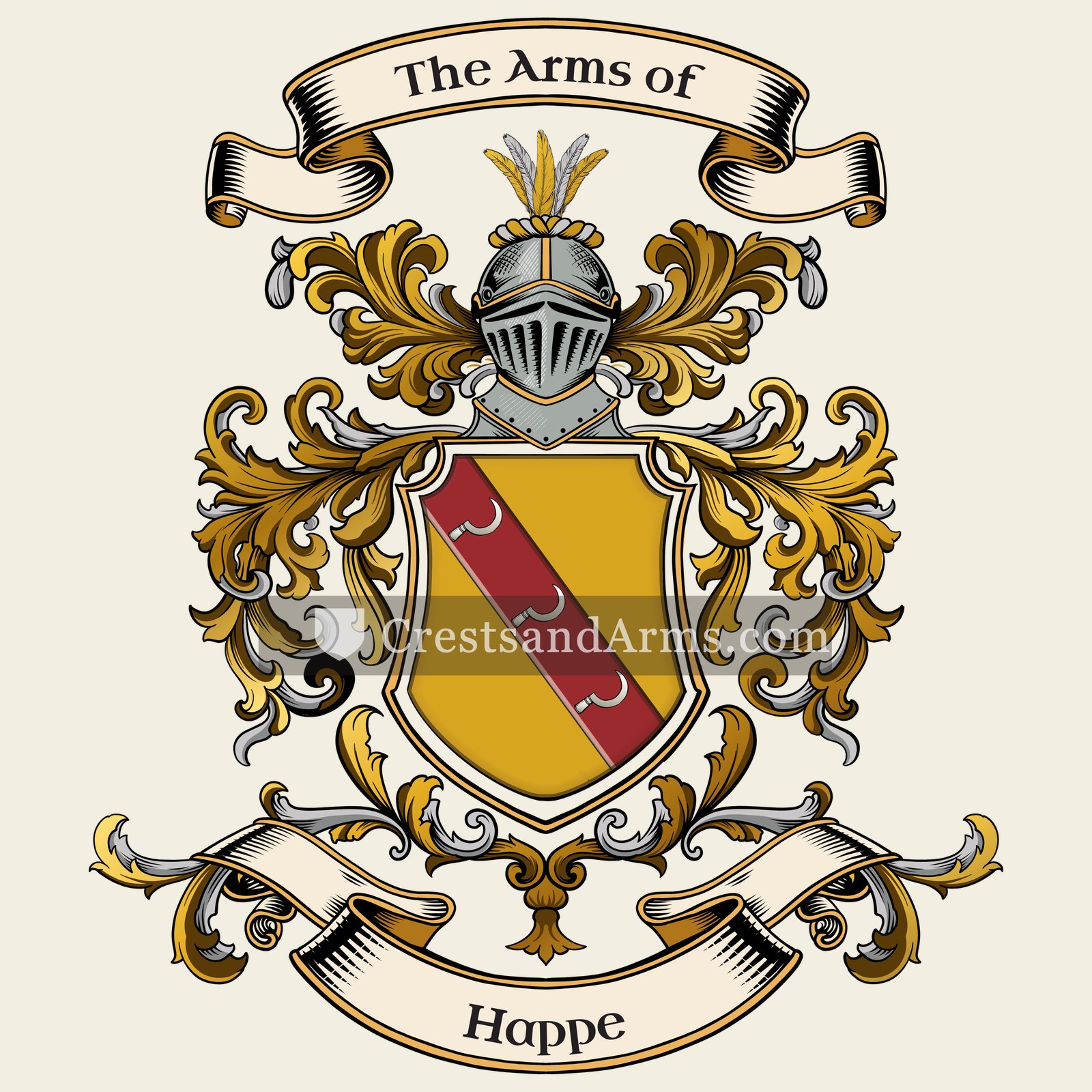
Symbols on this shield
bendDefence, and the scarf of a commander
sickleThe harvest, and the reaping of what was sown
Colours
Gold (Or)Means: Generosity
Red (Gules)Means: Military strength
Silver (Argent)Means: Peace and sincerity
Historical info
Source
J. B. Rietstap, Armorial Général, Gouda: G. B. van Goor Zonen, 1884–87
Blazon (the actual original written record)
“D'or à la bande de gu., ch. de trois faucilles d'arg., emm. d'or, posées en barres, le tranchant à dextre. C.: un bonnet albanais de gu., retr. d'arg. l. d'or et de gu.”
Germanyc. 1698
Where the Happe Arms Were Recorded
Bavaria
Map of Germany showing where the Happe arms are recorded
The Happe arms were recorded in Germany, c. 1698.
Arms such as these were typically recorded in Bavaria.
Bavaria was a country of old landed families and walled market towns. Estates passed down the same line for centuries, and both the landowners and the leading townsmen kept arms, which is why so many Bavarian names sit in the registers.
This is where the arms were entered in the register. Families often moved to other parts of the country, so the same name can turn up in more than one region.
The body that granted and recorded arms in Germany in this period.
Leopold I, Holy Roman Emperor
Sovereign of the period
Leopold I, Holy Roman Emperor
1658–1705
Reigning in Germany when the Happe arms are first recorded.
How Arms Worked in Germany
In the Holy Roman Empire, coats of arms were often granted to individuals by the Emperor or his representatives. These arms were then passed down through the generations to all legitimate descendants of the original holder. Younger branches of a family usually kept the same shield design without needing to change it, as the arms belonged to the entire lineage.
Granting authority
The Holy Roman Emperor held the sole power to grant new coats of arms throughout his vast imperial territories.
How they got arms
Families typically obtained their coats of arms through a formal imperial grant or by proving their noble status to the authorities.
Where arms were recorded
These grants were officially recorded in the Imperial Chancery registers, which began keeping formal records of such honors during the Middle Ages.
The family's standing
Recorded among the armigerous families of Germany.
Origin & History of the Happe Family in Germany
The family name Happe traces its roots to the German-speaking regions of Central Europe, with documented evidence placing members of the family in Bavaria by the year 1698. The name is considered a topographic or descriptive surname, likely derived from the Middle High German word "hap," which was often used to describe a person who was clever, quick, or perhaps someone who lived near a specific type of hook-shaped piece of land. During the late 17th century, Bavaria was a region defined by agricultural traditions and strict social structures, meaning that families like the Happes were typically tied to the land and local village life. As the family established itself in the Bavarian landscape, they became part of the local parish records that tracked births, marriages, and deaths. These early ancestors lived through a period of recovery and rebuilding following the devastation of the Thirty Years' War, which had reshaped the demographics and social organization of the German states. By maintaining their presence in the region, the Happe family integrated into the fabric of Bavarian society, contributing to the local community through trade, farming, and craftsmanship for generations.
Coat of Arms & Family Crest Details
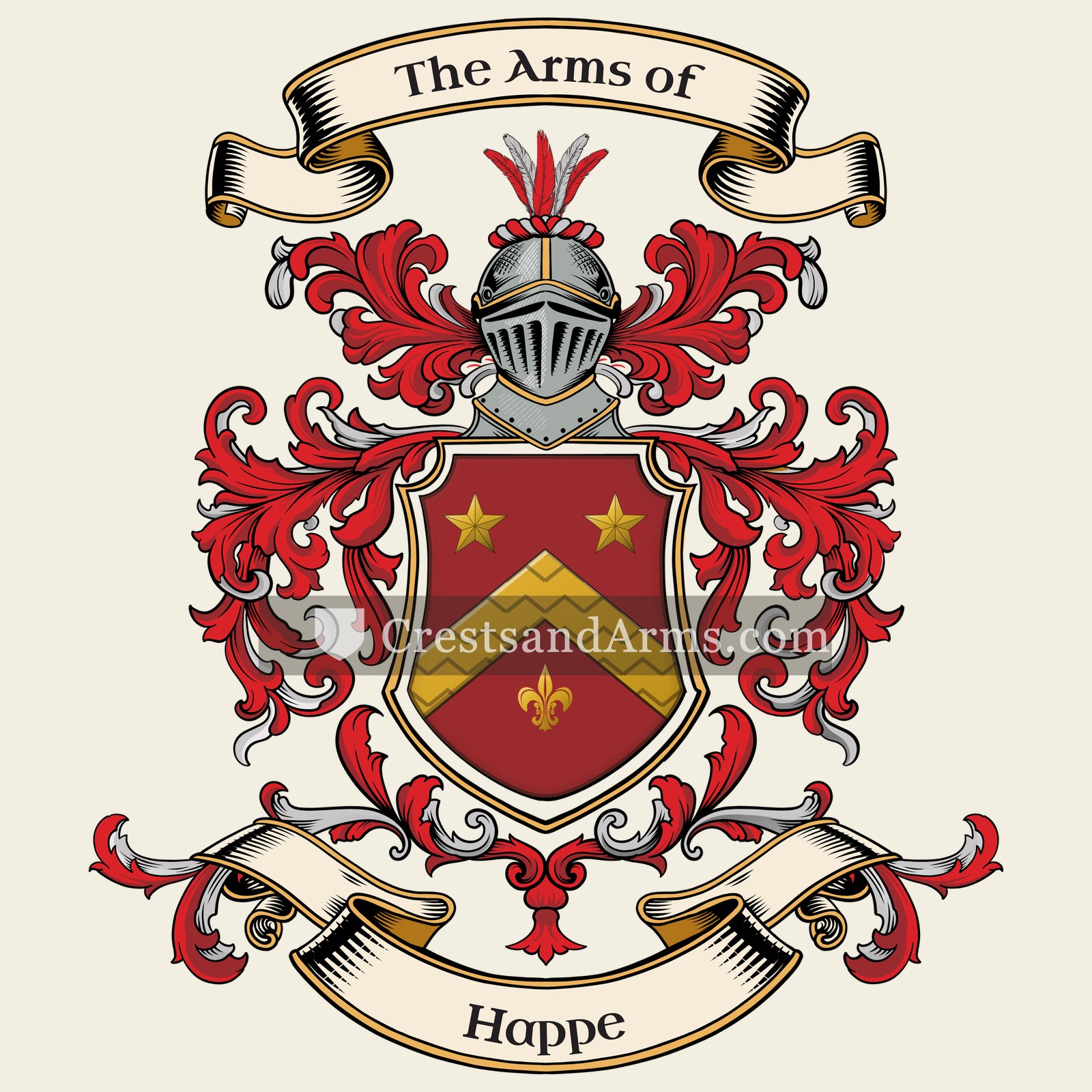
Symbols on this shield
chevronProtection, and faithful service completed
mulletThe third son, and a divine quality from above
fleur de lisPurity, light, and the sixth son
Colours
Red (Gules)Means: Military strength
Gold (Or)Means: Generosity
Historical info
Source
J. B. Rietstap, Armorial Général, Gouda: G. B. van Goor Zonen, 1884–87
Blazon (the actual original written record)
“De gu. au chev., acc. en chef de deux étoiles et en p. d'une fleur-de-lis, le tout d'or. C.: un vol. T.: deux hommes, hab. de jupes à la romaine.”
Netherlandsc. 1815
Where the Happe Arms Were Recorded
Friesland
Map of Netherlands showing where the Happe arms are recorded
The Happe arms were recorded in Netherlands, c. 1815.
Arms such as these were typically recorded in Friesland.
Friesland was low, wet country on the northern coast of the Netherlands, farmed by families who had held the same land for centuries. Free landholders were unusually common there, and a free landholder could carry arms.
This is where the arms were entered in the register. Families often moved to other parts of the country, so the same name can turn up in more than one region.
Region
Friesland
First recorded
1815
Granting Authority for the Happe Arms
Hoge Raad van Adel
Photograph made by me · CC BY-SA 3.0
The body that granted and recorded arms in Netherlands in this period.
William I of the Netherlands
Sovereign of the period
William I of the Netherlands
1815–1840
Reigning in Germany when the Happe arms are first recorded.
How Arms Worked in Netherlands
In the Netherlands, coats of arms were often used by noble families and those who held specific public offices. These arms were passed down through the generations to legitimate descendants. Younger branches of a family usually kept the original design without needing to add special marks. This system ensured that the family identity remained clear and consistent over many years.
Granting authority
The Hoge Raad van Adel is the official body that regulates and manages noble titles and coats of arms in the Netherlands.
How they got arms
Families typically obtained their coats of arms through official royal grants or by proving their long-standing historical use of the symbols.
Where arms were recorded
Coats of arms are officially recorded in the registers held by the Hoge Raad van Adel, which began its work in 1814.
The family's standing
Recorded among the armigerous families of Netherlands.
Origin & History of the Happe Family in Netherlands
The Happe family name has deep roots in the northern regions of the Netherlands, particularly within the province of Friesland. By the early nineteenth century, records confirm that members of the family were well-established in this coastal area, living during a time of significant political transition as the Netherlands emerged as a unified kingdom. The name itself likely originated as a descriptive term or a nickname, which was a common practice for families living in rural communities where local identity was tied to specific trades or personal traits. As the family moved through the nineteenth century, they integrated into the local Frisian society, participating in the agricultural and maritime traditions that defined the region. Their presence in the official census and civil registration records of 1815 serves as a clear starting point for tracing their lineage, marking the moment when the family became formally documented within the Dutch state system.
Related Branches & Arms
Root word
Hap
A Middle High German term denoting luck, fortune, or success.
This name
HappeA nickname for a lucky or fortunate individual.
also spelled
Hape
Hapay
Related arms
Bonnefoy du Charmelsimilar arms
Compagnoltsimilar arms
Garinsimilar arms
Reusssimilar arms
Documented Sources
J. B. Rietstap, Armorial Général, Gouda: G. B. van Goor Zonen, 1884–87
Bahlow, Hans, Deutsches Namenlexikon: Familien- und Vornamen nach Ursprung und Sinn erklärt, 1967


 bendDefence, and the scarf of a commander
 sickleThe harvest, and the reaping of what was sown
 bendDefence, and the scarf of a commander
 sickleThe harvest, and the reaping of what was sown

 chevronProtection, and faithful service completed
 mulletThe third son, and a divine quality from above
 fleur de lisPurity, light, and the sixth son