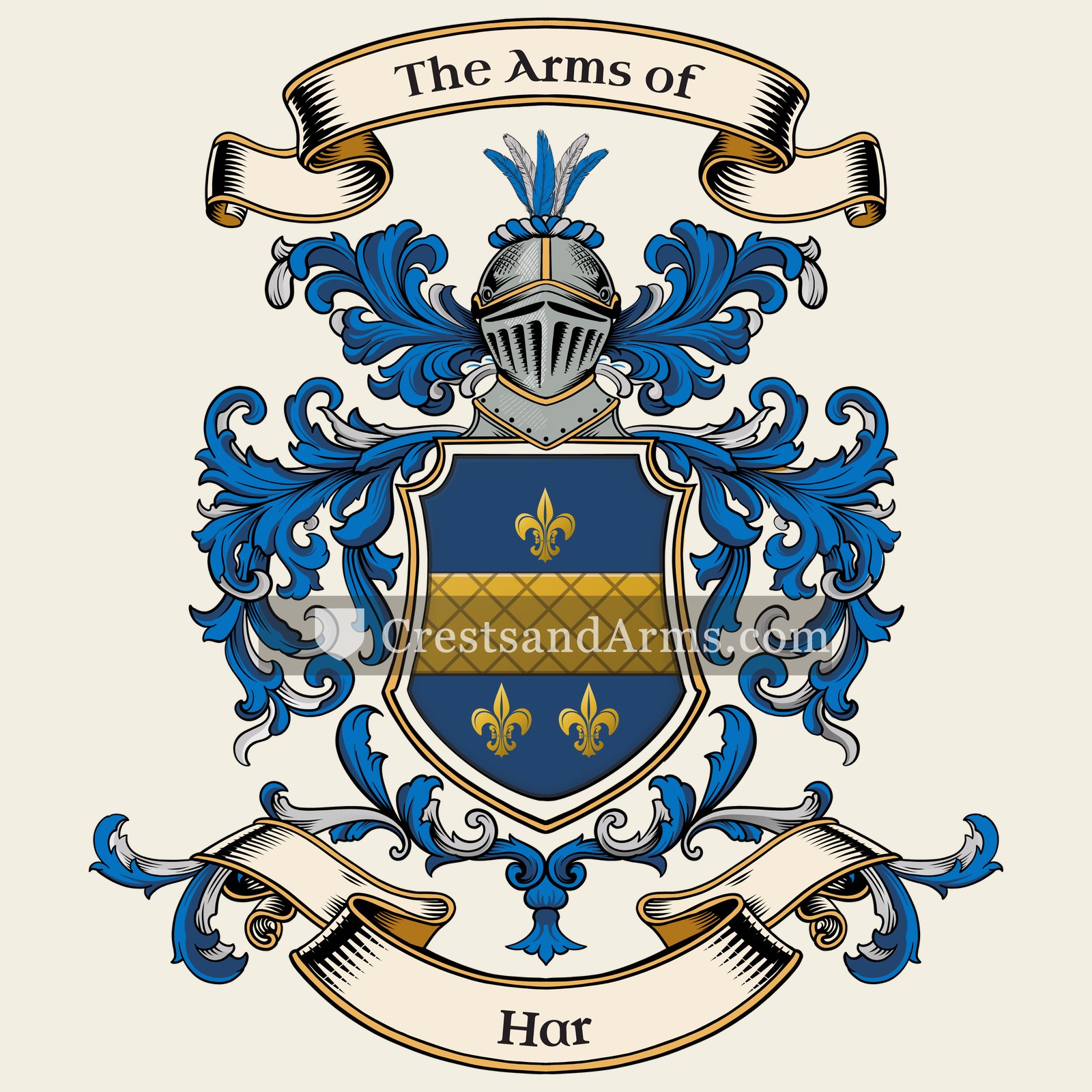
A record of documented arms, meaning and origin, researched for the Har family lines. Documented in 2 countries.
Reg. 8517 · Norwegian, G–I
Coat of Arms & Family Crest Details
Symbols on this shield
fessThe military belt, and readiness to serve
fleur de lisPurity, light, and the sixth son
Colours
Blue (Azure)Means: Loyalty and truth
Gold (Or)Means: Generosity
Historical info
Source
J. B. Rietstap, Armorial Général, Gouda: G. B. van Goor Zonen, 1884–87
Blazon (the actual original written record)
“D'azur à la fasce d'or, acc. de trois fleurs-de-lis du même, 1 en chef et 2 en p. C.: deux prob., coupées alt. d'azur et d'or.”
NorwayNorvège, c. 1605
Where the Har Arms Were Recorded
Oslo
Map of Norway showing where the Har arms are recorded
The Har arms were recorded in Norvège, c. 1605.
Arms such as these were typically recorded in Oslo.
Oslo held the Norwegian court and the offices that went with it. Norway's landed families were few and most held some post under the crown, and a post of that kind was what brought a shield.
This is where the arms were entered in the register. Families often moved to other parts of the country, so the same name can turn up in more than one region.
The body that granted and recorded arms in Norway in this period.
Christian IV of Denmark
Sovereign of the period
Christian IV of Denmark
1588–1648
Reigning in Norway when the Har arms are first recorded.
How Arms Worked in Norway
Norwegian families often assumed their own coats of arms freely without needing official permission from the crown. These symbols functioned as personal seals for merchants and farmers rather than just marks of nobility. Families passed these designs through generations as private property. When branches split, they frequently modified the original colors or shapes to create distinct versions for their own use.
Granting authority
The Norwegian royal chancery oversaw the formal recognition of noble status and the official registration of coats of arms.
How they got arms
Most families simply adopted their own unique designs to use on seals and property, though some sought royal confirmation.
Where arms were recorded
Official records of noble arms were kept in the royal chancery archives, which began documenting these grants during the union period.
The family's standing
Recorded among the armigerous families of Norway.
Origin & History of the Har Family in Norway
The name Har has deep roots in the historical landscape of Norway, with documented evidence placing members of the family in Oslo as early as 1605. During this period, Oslo was a growing center of trade and administration under the Dano-Norwegian union, and families like the Hars often integrated into the urban fabric of the city. The name itself is thought to be linked to Old Norse terminology, potentially reflecting a descriptive nickname or a reference to physical characteristics common among the early ancestors. As the family established itself in the capital, they navigated the social and economic shifts of the seventeenth century, a time when Norway was transitioning through significant political changes. By maintaining a presence in Oslo, the early Har family members were part of the foundational population that helped shape the city before it was rebuilt and renamed Christiania. Their survival and persistence in the capital suggest they were well-connected to the local merchant or administrative classes of the era.
Coat of Arms & Family Crest Details
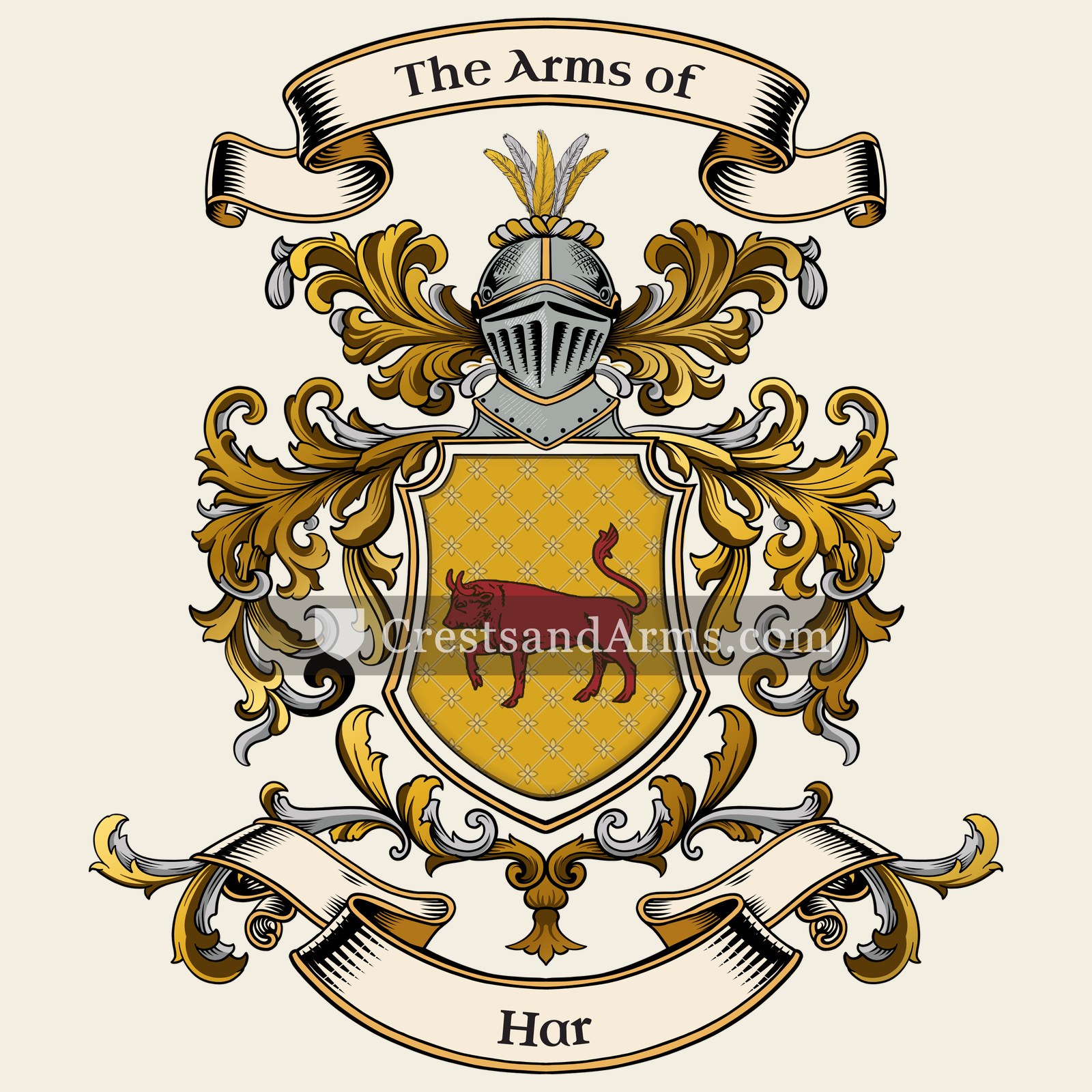
Symbols on this shield
saltireResolution, and St Andrew's cross
bullValour and generosity
Colours
Gold (Or)Means: Generosity
Red (Gules)Means: Military strength
Historical info
Source
J. B. Rietstap, Armorial Général, Gouda: G. B. van Goor Zonen, 1884–87
Blazon (the actual original written record)
“D'or à un rencontre de boeuf de gu., les cornes liées d'une corde de gu., nouée en saut. C.: le rencontre.”
Swedenc. 1700
Where the Har Arms Were Recorded
Stockholm
Map of Sweden showing where the Har arms are recorded
The Har arms were recorded in Sweden, c. 1700.
Arms such as these were typically recorded in Stockholm.
Stockholm held the Swedish court and the House of Nobility, where every noble family's arms were entered and kept. Families ennobled for service registered there, which is why so many are recorded around the city.
This is where the arms were entered in the register. Families often moved to other parts of the country, so the same name can turn up in more than one region.
The body that granted and recorded arms in Sweden in this period.
Carl XII of Sweden
Sovereign of the period
Carl XII of Sweden
1697–1718
Reigning in Norway when the Har arms are first recorded.
How Arms Worked in Sweden
In Sweden, a coat of arms belonged to a noble family as a whole rather than just one individual. These arms were passed down through the generations to all legitimate descendants. Younger branches of the family used the same shield without needing to change it. This system ensured that the entire lineage shared the same identity and status under the law.
Granting authority
The Riddarhuset, or House of Nobility, regulated all noble coats of arms in Sweden under royal authority.
How they got arms
Families received their coats of arms through royal grants of nobility which were then officially registered with the House.
Where arms were recorded
Coats of arms were officially recorded in the Swedish House of Nobility register starting in the year 1626.
The family's standing
Recorded among the armigerous families of Sweden.
Origin & History of the Har Family in Sweden
The family name Har emerged in Sweden during a time when surnames were becoming more common among urban residents and the growing middle class. By the early 1700s, records confirm that members of the Har family were already established in Stockholm, a city that served as the bustling center of trade and administration for the Swedish Empire. During this period, the name was likely adopted or assigned based on the linguistic customs of the era, which often favored short, distinct identifiers for individuals living in crowded city parishes. As these early family members navigated life in the capital, they participated in the social and economic shifts of the eighteenth century, moving through the city’s guilds and local neighborhoods. Their presence in the historical record of Stockholm provides a window into the lives of ordinary citizens who helped shape the urban identity of Sweden long before the modernization of the nineteenth century.
Related Branches & Arms
Root word
Hár
Old Norse term meaning high, tall, or exalted.
This name
HarRefers to a person of great stature or one held in high regard.
also spelled
Har
Documented Sources
J. B. Rietstap, Armorial Général, Gouda: G. B. van Goor Zonen, 1884–87
Norsk Slektshistorisk Forening, Norsk Slektshistorisk Tidsskrift, 1928
Oslo Bys Arkiv, Oslo skattelister 1600-1650
Statsarkivet i Oslo, Oslo domkapittels arkiv
Digital archive packCoat of arms PNG, gold border print PDF, vector SVG and the certificate of authenticity. Sent to your email in minutes.


 fessThe military belt, and readiness to serve
 fleur de lisPurity, light, and the sixth son
 fessThe military belt, and readiness to serve
 fleur de lisPurity, light, and the sixth son

 saltireResolution, and St Andrew's cross
 bullValour and generosity