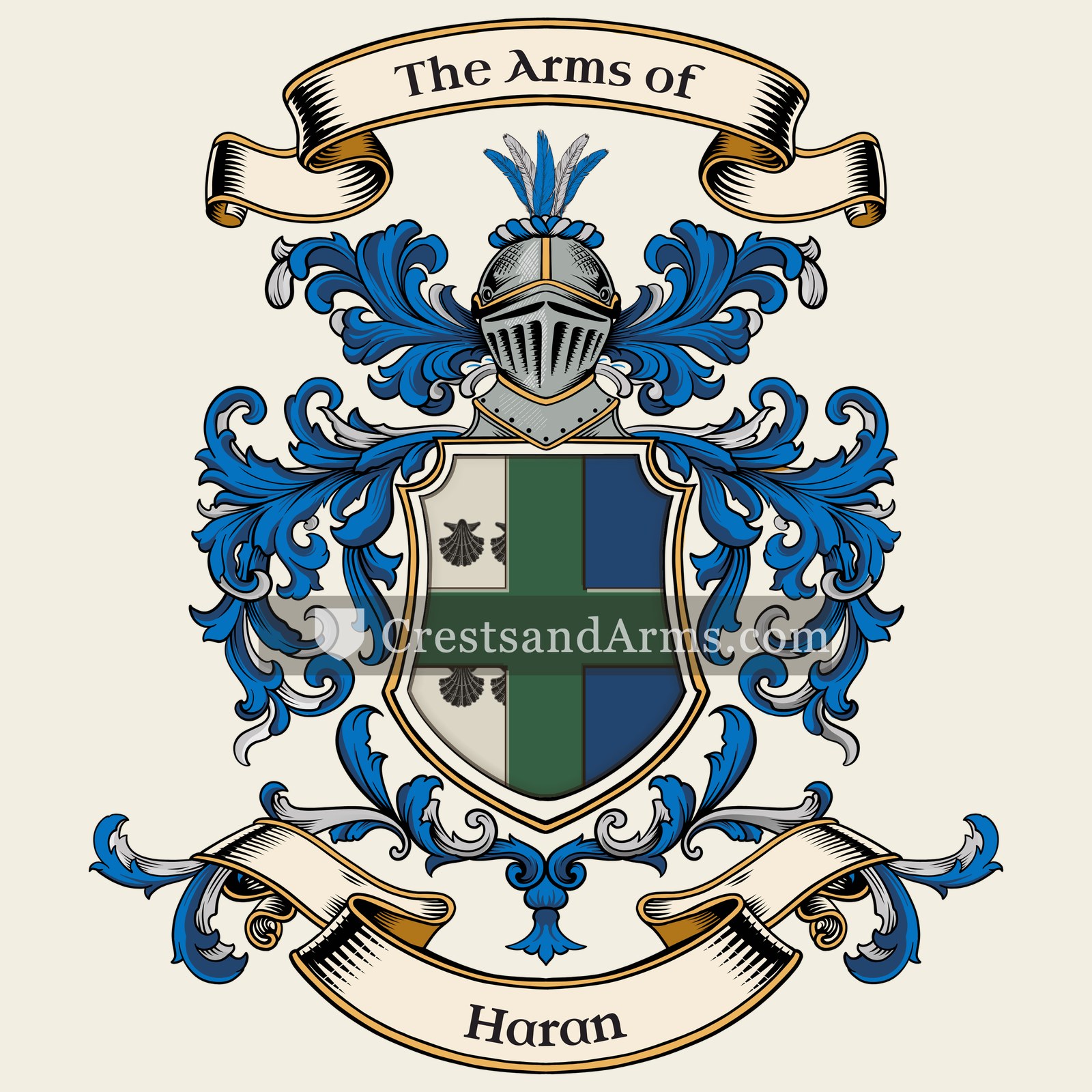
A record of documented arms, meaning and origin, researched for the Haran family of France.
Reg. 6524 · French, G–I
Coat of Arms & Family Crest Details
Symbols on this shield
cross symbolChristian faith and service
escallopThe pilgrim's shell, and a long journey made
martletA younger son, who must win his own land
Colours
Silver (Argent)Means: Peace and sincerity
Blue (Azure)Means: Loyalty and truth
Green (Vert)Means: Hope
Black (Sable)Means: Constancy
Historical info
Source
J. B. Rietstap, Armorial Général, Gouda: G. B. van Goor Zonen, 1884–87
Blazon (the actual original written record)
“Parti: au 1 d'arg. à la croix de sin., cant. de quatre coquilles de sa.; au 2 d'azur à un oiseau d'arg.”
BearnBearn, c. 1663
Where the Haran Arms Were Recorded
Bearn
Map of France showing where the Haran arms are recorded
The Haran arms were recorded in Bearn, c. 1663.
Bearn was Pyrenean country with its own laws and a strong class of small independent landholders. A great many families counted as gentry there, and each needed a shield to be told apart.
This is where the arms were entered in the register. Families often moved to other parts of the country, so the same name can turn up in more than one region.
The body that granted and recorded arms in France in this period.
Louis XIV of France
Sovereign of the period
Louis XIV of France
1643–1715
Reigning in France when the Haran arms are first recorded.
How Arms Worked in France
In France, a coat of arms was a mark of honor that passed down through the male line to all legitimate descendants. Families often used the same shield without changes to show their shared heritage. If a branch wanted to stand out, they could add a small mark to their shield to show their specific place in the family tree.
Granting authority
The Juge d'armes de France acted as the official authority that regulated and verified coats of arms across the country.
How they got arms
Families typically inherited their arms from ancestors, though they could also receive them through royal grants or by proving their noble status.
Where arms were recorded
Coats of arms were officially recorded in the Armorial Général de France, which began its main collection in the year 1696.
The family's standing
Recorded among the armigerous families of Bearn.
Origin & History of the Haran Family in France
The family name Haran has deep roots in the historical province of Béarn, located in the southwestern corner of France near the Pyrenees Mountains. By the year 1663, records confirm that members of the Haran family were already established residents in this region. The name is closely tied to the linguistic heritage of the area, which was historically influenced by the Gascon dialect of the Occitan language. In this rural society, families were often identified by the specific farmstead or house where they lived, and the name Haran likely emerged as a way to distinguish these early ancestors within their local community. Over generations, the family became part of the traditional social fabric of the Béarnais countryside, living through a period characterized by strong regional customs and a unique legal system that predated the full integration of the province into the French kingdom.
Related Branches & Arms
Root word
Haran
Derived from the Hebrew word for mountaineer or hill dweller.
This name
HaranA toponymic surname referring to individuals originating from the ancient city of Harran.
also spelled
Haran-Bordae
Haran
Documented Sources
J. B. Rietstap, Armorial Général, Gouda: G. B. van Goor Zonen, 1884–87
Tucoo-Chala, Pierre. La Vicomté de Béarn et le problème de sa souveraineté. 2009
Archives Départementales des Pyrénées-Atlantiques. Série E, Dépôt des archives communales et notariales
Digital archive packCoat of arms PNG, gold border print PDF, vector SVG and the certificate of authenticity. Sent to your email in minutes.


 cross symbolChristian faith and service
 escallopThe pilgrim's shell, and a long journey made
 martletA younger son, who must win his own land
 cross symbolChristian faith and service
 escallopThe pilgrim's shell, and a long journey made
 martletA younger son, who must win his own land