Map of Germany showing where the Haras arms are recorded
The Haras arms were recorded in Franconia, c. 1765.
Franconia was a patchwork of small territories in central Germany, full of minor landowners and prosperous market towns. So many separate households held land there that the region produced a great many coats of arms.
This is where the arms were entered in the register. Families often moved to other parts of the country, so the same name can turn up in more than one region.
The body that granted and recorded arms in Germany in this period.
Francis I, Holy Roman Emperor
Sovereign of the period
Francis I, Holy Roman Emperor
1745–1765
Reigning in Germany when the Haras arms are first recorded.
How Arms Worked in Germany
In the Holy Roman Empire, coats of arms were often granted to individuals by the Emperor or his representatives. These arms were then passed down through the generations to all legitimate descendants of the original holder. Younger branches of a family usually kept the same shield design without needing to change it, as the arms belonged to the entire lineage.
Granting authority
The Holy Roman Emperor held the sole power to grant new coats of arms throughout his vast imperial territories.
How they got arms
Families typically obtained their coats of arms through a formal imperial grant or by proving their noble status to the authorities.
Where arms were recorded
These grants were officially recorded in the Imperial Chancery registers, which began keeping formal records of such honors during the Middle Ages.
The family's standing
Recorded among the armigerous families of Franconia.
Origin & History of the Haras Family in Germany
The family name Haras finds its historical roots in the region of Franconia, a historic area in southern Germany known for its distinct cultural and linguistic traditions. By the year 1765, records confirm that members of the Haras family were well-established within this landscape, likely living as part of the agrarian or artisan classes that defined the local economy at the time. The name itself is thought to be linked to the Middle High German word for a horse or a stud farm, suggesting that the earliest ancestors may have been involved in animal husbandry or worked in roles related to the management of horses. During the eighteenth century, Franconia was a patchwork of small territories under the influence of the Holy Roman Empire, and families like the Haras often remained in the same villages for generations. This stability allowed them to become deeply integrated into the social and religious life of their local parishes, where they participated in the daily traditions and communal labor that kept the region thriving during the late Enlightenment period.
Coat of Arms & Family Crest Details
Colours
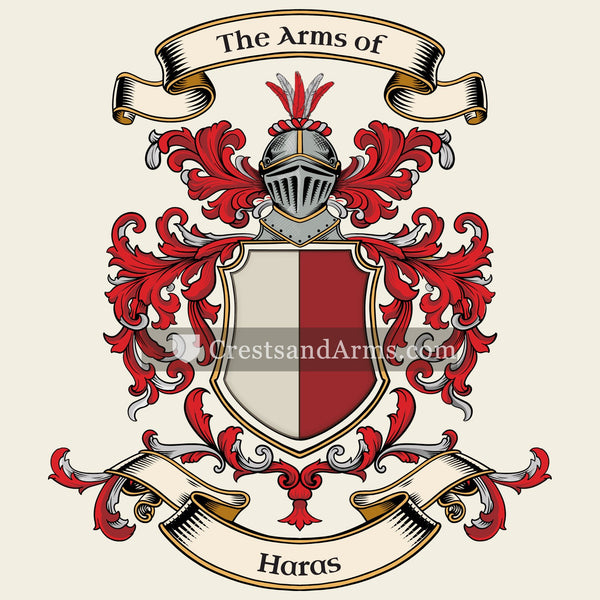
Silver (Argent)Means: Peace and sincerity
Red (Gules)Means: Military strength
Historical info
Source
J. B. Rietstap, Armorial Général, Gouda: G. B. van Goor Zonen, 1884–87
Blazon (the actual original written record)
“Parti: au 1 d'arg. plein; au 2 coupé de gu. sur sa. Cq. cour. C.: une boule de sa., ornée à l'ext. de six pl. d'aut. de gu., d'arg., de sa., de sa., d'arg. et de gu. L.: à dextre d'arg. et de gu., à sen. d'arg. et de sa.”
Austriac. 1650
Digital archive packCoat of arms PNG, gold border print PDF, vector SVG and the certificate of authenticity. Sent to your email in minutes.
Map of Austria showing where the Haras arms are recorded
The Haras arms were recorded in Austria, c. 1650.
Arms such as these were typically recorded in Tyrol.
Tyrol was mountain country in western Austria, where the valleys were held by families who had been there a very long time. Old tenure counted for more than money, and old families carried arms.
This is where the arms were entered in the register. Families often moved to other parts of the country, so the same name can turn up in more than one region.
Region
Tyrol
First recorded
1650
Granting Authority for the Haras Arms
Imperial and Royal chancery
Sodacan · CC BY-SA 3.0
The body that granted and recorded arms in Austria in this period.
Ferdinand III, Holy Roman Emperor
Sovereign of the period
Ferdinand III, Holy Roman Emperor
1637–1657
Reigning in Germany when the Haras arms are first recorded.
How Arms Worked in Austria
Austrian coats of arms were often linked directly to noble titles granted by the Emperor. These symbols belonged to the entire family line rather than just one individual. When a family grew, new branches kept the original design without needing to change it. This system allowed all members of a noble house to share the same identity across many generations.
Granting authority
The Imperial and Royal chancery managed all heraldic matters and controlled the official granting of arms throughout the Austrian lands.
How they got arms
Families typically received their arms through a formal imperial decree that often accompanied the elevation of a person to noble status.
Where arms were recorded
Official records of these grants were kept in the Imperial Register of Nobility which began its formal documentation process in 1453.
The family's standing
Recorded among the armigerous families of Austria.
Origin & History of the Haras Family in Austria
The history of the Haras family in Austria is deeply rooted in the rugged landscape of the Tyrol region, where records first confirm their presence around 1650. During this period, families in the Alpine valleys often took names that reflected their connection to the land or their specific trade within the local mountain communities. Life in seventeenth-century Tyrol was defined by strict social hierarchies and the influence of the Catholic Church, which meticulously tracked births, marriages, and deaths in parish registers. As residents of a vital crossroads between the German lands and Italy, the early Haras family likely navigated a culture shaped by both trade routes and the isolation of high-altitude farming. Their survival and growth in this challenging environment suggest they were well-integrated into the local agrarian economy, contributing to the development of the small, tight-knit villages that still characterize the Tyrolean landscape today.
Haras Meaning & Related Branches
Root word
Har
An ancient Germanic element meaning army or warrior.
This name
HarasA topographic name for someone living near a wooded hill or forest.
also spelled
Haras
Documented Sources
J. B. Rietstap, Armorial Général, Gouda: G. B. van Goor Zonen, 1884–87
Bader, Karl S., Der deutsche Südwesten in seiner territorialgeschichtlichen Entwicklung, 1978
Staatsarchiv Bamberg, Standesamtliche Unterlagen und Kirchenbücher der Region Franken, 1765


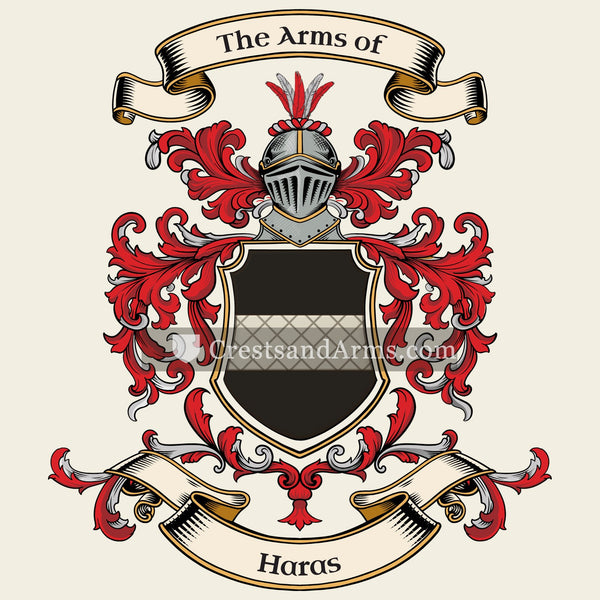
 fessThe military belt, and readiness to serve
 fessThe military belt, and readiness to serve