A record of documented arms, meaning and origin, researched for the Härd family lines. Documented in 2 countries.
Reg. 9131 · Swedish, G–I
Coat of Arms & Family Crest Details
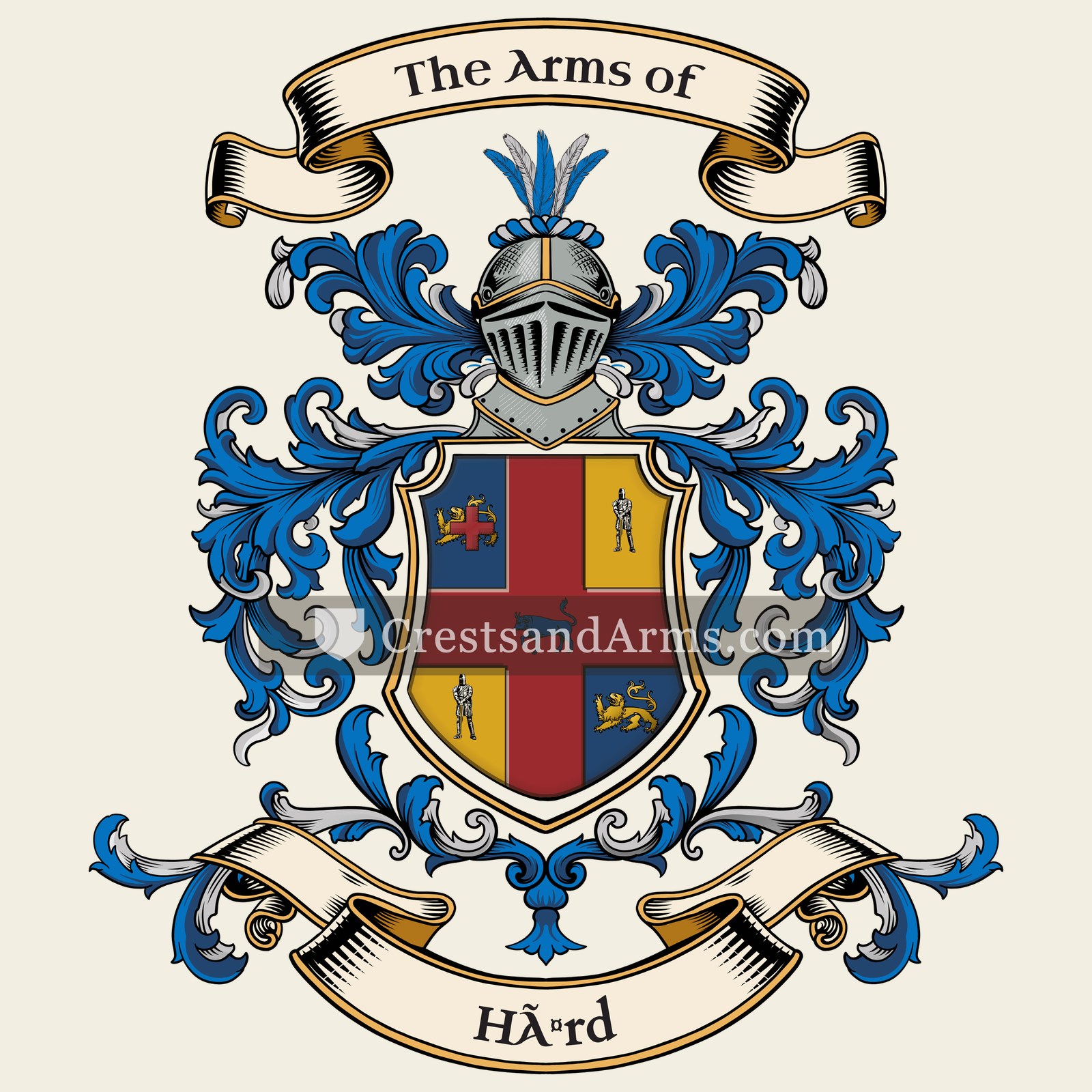
Symbols on this shield
cross symbolChristian faith and service
bullValour and generosity
lionCourage, strength and royalty
knightChivalry and service in arms
Colours
Blue (Azure)Means: Loyalty and truth
Gold (Or)Means: Generosity
Red (Gules)Means: Military strength
Silver (Argent)Means: Peace and sincerity
Historical info
Source
J. B. Rietstap, Armorial Général, Gouda: G. B. van Goor Zonen, 1884–87
Blazon (the actual original written record)
“Ec.: aux 1 et 4 d'azur au lion d'or, tenant entre ses pattes un écusson d'arg., ch. du chiffre XII de sa.; aux 2 et 3 d'or à un cavalier, hab. d'arg., coiffé d'un chapeau du même, tenant une épée et monté sur un cheval galopant au nat. A la croix pattée de gu., br. sur l'écartelé. Sur le tout d'or à un rencontre de boeuf de gu. Deux cq. cour. C.: 1° le rencontre; entre deux prob., coupées alt. d'or et de gu.; 2° l'écusson du 1, entre deux bannières d'azur, frangées d'arg., ch. celle à dextre d'une fleur-de-lis d'arg. et celle à sen. d'un croiss. d'arg. L.: d'or, d'azur et d'arg. S.: deux lions reg. d'or, lamp. de gu.”
Swedenc. 1700
Where the Härd Arms Were Recorded
Stockholm
Map of Sweden showing where the Härd arms are recorded
The Härd arms were recorded in Sweden, c. 1700.
Arms such as these were typically recorded in Stockholm.
Stockholm held the Swedish court and the House of Nobility, where every noble family's arms were entered and kept. Families ennobled for service registered there, which is why so many are recorded around the city.
This is where the arms were entered in the register. Families often moved to other parts of the country, so the same name can turn up in more than one region.
The body that granted and recorded arms in Sweden in this period.
Carl XII of Sweden
Sovereign of the period
Carl XII of Sweden
1697–1718
Reigning in Sweden when the Härd arms are first recorded.
How Arms Worked in Sweden
In Sweden, a coat of arms belonged to a noble family as a whole rather than just one individual. These arms were passed down through the generations to all legitimate descendants. Younger branches of the family used the same shield without needing to change it. This system ensured that the entire lineage shared the same identity and status under the law.
Granting authority
The Riddarhuset, or House of Nobility, regulated all noble coats of arms in Sweden under royal authority.
How they got arms
Families received their coats of arms through royal grants of nobility which were then officially registered with the House.
Where arms were recorded
Coats of arms were officially recorded in the Swedish House of Nobility register starting in the year 1626.
The family's standing
Recorded among the armigerous families of Sweden.
Origin & History of the Härd Family in Sweden
The name Härd carries a sense of strength and resilience that reflects the character of its early bearers in Sweden. By the year 1700, records confirm that members of the family were established in Stockholm, which was a time of significant growth and transformation for the city. During this period, the Swedish capital served as a bustling hub for trade and administration, drawing in families who were often involved in skilled crafts or urban commerce. The name itself is derived from the Old Swedish word for hard or firm, suggesting that the original ancestors were likely known for their steady nature or their physical endurance. As these early family members navigated life in the capital, they became part of the social fabric of a nation transitioning into a major European power. Their presence in Stockholm during the turn of the eighteenth century highlights a history rooted in the urban development and the hardworking spirit of early modern Sweden.
Coat of Arms & Family Crest Details
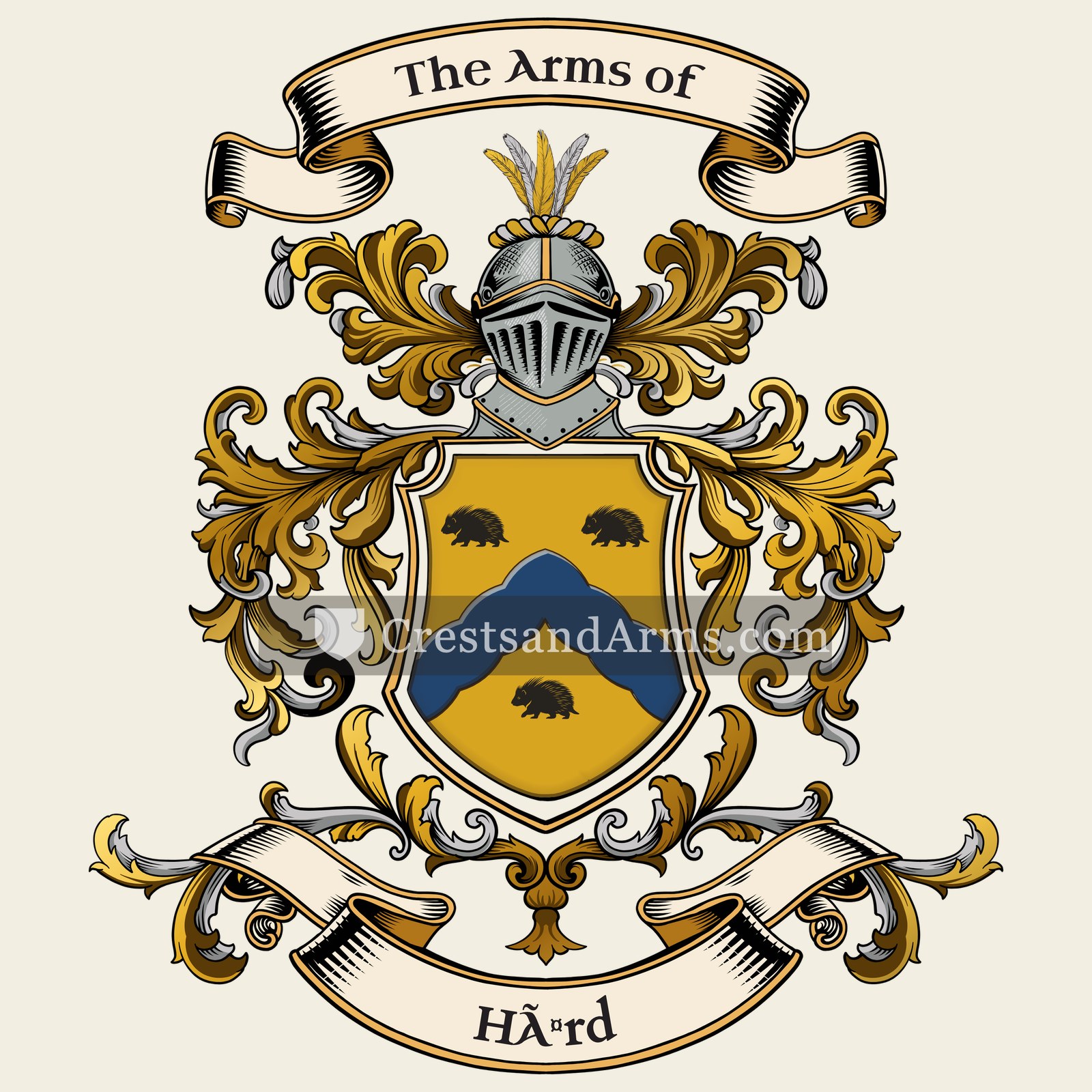
Symbols on this shield
chevronProtection, and faithful service completed
hedgehogA provident provider
Colours
Gold (Or)Means: Generosity
Blue (Azure)Means: Loyalty and truth
Black (Sable)Means: Constancy
Historical info
Source
Sir Bernard Burke, The General Armory of England, Scotland, Ireland and Wales, London: Harrison & Sons, 1884
Blazon (the actual original written record)
“Or, a chev. engr. az. betw. three hedgehogs sa”
Englandc. 1620
Where the Härd Arms Were Recorded
York
Map of England showing where the Härd arms are recorded
The Härd arms were recorded in England, c. 1620.
Arms such as these were typically recorded in York.
Yorkshire is the largest of the English counties, and it held more gentry families than any other. Land there was split among a great many households rather than a few, so a great many of them carried arms.
This is where the arms were entered in the register. Families often moved to other parts of the country, so the same name can turn up in more than one region.
The body that granted and recorded arms in England in this period.
James VI and I
Sovereign of the period
James VI and I
1603–1625
Reigning in Sweden when the Härd arms are first recorded.
How Arms Worked in England
English heraldry allowed arms to be shared by all legitimate descendants of the original owner. These symbols were treated as personal property that moved through the generations to all children. While the eldest son kept the original design, other family members could use the same shield without needing to change it or register their own unique versions.
Granting authority
The College of Arms in London has regulated the use of coats of arms throughout England and Wales since 1484.
How they got arms
Families typically obtained their coats of arms through a formal grant from the Crown or by proving their ancient right to them.
Where arms were recorded
All official coats of arms are recorded in the registers kept at the College of Arms, which date back to the fifteenth century.
The family's standing
Recorded among the armigerous families of England.
Origin & History of the Härd Family in England
The history of the Härd family in England begins with their documented presence in the city of York by 1620. During this period, York was a bustling center of trade and religion, serving as a vital hub for northern England. Families with names like Härd often settled in such cities to participate in the growing merchant class or to practice specialized crafts. The name itself suggests a connection to the Old English or Old Norse roots meaning hardy or strong, which likely reflected the resilient nature of those who moved to the region during the early seventeenth century. As the family established their roots in York, they became part of the local social fabric, navigating the political and economic shifts that defined the Stuart era. Their presence in city records from this time highlights a family that was integrated into the urban life of one of England’s most historic northern settlements.
Related Branches & Arms
Root word
Hardus
A Germanic term denoting someone who is firm, brave, or hardy.
This name
HärdRefers to a person characterized by a tough, resilient, or steadfast nature.
also spelled
Haard
Hardt
Hardde
Related arms
Hepperger auf Tirschtenberg und Hoffensthalsimilar arms
Krautnersimilar arms
Lübeck de Lübendorfsimilar arms
Documented Sources
J. B. Rietstap, Armorial Général, Gouda: G. B. van Goor Zonen, 1884–87
Hellquist, Elof. Svensk etymologisk ordbok. 1922
Otterbjörk, Roland. Svenska förnamn: kortfattat namnlexikon. 1964
Stockholm City Archives (Stockholms stadsarkiv), Mantalslängder för Stockholms stad
Digital archive packCoat of arms PNG, gold border print PDF, vector SVG and the certificate of authenticity. Sent to your email in minutes.


 cross symbolChristian faith and service
 bullValour and generosity
 lionCourage, strength and royalty
 knightChivalry and service in arms
 cross symbolChristian faith and service
 bullValour and generosity
 lionCourage, strength and royalty
 knightChivalry and service in arms

 chevronProtection, and faithful service completed
 hedgehogA provident provider