A record of documented arms, meaning and origin, researched for the Hardinge family lines. Documented in 3 countries.
Reg. 0503 · Britain, G–I
Coat of Arms & Family Crest Details
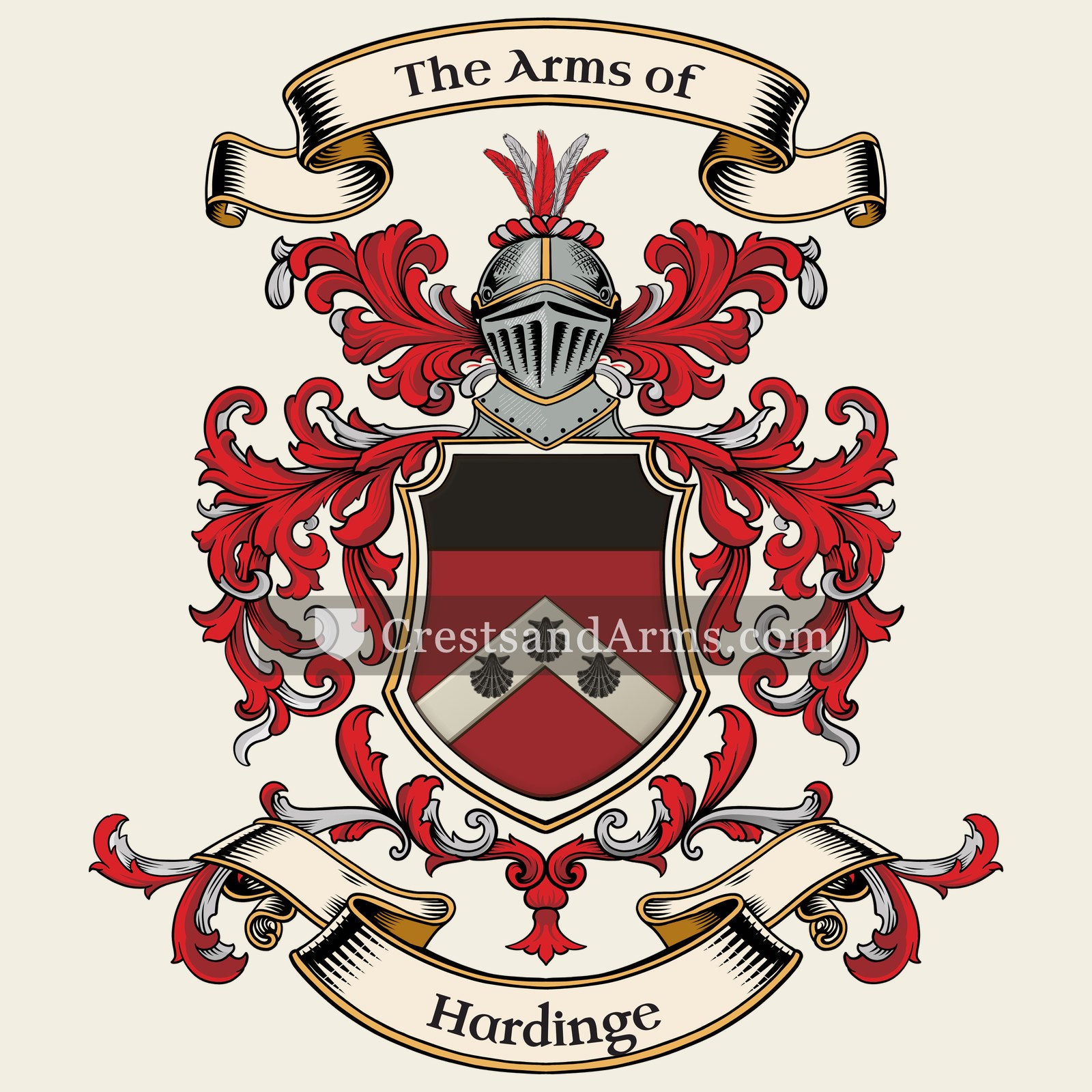
Symbols on this shield
chevronProtection, and faithful service completed
chiefAuthority, wisdom and dominion
saltireResolution, and St Andrew's cross
escallopThe pilgrim's shell, and a long journey made
Colours
Red (Gules)Means: Military strength
Silver (Argent)Means: Peace and sincerity
Black (Sable)Means: Constancy
Historical info
Source
J. B. Rietstap, Armorial Général, Gouda: G. B. van Goor Zonen, 1884–87
Blazon (the actual original written record)
“De gu. au chev. d'arg., bordé d'or et ch. de trois coquilles de sa.; au chef ondé du sec., ch. de la représentation d'une frégate française, trainée à la remorque par une frégate anglaise, le tout au nat. C.: 1º un mitre épiscopal aux armes de l'écu; 2º un avant-bras, posé en fasce, paré de l'uniforme de marine, la main de carn. tenant une épée en pal, enfilant une couronne de cyprès et une couronne de laurier; le tout br. sur deux drapeaux passés en saut., celui à dextre hollandais inscrit du mot ATALANTA, celui à sen. français inscrit du mot PIEMONTAISE; ce cimier surm. de la D.: POSTERA LAUDE RECENS. D. (au-dessous des armes :) POSTERA LAUDE RECENS.”
KentKent, c. 1801
Where the Hardinge Arms Were Recorded
Kent
Map of Britain showing where the Hardinge arms are recorded
The Hardinge arms were recorded in Kent, c. 1801.
Kent sits between London and the short crossing to Europe, and the trade passing through made it wealthy. Merchant families bought land with that money, and it was landowners who took coats of arms.
This is where the arms were entered in the register. Families often moved to other parts of the country, so the same name can turn up in more than one region.
The body that granted and recorded arms in Britain in this period.
George III of Great Britain
Sovereign of the period
George III of Great Britain
1760–1801
Reigning in Britain when the Hardinge arms are first recorded.
How Arms Worked in Britain
English heraldry allowed arms to be shared by all legitimate descendants of the original owner. These symbols were treated as personal property that moved through the generations to all children. While the eldest son kept the original design, other family members could use the same shield without needing to change it or register their own unique versions.
Granting authority
The College of Arms in London has regulated the use of coats of arms throughout England and Wales since 1484.
How they got arms
Families typically obtained their coats of arms through a formal grant from the Crown or by proving their ancient right to them.
Where arms were recorded
All official coats of arms are recorded in the registers kept at the College of Arms, which date back to the fifteenth century.
The family's standing
Recorded among the armigerous families of Kent.
Origin & History of the Hardinge Family in Britain
The surname Hardinge originates from the Old English personal name Heard, which carries the meaning of brave or hardy. During the medieval period, names often evolved to describe a person’s character or their connection to a specific ancestor, and the suffix added to the root name helped identify family lineages across various English counties. By the time the family established a notable presence in Kent in 1801, they were part of a long tradition of families who had settled into the agricultural and social fabric of Southern England. Historical records from this era suggest that the Hardinge family played an active role in local community life, often participating in the administrative and land-owning developments that defined the region during the turn of the nineteenth century. Their history in Kent reflects the broader movement of families who maintained deep roots in the English countryside, contributing to the local economy and the evolving identity of the British landscape over several generations.
Coat of Arms & Family Crest Details
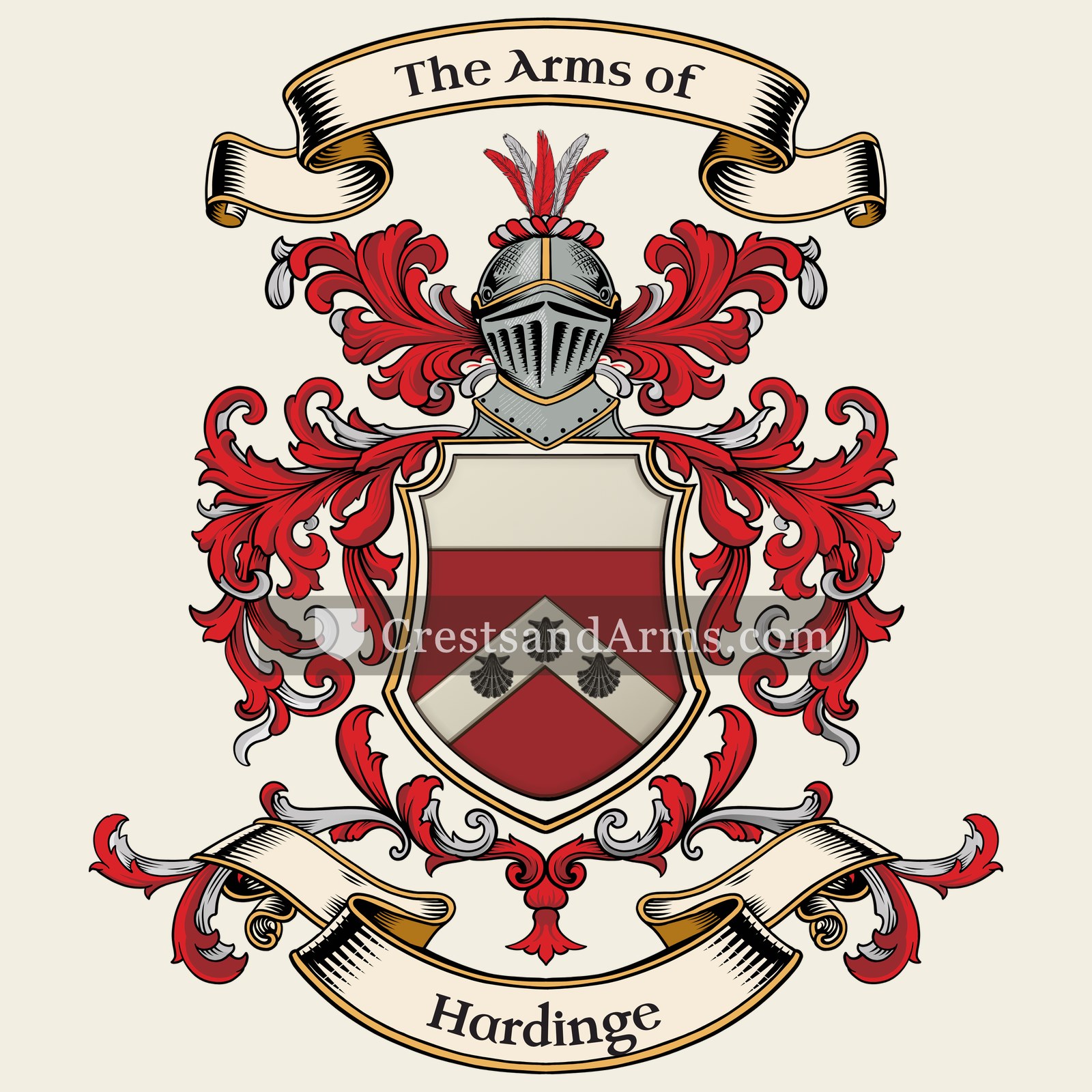
Symbols on this shield
chevronProtection, and faithful service completed
chiefAuthority, wisdom and dominion
escallopThe pilgrim's shell, and a long journey made
Colours
Red (Gules)Means: Military strength
Silver (Argent)Means: Peace and sincerity
Black (Sable)Means: Constancy
Historical info
Source
Sir Bernard Burke, The General Armory of England, Scotland, Ireland and Wales, London: Harrison & Sons, 1884
Blazon (the actual original written record)
“Gu. on a chev. ar. fimbriated or, three escallops sa. and as an honourable augmentation, on a chief wavy of the second a dismasted French frigate with her colours struck, towed by an English frigate all ppr”
KentBoundes Park · Kent, c. 1620
Where the Hardinge Arms Were Recorded
Kent
Map of England showing where the Hardinge arms are recorded
The Hardinge arms were recorded in Kent, c. 1620.
Kent sits between London and the short crossing to Europe, and the trade passing through made it wealthy. Merchant families bought land with that money, and it was landowners who took coats of arms.
This is where the arms were entered in the register. Families often moved to other parts of the country, so the same name can turn up in more than one region.
The body that granted and recorded arms in England in this period.
James VI and I
Sovereign of the period
James VI and I
1603–1625
Reigning in Britain when the Hardinge arms are first recorded.
How Arms Worked in England
English heraldry allowed arms to be shared by all legitimate descendants of the original owner. These symbols were treated as personal property that moved through the generations to all children. While the eldest son kept the original design, other family members could use the same shield without needing to change it or register their own unique versions.
Granting authority
The College of Arms in London has regulated the use of coats of arms throughout England and Wales since 1484.
How they got arms
Families typically obtained their coats of arms through a formal grant from the Crown or by proving their ancient right to them.
Where arms were recorded
All official coats of arms are recorded in the registers kept at the College of Arms, which date back to the fifteenth century.
The family's standing
Recorded among the armigerous families of Kent.
Origin & History of the Hardinge Family in England
The surname Hardinge traces its roots to the Old English personal name Heard, which translates to brave or hardy. By the time the family established a documented presence in the county of Kent during the early 1600s, the name had already evolved through centuries of local usage. Families with this name were often associated with the agricultural and social structures of southern England, where they lived as landholders and members of the local community. The presence of the Hardinge name in Kent by 1620 suggests that the family was well-integrated into the regional life of the era, likely participating in the shift toward the early modern economy. As the name moved from a descriptive nickname to a hereditary surname, it became a marker of a family that had successfully established deep roots in the English countryside.
Coat of Arms & Family Crest Details
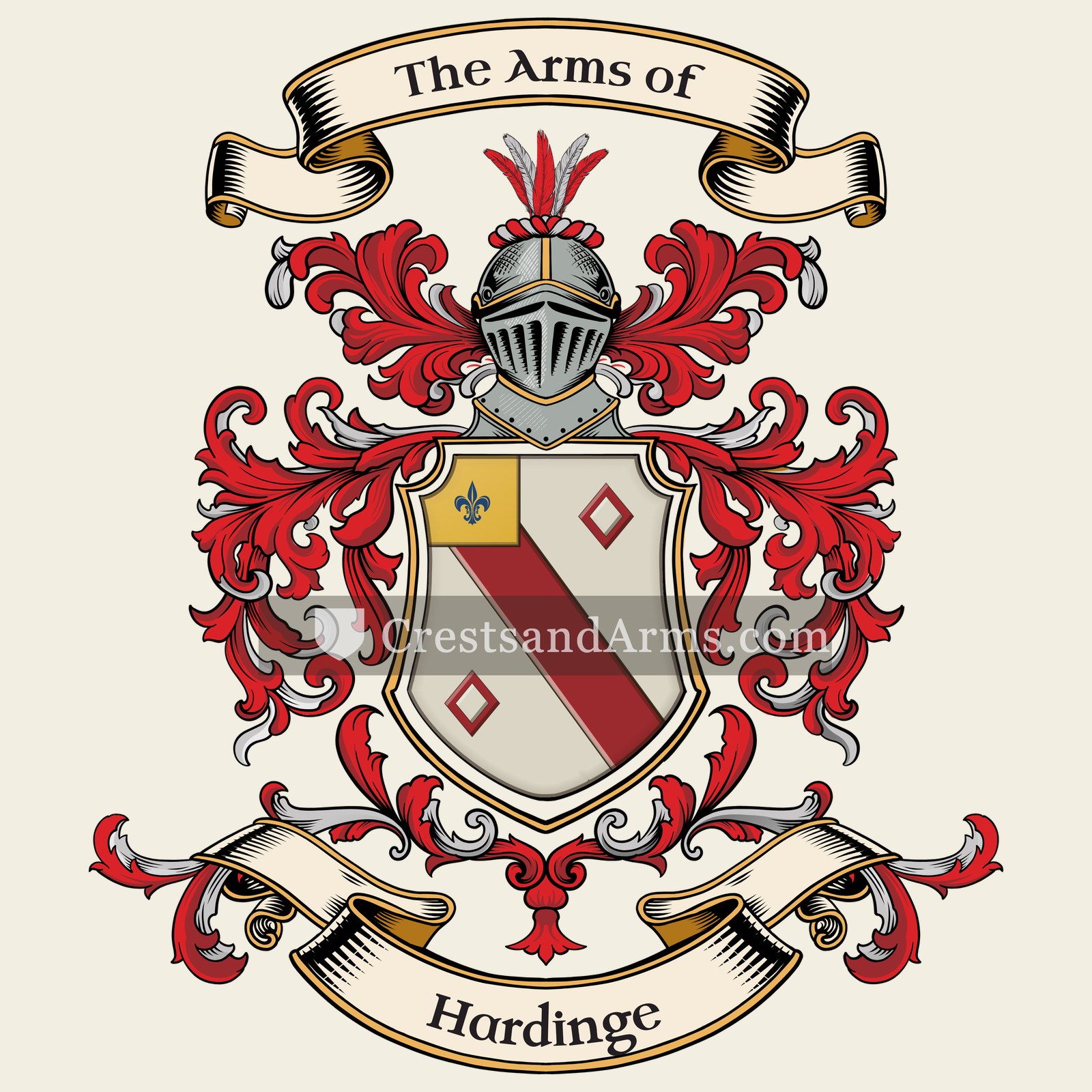
Symbols on this shield
bendDefence, and the scarf of a commander
cantonA mark of honour granted by the sovereign
masclePersuasion and the mail of a knight's coat
fleur de lisPurity, light, and the sixth son
Colours
Silver (Argent)Means: Peace and sincerity
Red (Gules)Means: Military strength
Gold (Or)Means: Generosity
Blue (Azure)Means: Loyalty and truth
Historical info
Source
Sir Bernard Burke, The General Armory of England, Scotland, Ireland and Wales, London: Harrison & Sons, 1884
Blazon (the actual original written record)
“Ar. a bend betw. two mascles gu. on a canton or, a fleur-de-lis az”
DublinDublin, c. 1645
Where the Hardinge Arms Were Recorded
Dublin
Map of Ireland showing where the Hardinge arms are recorded
The Hardinge arms were recorded in Dublin, c. 1645.
Dublin was the seat of government in Ireland and the place where grants were sought and recorded. Families with business at the castle or the courts settled nearby, and settling there put their arms on record.
This is where the arms were entered in the register. Families often moved to other parts of the country, so the same name can turn up in more than one region.
The body that granted and recorded arms in Ireland in this period.
Charles I of England
Sovereign of the period
Charles I of England
1625–1649
Reigning in Britain when the Hardinge arms are first recorded.
How Arms Worked in Ireland
The Ulster King of Arms granted coats of arms to individuals who proved their social standing and good character. These symbols were typically inherited by all legitimate descendants of the original holder. If a family branch wanted a unique look, they could apply for a specific change to their design through the office to ensure their identity remained distinct.
Granting authority
The Ulster King of Arms acted as the official body that regulated and issued all coats of arms throughout Ireland.
How they got arms
Families obtained their arms through formal grants issued by the office after proving their eligibility and paying the required fees.
Where arms were recorded
All official grants were recorded in the registers held by the Ulster King of Arms starting from the year 1552.
The family's standing
Recorded among the armigerous families of Dublin.
Origin & History of the Hardinge Family in Ireland
The Hardinge family established a significant presence in Ireland by the mid-seventeenth century, with records confirming their residence in Dublin as early as 1645. This period was a time of great political upheaval in Ireland, and the family likely arrived as part of the broader movement of English settlers seeking new opportunities in the capital city. Over the following decades, members of the family integrated into the administrative and social fabric of Dublin, often serving in professional roles that allowed them to rise in local influence. By settling in a major urban center like Dublin, the Hardinges were positioned to participate in the legal and commercial developments that defined the city during the late Stuart era. Their early history reflects the experience of many families who transitioned from English origins to becoming deeply rooted in the Irish landscape, eventually becoming a notable part of the country’s civic history.
Related Branches & Arms
Root word
Heard
Old English term meaning brave, hardy, or strong.
This name
HardingePatronymic form denoting the son of the brave or hardy one.
also spelled
Harding
Hardyng
Hardynge
Related arms
Mazerecorded with Hardinge, same area
Documented Sources
J. B. Rietstap, Armorial Général, Gouda: G. B. van Goor Zonen, 1884–87
Reaney, P.H., A Dictionary of English Surnames, 1958
The National Archives, Census Returns of England and Wales, 1801, HO 67
Cottle, Basil, The Penguin Dictionary of Surnames, 1967
Digital archive packCoat of arms PNG, gold border print PDF, vector SVG and the certificate of authenticity. Sent to your email in minutes.


 chevronProtection, and faithful service completed
 chiefAuthority, wisdom and dominion
 saltireResolution, and St Andrew's cross
 escallopThe pilgrim's shell, and a long journey made
 chevronProtection, and faithful service completed
 chiefAuthority, wisdom and dominion
 saltireResolution, and St Andrew's cross
 escallopThe pilgrim's shell, and a long journey made


 bendDefence, and the scarf of a commander
 cantonA mark of honour granted by the sovereign
 masclePersuasion and the mail of a knight's coat
 fleur de lisPurity, light, and the sixth son