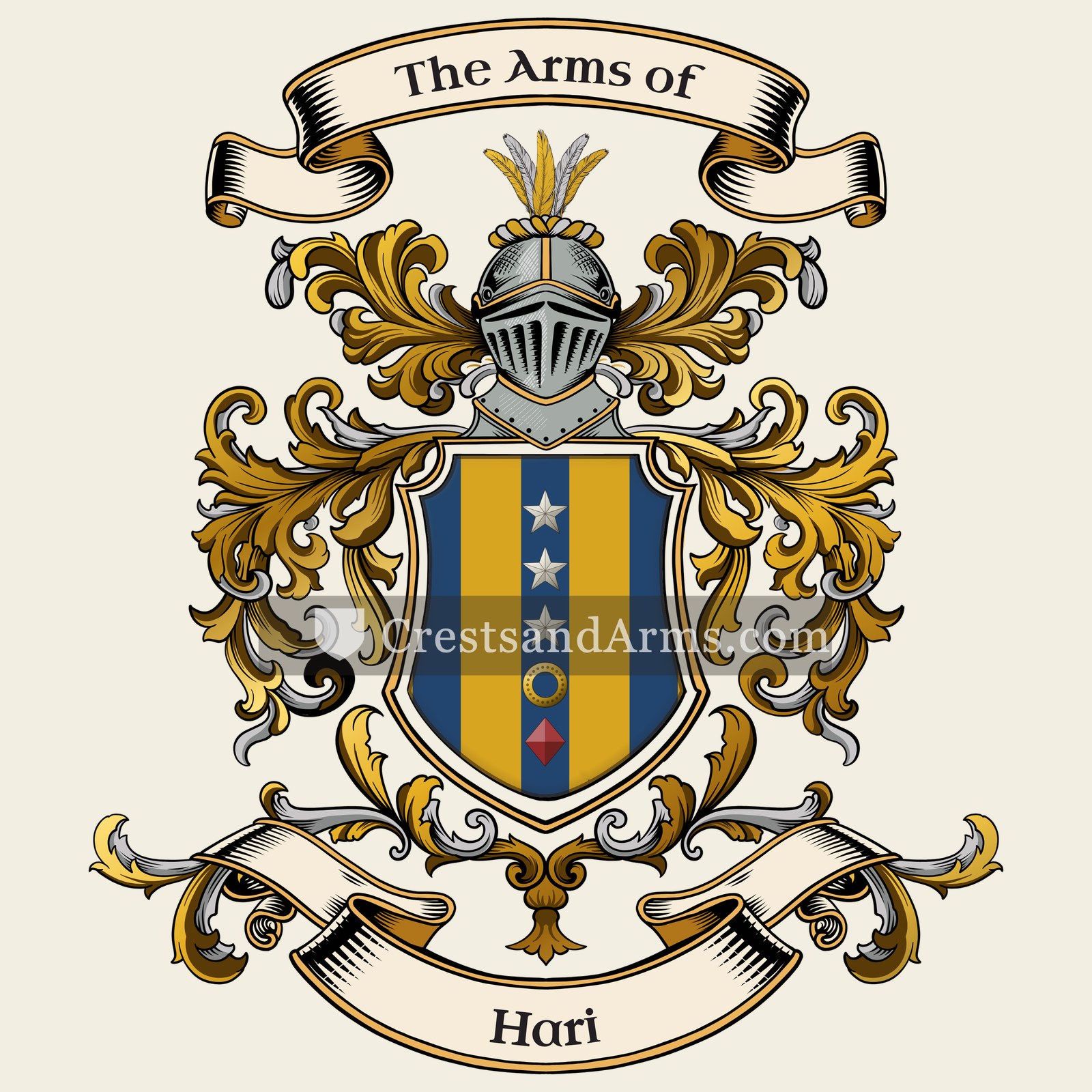
A record of documented arms, meaning and origin, researched for the Hari family of Switzerland.
Reg. 4911 · Swiss, G–I
Coat of Arms & Family Crest Details
Symbols on this shield
paleMilitary strength, and a fortified defence
mulletThe third son, and a divine quality from above
ringFidelity, and a promise kept
lozengeHonour and nobility, and the arms of a woman
Colours
Gold (Or)Means: Generosity
Blue (Azure)Means: Loyalty and truth
Silver (Argent)Means: Peace and sincerity
Red (Gules)Means: Military strength
Historical info
Source
J. B. Rietstap, Armorial Général, Gouda: G. B. van Goor Zonen, 1884–87
Blazon (the actual original written record)
“D'or au pal d'azur, et deux émanches de deux pièces et deux demies de gu., mouv. des flancs et touchant le pal; ledit pal ch. de trois étoiles (3) d'arg., la deuxième posée au centre d'une bague d'or, châtonnée d'un rubis, ledit rubis en bas.”
SwitzerlandHoll, c. 1745
Where the Hari Arms Were Recorded
Bern
Map of Switzerland showing where the Hari arms are recorded
The Hari arms were recorded in Holl, c. 1745.
Arms such as these were typically recorded in Bern.
Bern was the largest of the Swiss cantons and ran itself, with its own council and its own courts. Its governing families held office for generations, and office of that kind carried a shield with it.
This is where the arms were entered in the register. Families often moved to other parts of the country, so the same name can turn up in more than one region.
The body that granted and recorded arms in Switzerland in this period.
How Arms Worked in Switzerland
In Switzerland, coats of arms were not restricted to the nobility and were often adopted by common citizens and families. These symbols were passed down through generations to show family identity. When branches of a family grew, they often changed small details of the design to distinguish their own line from the original group.
Granting authority
Cantonal and civic authorities managed the use of coats of arms within their specific regions and local jurisdictions.
How they got arms
Families typically assumed their own coats of arms based on local custom rather than receiving them from a central monarch.
Where arms were recorded
Arms were recorded in various cantonal and civic registers starting from the fourteenth century throughout the Swiss region.
The family's standing
Recorded among the armigerous families of Switzerland.
Origin & History of the Hari Family in Switzerland
The family name Hari has deep roots in the mountainous regions of Switzerland, particularly within the Canton of Bern. By the year 1745, records confirm that members of the Hari family were well-established residents in this area. The name likely originated as a shortened form of names like Heinrich or as a descriptive term linked to the local geography of the Bernese Oberland. Families with this name were often deeply connected to the alpine landscape, working as farmers or craftsmen in the high valleys. Over the centuries, the Hari family became a recognized part of the local community, contributing to the social and economic life of the region through their steady presence in village records and parish registers.
Related Branches & Arms
Root word
Heinrich
Derived from Germanic elements meaning home ruler or enclosure ruler.
This name
HariA Swiss-German patronymic surname originating as a short form of Henry.
also spelled
Hary
Related arms
Desmartinezrecorded with Hari, same area
Meysrecorded with Hari, same area
Documented Sources
J. B. Rietstap, Armorial Général, Gouda: G. B. van Goor Zonen, 1884–87
Familiennamenbuch der Schweiz (Swiss Genealogical Society), 1989
Dubler, Anne-Marie, Die bernische Wirtschaft im 18. Jahrhundert, 1983
Staatsarchiv des Kantons Bern, Kirchenbücher (Parish Registers), Series B
Digital archive packCoat of arms PNG, gold border print PDF, vector SVG and the certificate of authenticity. Sent to your email in minutes.


 paleMilitary strength, and a fortified defence
 mulletThe third son, and a divine quality from above
 ringFidelity, and a promise kept
 lozengeHonour and nobility, and the arms of a woman
 paleMilitary strength, and a fortified defence
 mulletThe third son, and a divine quality from above
 ringFidelity, and a promise kept
 lozengeHonour and nobility, and the arms of a woman