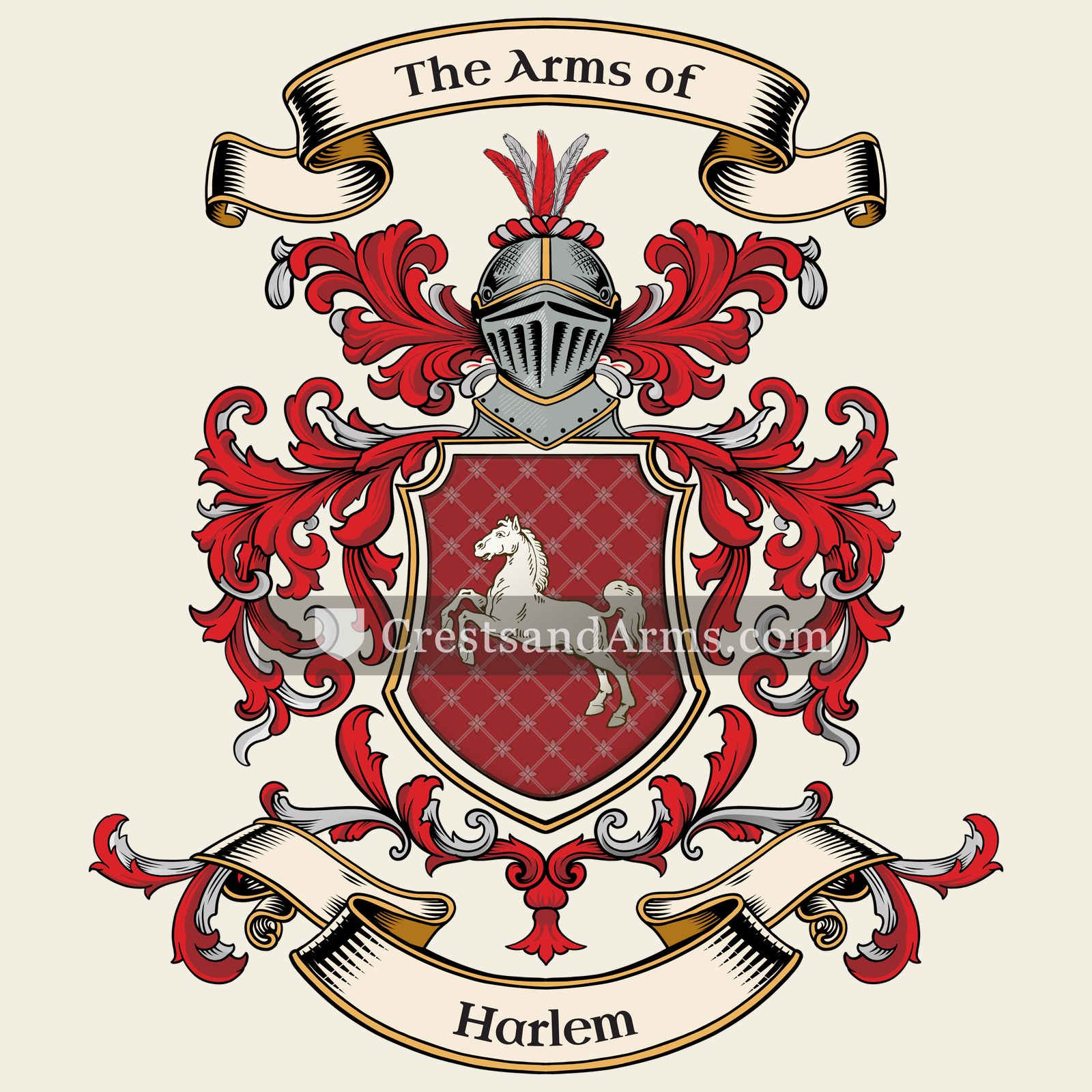
A record of documented arms, meaning and origin, researched for the Harlem family of Poland.
Reg. 1104 · Polish, G–I
Coat of Arms & Family Crest Details
Symbols on this shield
horseReadiness to serve king and country
Colours
Red (Gules)Means: Military strength
Silver (Argent)Means: Peace and sincerity
Historical info
Source
J. B. Rietstap, Armorial Général, Gouda: G. B. van Goor Zonen, 1884–87
Blazon (the actual original written record)
“De gu. à un cheval pass. d'arg. (armes de la maison d'Assendelft). C.: un Pégase iss. d'arg., entre deux prob. de gu. [Comp. Haerlem.]”
PolandPosnanie, c. 1772
Where the Harlem Arms Were Recorded
Posnanie
Map of Poland showing where the Harlem arms are recorded
The Harlem arms were recorded in Posnanie, c. 1772.
This is where the arms were entered in the register. Families often moved to other parts of the country, so the same name can turn up in more than one region.
Region
Posnanie
Town
Posnanie
First recorded
1772
Granting Authority for the Harlem Arms
Ennoblement by the Sejm
Author: Olek Remesz · CC BY-SA 3.0
The body that granted and recorded arms in Poland in this period.
Stanisław August Poniatowski
Sovereign of the period
Stanisław August Poniatowski
1764–1795
Reigning in Poland when the Harlem arms are first recorded.
How Arms Worked in Poland
Polish noble families shared a single coat of arms across many different surnames, creating large clans rather than individual designs. These symbols were held collectively by all members of the clan regardless of their specific family name. When a new family joined the nobility, they were adopted into an existing clan and began using that group's established shield.
Granting authority
The Sejm, which was the Polish parliament, held the power to grant noble status and the right to bear arms.
How they got arms
Families typically received their coat of arms through a formal act of ennoblement granted by the Sejm for distinguished service.
Where arms were recorded
These grants were officially recorded in the Crown Metrica, which served as the central archive for state documents starting in the sixteenth century.
The family's standing
Recorded among the armigerous families of Poland.
Origin & History of the Harlem Family in Poland
The history of the Harlem family name is deeply rooted in the region of Posnanie, which was a significant area in the former Polish-Lithuanian Commonwealth. By 1772, records confirm that members of the family were already established in this territory, a time when the region was undergoing major political shifts due to the First Partition of Poland. The name itself likely originated as a locative surname, which was a common practice in Europe for families to adopt the name of the town or district where they lived. During the late 18th century, Posnanie served as a cultural and economic crossroads, and families living there were often involved in the local trade and agricultural networks that defined the landscape. As the family grew and moved across borders, the name traveled with them, serving as a lasting connection to their ancestral home in the heart of Central Europe.
Related Branches & Arms
Root word
Harla
A Germanic term referring to a hare or a rabbit.
This name
HarlemA locational or topographic surname likely denoting someone who lived near a hare-inhabited meadow or field.
also spelled
Haerlem
Harlemme
Harleem
Related arms
van Haerlemvariant spelling
Documented Sources
J. B. Rietstap, Armorial Général, Gouda: G. B. van Goor Zonen, 1884–87
Archiwum Państwowe w Poznaniu (State Archives in Poznań), Zespół: Akta miasta Poznania (Records of the City of Poznań)
Archiwum Główne Akt Dawnych (Central Archives of Historical Records), Zespół: Księgi grodzkie poznańskie (Poznań Castle Books)
Dworzaczek, Włodzimierz, Teki Dworzaczka: Materiały historyczno-genealogiczne do dziejów szlachty wielkopolskiej XV-XX wieku, 1995
Topolski, Jerzy, Dzieje Poznania do roku 1793, 1988
Digital archive packCoat of arms PNG, gold border print PDF, vector SVG and the certificate of authenticity. Sent to your email in minutes.


 horseReadiness to serve king and country
 horseReadiness to serve king and country