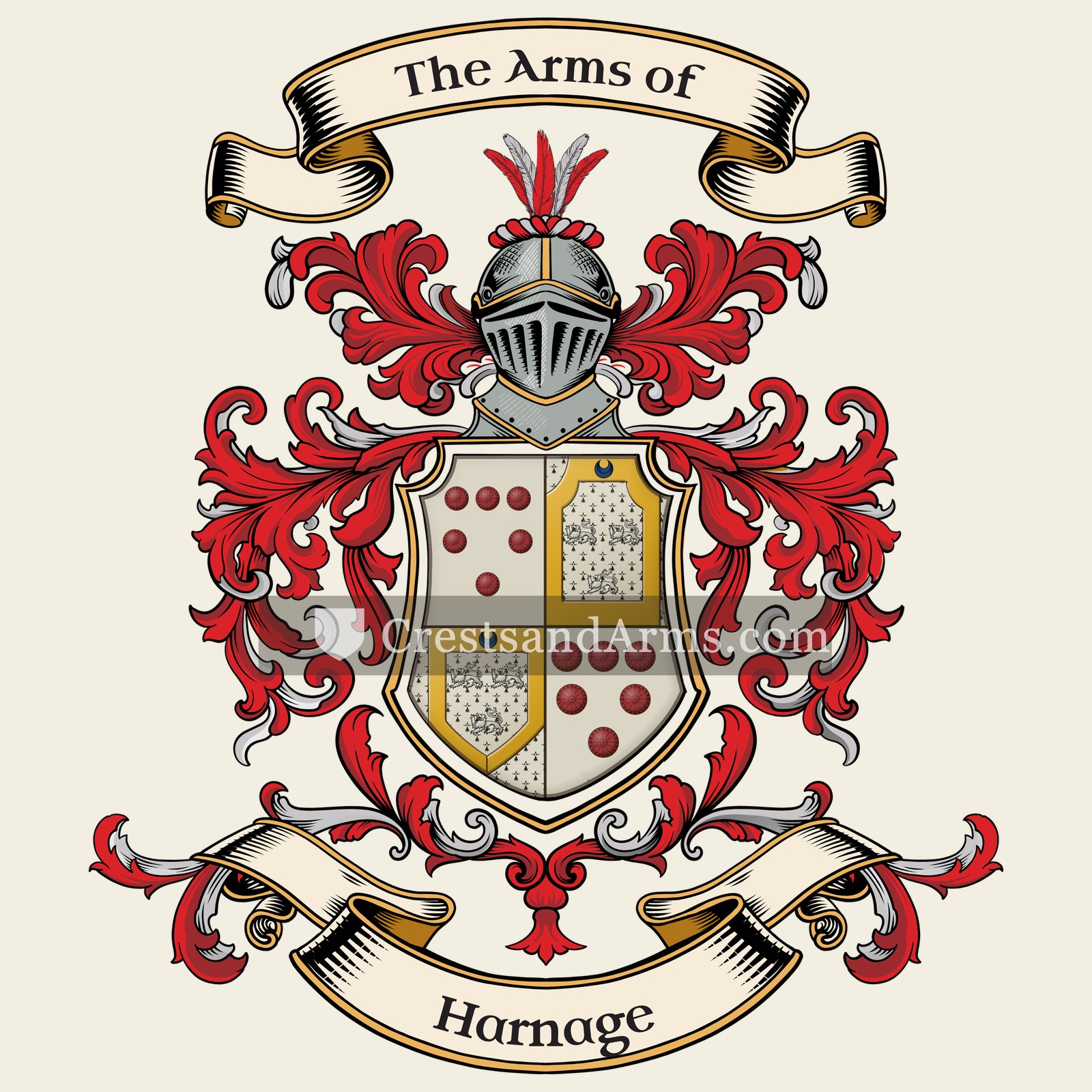
A record of documented arms, meaning and origin, researched for the Harnage family of England.
Reg. 6831 · English, G–I
Coat of Arms & Family Crest Details
Symbols on this shield
bordureA difference between branches of one family
roundelA coin, and one who has been to the crusades
lionCourage, strength and royalty
crescentHonour by the sovereign, and the second son
Colours
Silver (Argent)Means: Peace and sincerity
ErmineMeans: Dignity
Gold (Or)Means: Generosity
Red (Gules)Means: Military strength
Blue (Azure)Means: Loyalty and truth
Historical info
Source
Sir Bernard Burke, The General Armory of England, Scotland, Ireland and Wales, London: Harrison & Sons, 1884
Blazon (the actual original written record)
“Quarterly, 1st and 4th. ar. six torteaux, three, two, and one, for HARNAGE; 2nd and 3rd, erm. three lions ramp. ar. a bordure or, semée of crescents az., for BLACKMAN”
SalopBelswardyne · Salop, c. 1620
Where the Harnage Arms Were Recorded
Salop
Map of England showing where the Harnage arms are recorded
The Harnage arms were recorded in Salop, c. 1620.
Shropshire lay on the Welsh border, and border country needed men who could fight. Families held their land in return for service, and service in arms is what a coat of arms was originally for.
This is where the arms were entered in the register. Families often moved to other parts of the country, so the same name can turn up in more than one region.
The body that granted and recorded arms in England in this period.
James VI and I
Sovereign of the period
James VI and I
1603–1625
Reigning in England when the Harnage arms are first recorded.
How Arms Worked in England
English heraldry allowed arms to be shared by all legitimate descendants of the original owner. These symbols were treated as personal property that moved through the generations to all children. While the eldest son kept the original design, other family members could use the same shield without needing to change it or register their own unique versions.
Granting authority
The College of Arms in London has regulated the use of coats of arms throughout England and Wales since 1484.
How they got arms
Families typically obtained their coats of arms through a formal grant from the Crown or by proving their ancient right to them.
Where arms were recorded
All official coats of arms are recorded in the registers kept at the College of Arms, which date back to the fifteenth century.
The family's standing
Recorded among the armigerous families of Salop.
Origin & History of the Harnage Family in England
The surname Harnage is deeply rooted in the history of the English county of Shropshire, which was historically known as Salop. By the year 1620, the family was well-established in this region, particularly around the area of Belswardine. The name is believed to be locational in origin, likely derived from a specific place or manor that the family held or lived near during the medieval period. During the seventeenth century, members of the Harnage family were recognized as members of the local landed gentry, often serving in roles that involved managing land and participating in the social life of the county. Their presence in Salop during this era suggests that they were deeply integrated into the rural economy and the administrative structures of the West Midlands. Over time, the family name became synonymous with the regional identity of Shropshire, reflecting the long-standing ties that families of that era maintained with their ancestral estates.
Related Branches & Arms
Root word
Harnage
Derived from the Old English words for a corner or nook.
This name
HarnageRefers to a person who lived at a corner or a nook of land.
also spelled
Harnedge
Harnadge
Related arms
Harngevariant spelling
Everardrecorded with Harnage, same area
Wollastonrecorded with Harnage, same area
Documented Sources
Sir Bernard Burke, The General Armory of England, Scotland, Ireland and Wales, London: Harrison & Sons, 1884
Grazebrook, George and Rylands, John Paul, The Visitation of Shropshire, taken in the year 1623, 1889


 bordureA difference between branches of one family
 roundelA coin, and one who has been to the crusades
 lionCourage, strength and royalty
 crescentHonour by the sovereign, and the second son
 bordureA difference between branches of one family
 roundelA coin, and one who has been to the crusades
 lionCourage, strength and royalty
 crescentHonour by the sovereign, and the second son