A record of documented arms, meaning and origin, researched for the Harpe family lines. Documented in 2 countries.
Reg. 4159 · Polish, G–I
Coat of Arms & Family Crest Details
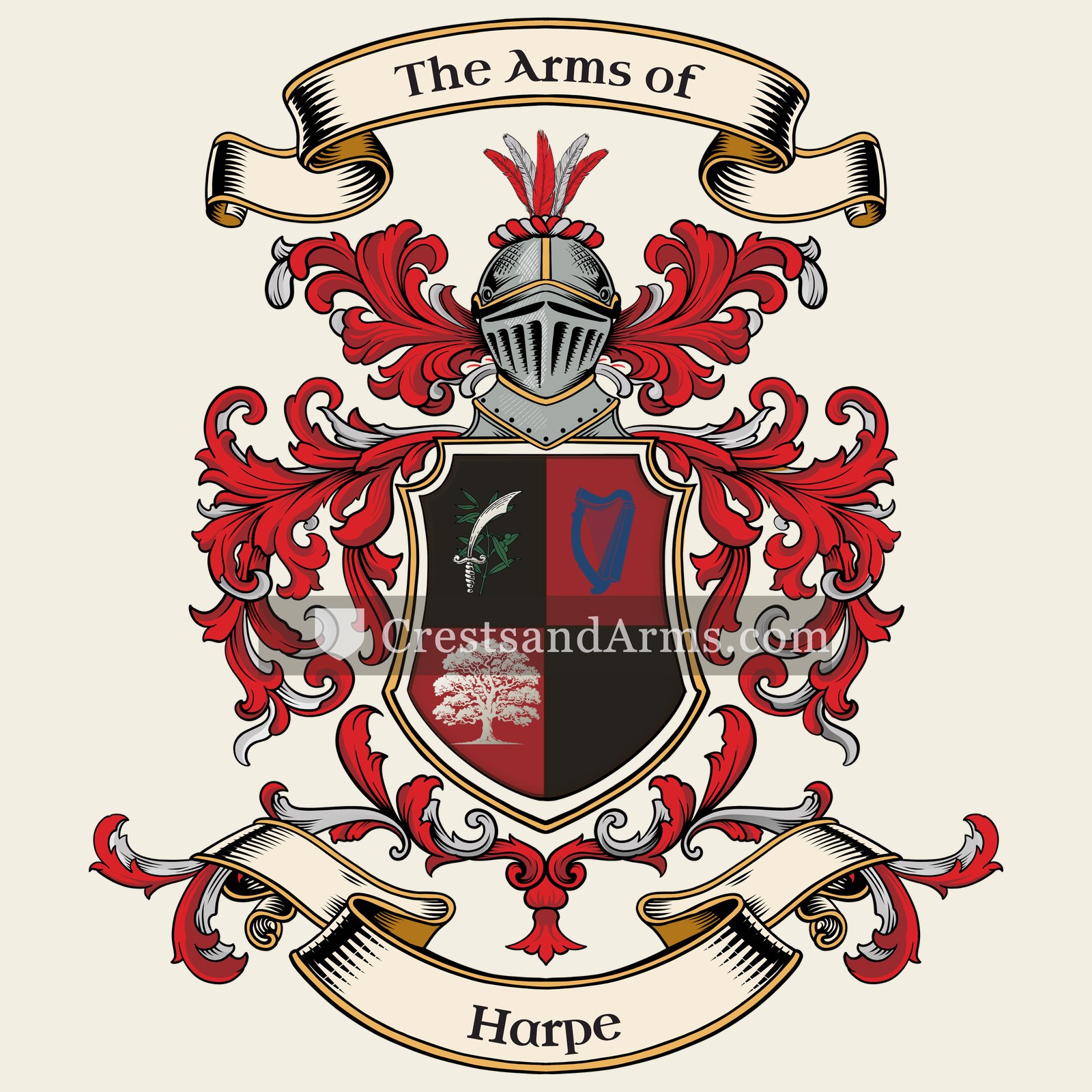
Symbols on this shield
saltireResolution, and St Andrew's cross
branchPeace, and new growth
swordJustice, and military honour
harpWell-tuned governance and love of music
treeLife, endurance and deep roots
Colours
Black (Sable)Means: Constancy
Red (Gules)Means: Military strength
Green (Vert)Means: Hope
Silver (Argent)Means: Peace and sincerity
Blue (Azure)Means: Loyalty and truth
Historical info
Source
J. B. Rietstap, Armorial Général, Gouda: G. B. van Goor Zonen, 1884–87
Blazon (the actual original written record)
“Ec.: au 1 coupé de sa. sur gu.; à une branche d'olivier de sin. en bande, et une épée d'arg., garnie d'or, en barre, passées en saut. et br. sur le coupé; au 2 d'or à une harpe d'azur; au 3 d'arg. à un tilleul arr. au nat.; au 4 taillé à dents arrondis de gu. sur arg. Deux cq. le 1 cour. C.: 1° les meubles du 1; entre deux prob., coupées de sa. sur gu.; l. d'arg. et de gu.; 2° la harpe, entre un vol d'or; l. d'or et d'azur.”
CourlandCourland, c. 1790
Where the Harpe Arms Were Recorded
Map of Poland showing where the Harpe arms are recorded
The Harpe arms were recorded in Courland, c. 1790.
Courland was Baltic coast country held in large estates by a small number of families. They kept their land for generations and served as officers abroad, and both landholding and service brought arms with them.
This is where the arms were entered in the register. Families often moved to other parts of the country, so the same name can turn up in more than one region.
Region
Courland
First recorded
1790
Granting Authority for the Harpe Arms
Ennoblement by the Sejm
Author: Olek Remesz · CC BY-SA 3.0
The body that granted and recorded arms in Poland in this period.
Stanisław August Poniatowski
Sovereign of the period
Stanisław August Poniatowski
1764–1795
Reigning in Poland when the Harpe arms are first recorded.
How Arms Worked in Poland
Polish noble families shared a single coat of arms across many different surnames, creating large clans rather than individual designs. These symbols were held collectively by all members of the clan regardless of their specific family name. When a new family joined the nobility, they were adopted into an existing clan and began using that group's established shield.
Granting authority
The Sejm, which was the Polish parliament, held the power to grant noble status and the right to bear arms.
How they got arms
Families typically received their coat of arms through a formal act of ennoblement granted by the Sejm for distinguished service.
Where arms were recorded
These grants were officially recorded in the Crown Metrica, which served as the central archive for state documents starting in the sixteenth century.
The family's standing
Recorded among the armigerous families of Courland.
Origin & History of the Harpe Family in Poland
The history of the Harpe family in the region of Courland is deeply connected to the shifting borders and cultural exchanges of the late eighteenth century. By 1790, members of the family were established in this territory, which was a duchy with strong historical ties to the Polish-Lithuanian Commonwealth. During this era, families in Courland often navigated a complex landscape where German, Polish, and Baltic influences overlapped. The Harpe name likely emerged within this environment as a result of administrative record-keeping that tracked landholders and officials serving the local nobility. As the region transitioned through political changes, the family maintained a presence that reflected the broader movement of people across the Baltic lands. Their early history illustrates how families of that time adapted to the social structures of the Polish-influenced territories before the major partitions of the late 1700s.
Coat of Arms & Family Crest Details
Symbols on this shield
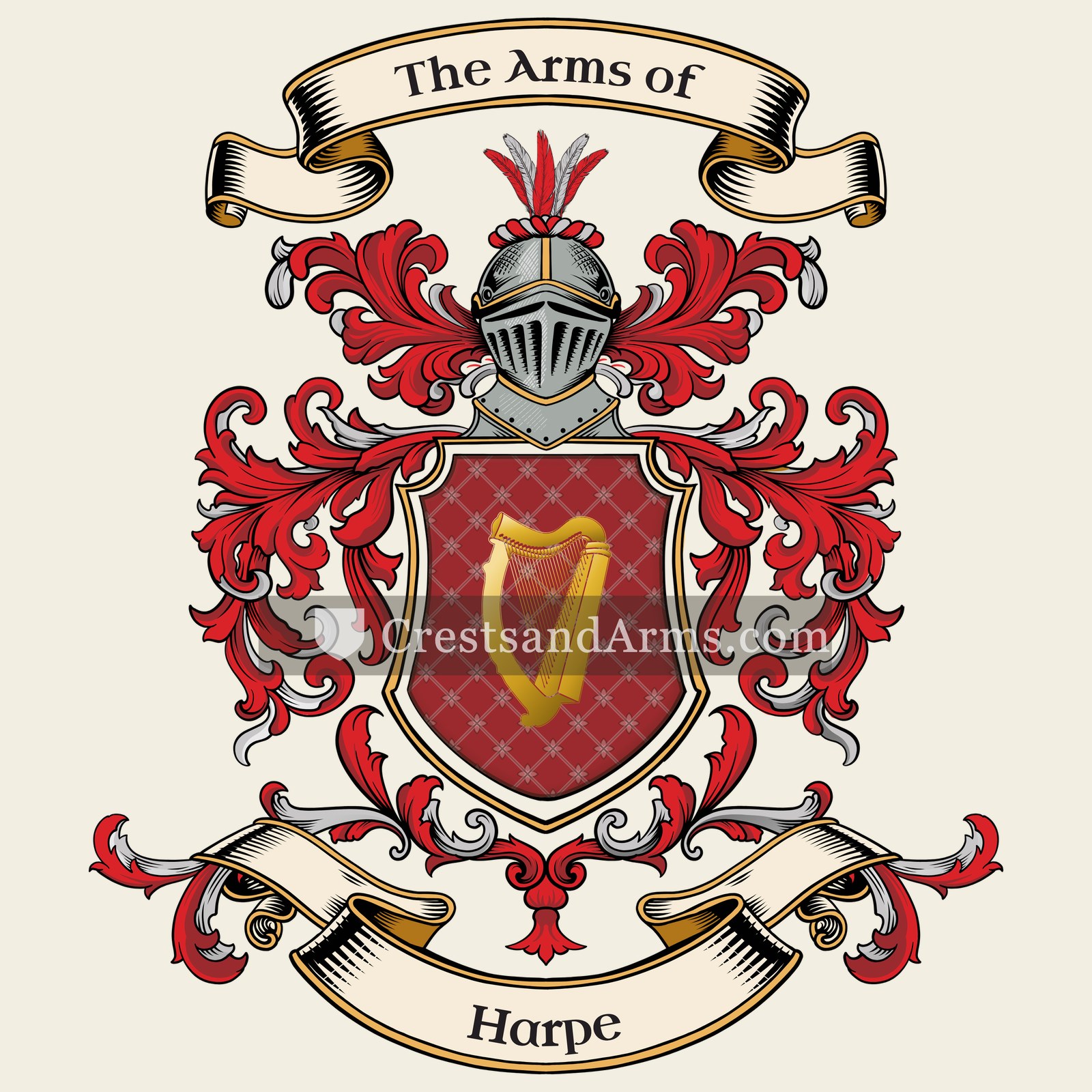
harpWell-tuned governance and love of music
Colours
Red (Gules)Means: Military strength
Gold (Or)Means: Generosity
Historical info
Source
J. B. Rietstap, Armorial Général, Gouda: G. B. van Goor Zonen, 1884–87
Blazon (the actual original written record)
“De gu. à une harpe d'or. C.: un cheval iss. d'arg.”
Switzerlandc. 1745
Where the Harpe Arms Were Recorded
Bern
Map of Switzerland showing where the Harpe arms are recorded
The Harpe arms were recorded in Switzerland, c. 1745.
Arms such as these were typically recorded in Bern.
Bern was the largest of the Swiss cantons and ran itself, with its own council and its own courts. Its governing families held office for generations, and office of that kind carried a shield with it.
This is where the arms were entered in the register. Families often moved to other parts of the country, so the same name can turn up in more than one region.
The body that granted and recorded arms in Switzerland in this period.
How Arms Worked in Switzerland
In Switzerland, coats of arms were not restricted to the nobility and were often adopted by common citizens and families. These symbols were passed down through generations to show family identity. When branches of a family grew, they often changed small details of the design to distinguish their own line from the original group.
Granting authority
Cantonal and civic authorities managed the use of coats of arms within their specific regions and local jurisdictions.
How they got arms
Families typically assumed their own coats of arms based on local custom rather than receiving them from a central monarch.
Where arms were recorded
Arms were recorded in various cantonal and civic registers starting from the fourteenth century throughout the Swiss region.
The family's standing
Recorded among the armigerous families of Switzerland.
Origin & History of the Harpe Family in Switzerland
The Harpe family name finds its historical roots in the Swiss canton of Bern, where records confirm their presence by the year 1745. During this period, families in the region were often deeply integrated into the local civic and social structures of the city. The name itself is thought to be linked to the medieval term for a harp, which suggests that the earliest ancestors may have been associated with music or were perhaps known for their skill as minstrels or instrument makers. As the family established themselves in Bern, they became part of the complex social fabric of the Swiss Confederation, a time defined by strict guild systems and regional governance. Over the following decades, members of the family transitioned from these early roles into various professional and administrative positions, reflecting the broader movement of families seeking stability and status within the growing urban centers of Switzerland.
Related Branches & Arms
Root word
harfa
A stringed musical instrument known as a harp.
This name
HarpeAn occupational surname referring to a person who played the harp or a harp maker.
also spelled
Harpp
Harp
Documented Sources
J. B. Rietstap, Armorial Général, Gouda: G. B. van Goor Zonen, 1884–87
Arbusov, Leonid, Grundriss der Geschichte Liv-, Est- und Kurlands, 1918
Dunsdorfs, Edgars, Der große schwedische Kataster in Livland 1681–1710, 1974
Latvian State Historical Archives (Latvijas Valsts vēstures arhīvs), Fond 214: Kurzemes bruņniecība (Courland Nobility Records)
Digital archive packCoat of arms PNG, gold border print PDF, vector SVG and the certificate of authenticity. Sent to your email in minutes.


 saltireResolution, and St Andrew's cross
 branchPeace, and new growth
 swordJustice, and military honour
 harpWell-tuned governance and love of music
 treeLife, endurance and deep roots
 saltireResolution, and St Andrew's cross
 branchPeace, and new growth
 swordJustice, and military honour
 harpWell-tuned governance and love of music
 treeLife, endurance and deep roots