Map of England showing where the Harper arms are recorded
The Harper arms were recorded in Kent, c. 1547.
Kent sits between London and the short crossing to Europe, and the trade passing through made it wealthy. Merchant families bought land with that money, and it was landowners who took coats of arms.
This is where the arms were entered in the register. Families often moved to other parts of the country, so the same name can turn up in more than one region.
The body that granted and recorded arms in England in this period.
Henry VIII of England
Sovereign of the period
Henry VIII of England
1509–1547
Reigning in England when the Harper arms are first recorded.
How Arms Worked in England
English heraldry allowed arms to be shared by all legitimate descendants of the original owner. These symbols were treated as personal property that moved through the generations to all children. While the eldest son kept the original design, other family members could use the same shield without needing to change it or register their own unique versions.
Granting authority
The College of Arms in London has regulated the use of coats of arms throughout England and Wales since 1484.
How they got arms
Families typically obtained their coats of arms through a formal grant from the Crown or by proving their ancient right to them.
Where arms were recorded
All official coats of arms are recorded in the registers kept at the College of Arms, which date back to the fifteenth century.
The family's standing
Recorded among the armigerous families of Kent.
Origin & History of the Harper Family in England
The surname Harper originated as an occupational name for a person who played the harp, a highly respected musical instrument in medieval society. During the Middle Ages, traveling musicians were common figures who provided entertainment in royal courts, local taverns, and village festivals. By the time the family was firmly established in Kent in 1547, the name had transitioned from a simple job description into a permanent hereditary surname passed down through generations. Living in Kent during the mid-sixteenth century placed these early family members in a region known for its agricultural wealth and proximity to the political center of London. As the family grew, they became part of the local social fabric, contributing to the development of English village life during a period of significant cultural and religious change.
Coat of Arms & Family Crest Details
Symbols on this shield
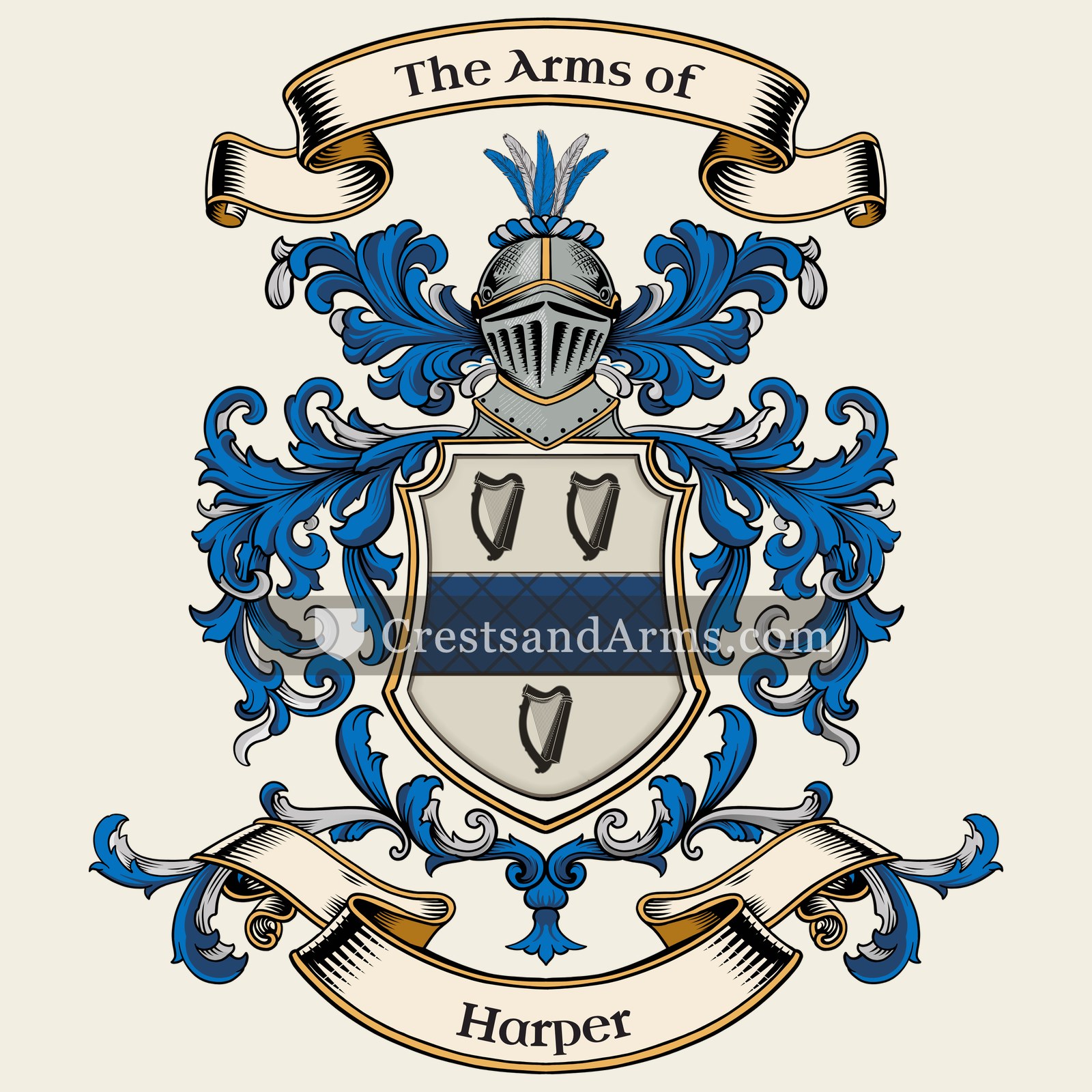
fessThe military belt, and readiness to serve
harpWell-tuned governance and love of music
Colours
Silver (Argent)Means: Peace and sincerity
Blue (Azure)Means: Loyalty and truth
Black (Sable)Means: Constancy
Historical info
Source
Sir Bernard Burke, The General Armory of England, Scotland, Ireland and Wales, London: Harrison & Sons, 1884
Blazon (the actual original written record)
“Ar. a fess az. betw. three harps sa. stringed or”
EdinburghEdinburgh, c. 1870
Digital archive packCoat of arms PNG, gold border print PDF, vector SVG and the certificate of authenticity. Sent to your email in minutes.
Map of Scotland showing where the Harper arms are recorded
The Harper arms were recorded in Edinburgh, c. 1870.
Edinburgh was the seat of Scotland's government, its courts and its heralds. Families with business there settled nearby, and being close to where arms were recorded is exactly why so many of them appear.
This is where the arms were entered in the register. Families often moved to other parts of the country, so the same name can turn up in more than one region.
The body that granted and recorded arms in Scotland in this period.
Victoria
Sovereign of the period
Victoria
1837–1901
Reigning in England when the Harper arms are first recorded.
How Arms Worked in Scotland
Scottish heraldry is unique because it treats a coat of arms as a piece of personal property protected by law. Only one person can own a specific design at any given time. When a family grows, the head keeps the original shield while other relatives must apply for their own distinct version with slight changes to prove their specific identity.
Granting authority
The Court of the Lord Lyon acts as the official body that regulates and controls all heraldic matters throughout Scotland.
How they got arms
Individuals obtain a legal right to their arms through a formal petition process that confirms their identity and family connection.
Where arms were recorded
All valid coats of arms are officially entered into the Public Register of All Arms and Bearings starting from 1672.
The family's standing
Recorded among the armigerous families of Edinburgh.
Origin & History of the Harper Family in Scotland
The name Harper originated as an occupational surname, identifying individuals who earned their living as professional musicians playing the harp in the households of medieval nobility. In Scotland, the name became well-established across the Lowlands, where itinerant harpers were essential figures in local culture and social gatherings. By the time the family appeared in Edinburgh records during the late nineteenth century, the name had long transitioned from a description of a trade into a stable hereditary surname. These early Edinburgh residents were part of a growing urban population during a period of significant industrial change. Their presence in the city reflects the broader movement of families from rural areas into the capital to seek new opportunities in trade and commerce. This shift helped solidify the name as a common fixture in Scottish society, moving far beyond its musical roots to become a permanent part of the national identity.
Coat of Arms & Family Crest Details
Symbols on this shield
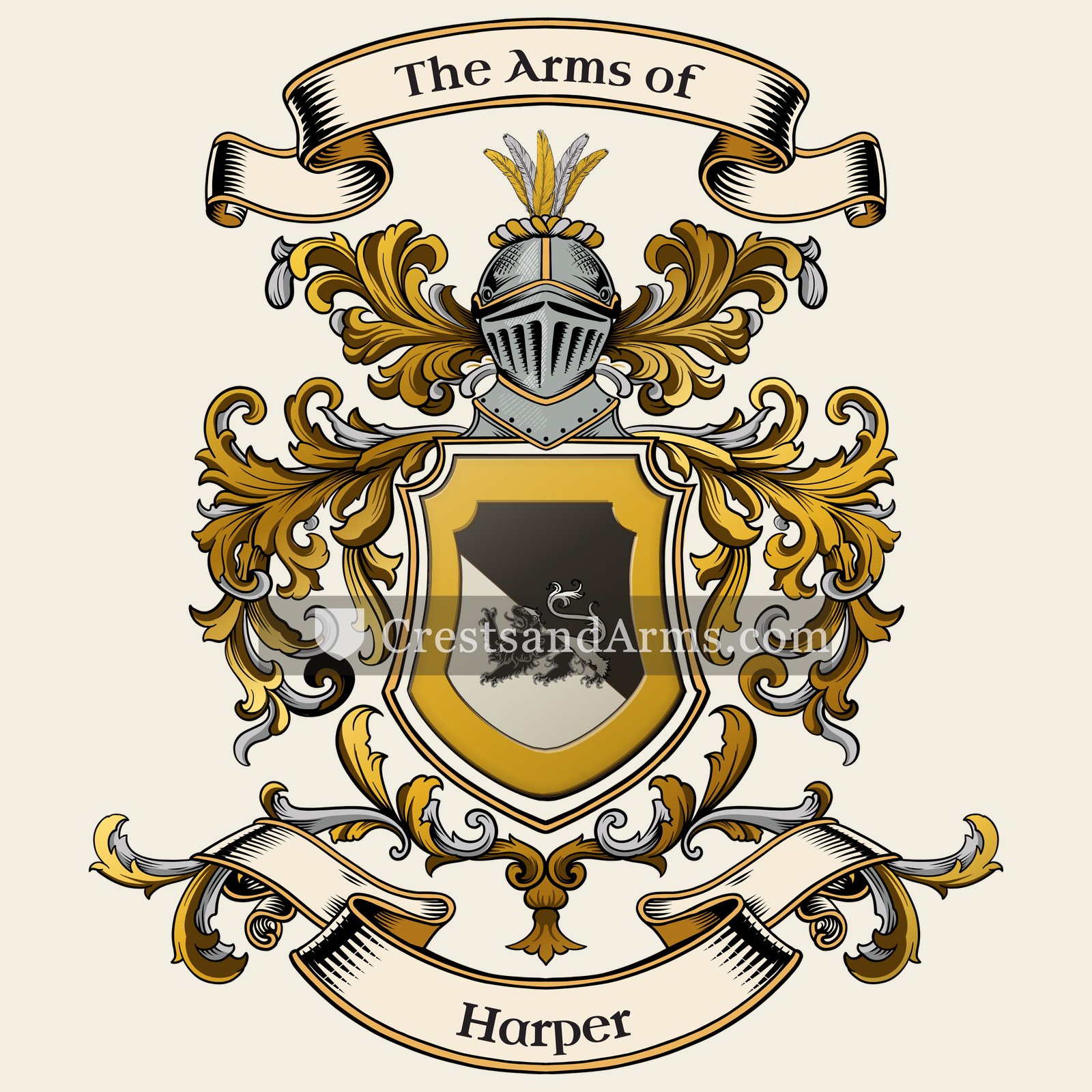
bordureA difference between branches of one family
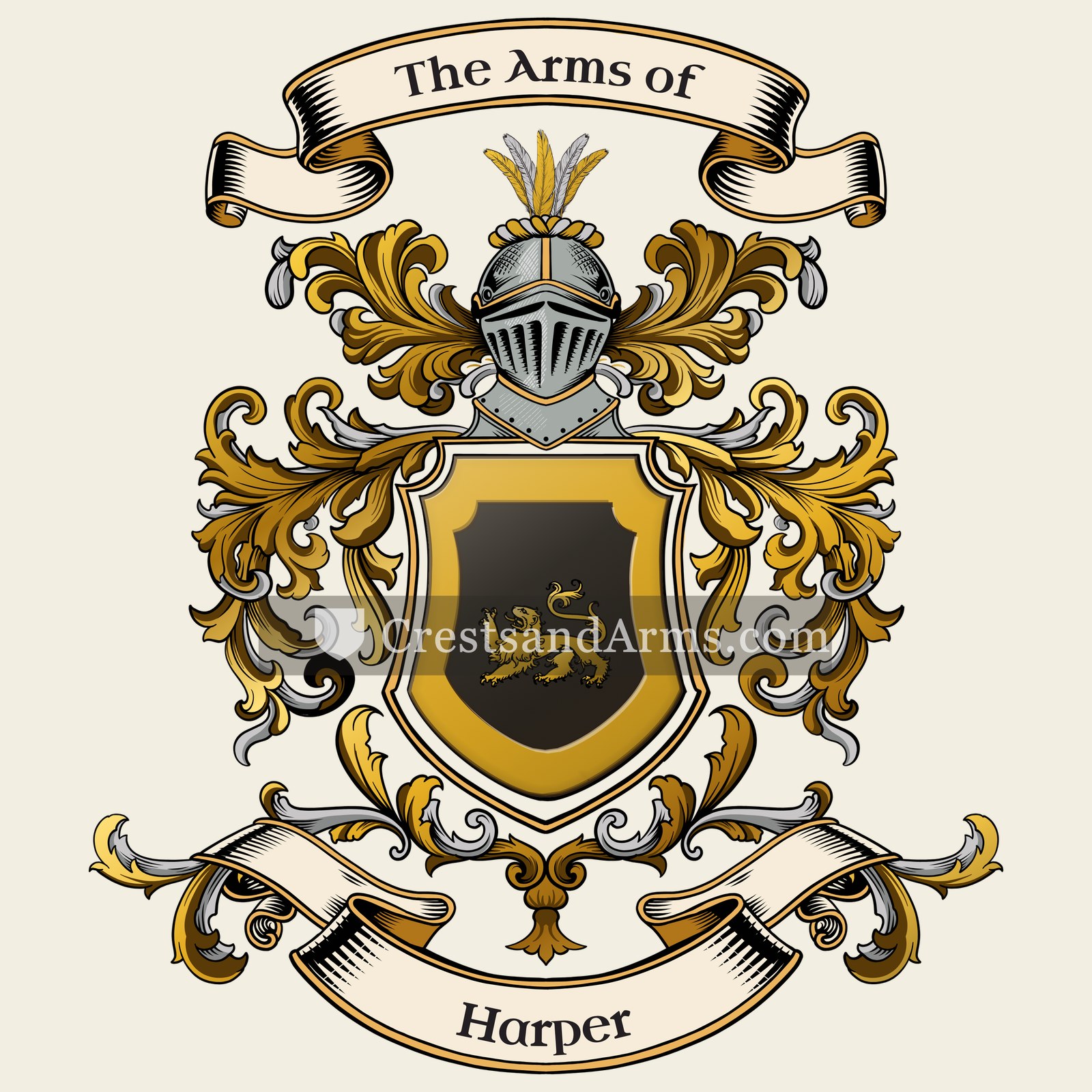
lionCourage, strength and royalty
Colours
Silver (Argent)Means: Peace and sincerity
Black (Sable)Means: Constancy
Gold (Or)Means: Generosity
Historical info
Source
Sir Bernard Burke, The General Armory of England, Scotland, Ireland and Wales, London: Harrison & Sons, 1884
Blazon (the actual original written record)
“Per bend sinister ar. and sa. a lion ramp. counterchanged, a border gobony or and gu”
DerbySwarkeston · Derby, c. 1752
Digital archive packCoat of arms PNG, gold border print PDF, vector SVG and the certificate of authenticity. Sent to your email in minutes.
Map of France showing where the Harper arms are recorded
The Harper arms were recorded in Derby, c. 1752.
Derbyshire had lead mines in its hills and good grazing in its valleys. Both made steady money, and families who made it bought manors, which is what put their names into the heraldic records.
This is where the arms were entered in the register. Families often moved to other parts of the country, so the same name can turn up in more than one region.
The body that granted and recorded arms in France in this period.
Louis XV of France
Sovereign of the period
Louis XV of France
1715–1774
Reigning in England when the Harper arms are first recorded.
How Arms Worked in France
In France, a coat of arms was a mark of honor that passed down through the male line to all legitimate descendants. Families often used the same shield without changes to show their shared heritage. If a branch wanted to stand out, they could add a small mark to their shield to show their specific place in the family tree.
Granting authority
The Juge d'armes de France acted as the official authority that regulated and verified coats of arms across the country.
How they got arms
Families typically inherited their arms from ancestors, though they could also receive them through royal grants or by proving their noble status.
Where arms were recorded
Coats of arms were officially recorded in the Armorial Général de France, which began its main collection in the year 1696.
The family's standing
Recorded among the armigerous families of Derby.
Origin & History of the Harper Family in France
The surname Harper originated as an occupational name for a person who played the harp, a profession held in high regard during the Middle Ages. While the name is famously associated with English history, its roots trace back to the Old French word *harpeur*. During the period following the Norman Conquest, many individuals with this title migrated from France to the British Isles, bringing their musical skills and their new occupational labels with them. By the time the name became firmly established in records in places like Derby by 1752, it had evolved from a simple description of a traveling musician into a permanent family identifier. These early ancestors were often essential members of local communities, providing entertainment at social gatherings and royal courts alike. Over several centuries, the name transitioned from a professional title used in French-speaking regions into a hereditary surname that traveled across borders and eventually settled into the English Midlands.
Harper Meaning & Related Branches
Root word
Hearpe
An Old English term for a stringed musical instrument.
This name
HarperAn occupational surname for a person who played the harp professionally.
also spelled
Harpar
Related arms
Herpersame arms
Harpurvariant spelling
Somervillerecorded with Harper, same area
Documented Sources
Sir Bernard Burke, The General Armory of England, Scotland, Ireland and Wales, London: Harrison & Sons, 1884
Reaney, P.H., A Dictionary of English Surnames, 1991
Bardsley, Charles Wareing, A Dictionary of English and Welsh Surnames, 1901
The National Archives, Prerogative Court of Canterbury and Related Probate Jurisdictions: Will Registers, 1547
Kent History and Library Centre, Archdeaconry Court of Canterbury: Wills and Administrations, 1547
Digital archive packCoat of arms PNG, gold border print PDF, vector SVG and the certificate of authenticity. Sent to your email in minutes.


 bordureA difference between branches of one family
 lionCourage, strength and royalty
 bordureA difference between branches of one family
 lionCourage, strength and royalty


 fessThe military belt, and readiness to serve
 harpWell-tuned governance and love of music