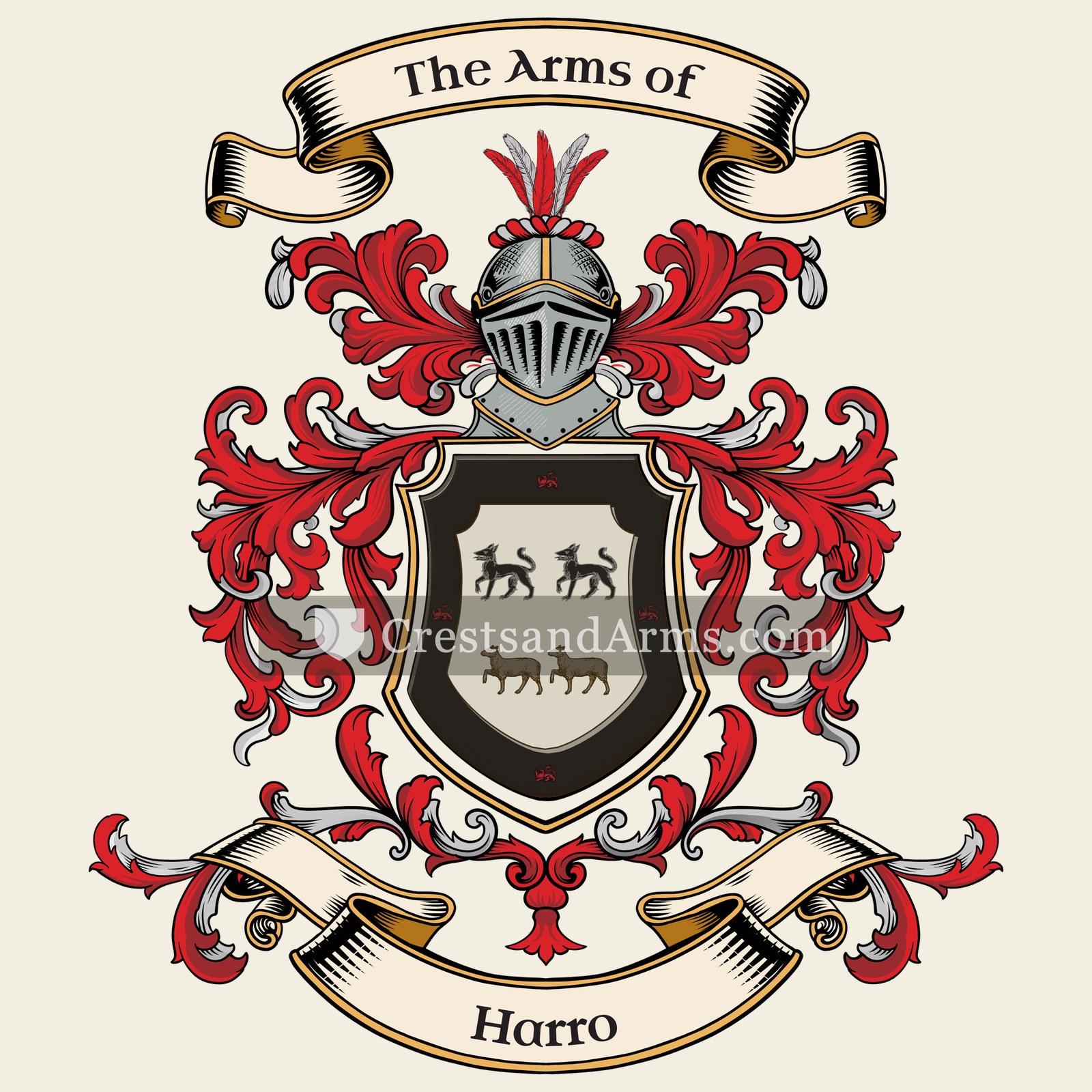
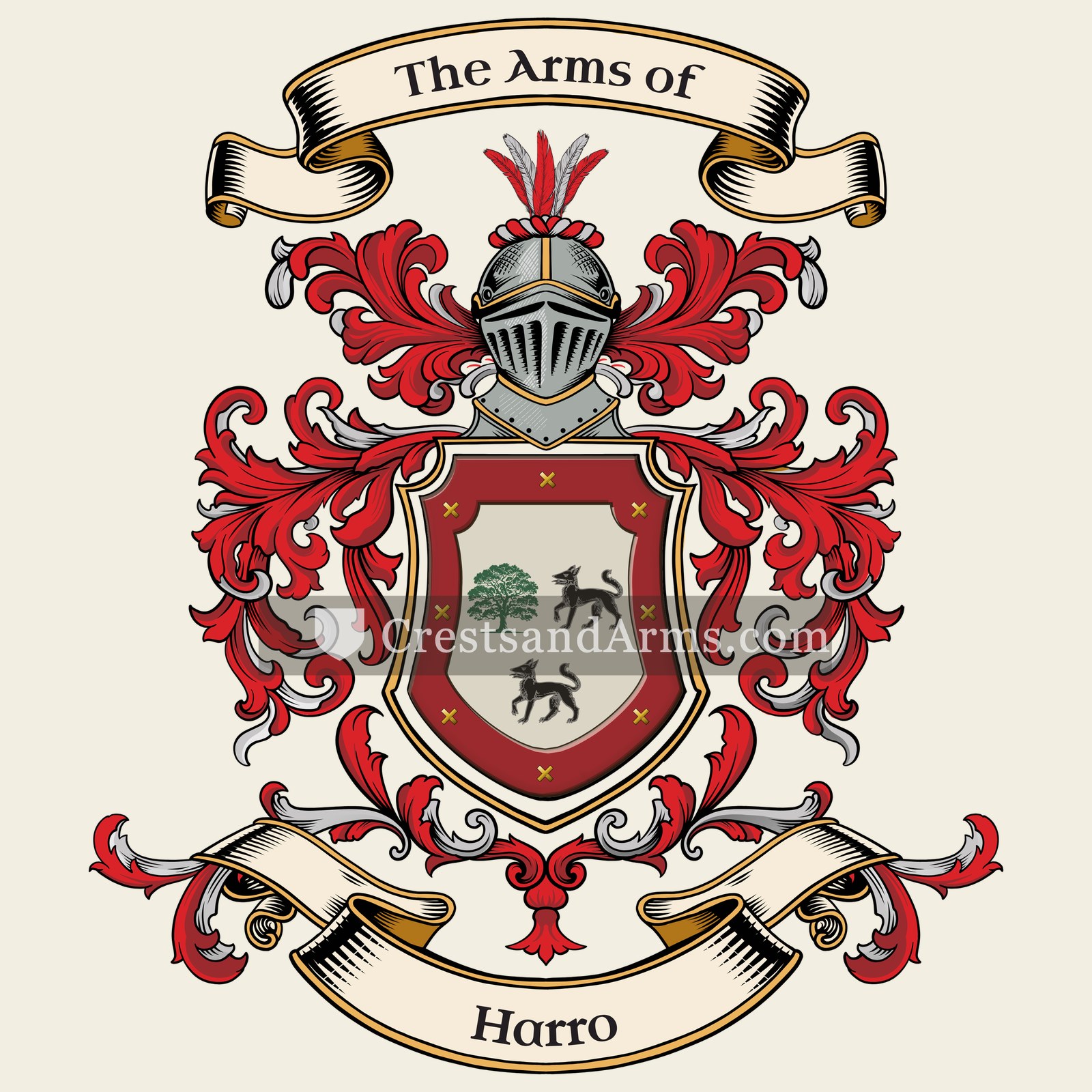
A record of documented arms, meaning and origin, researched for the Harro family lines. Documented in 2 countries.
Reg. 0222 · Spanish, G–I
Coat of Arms & Family Crest Details
Symbols on this shield
wolfReward from long service and hard work
lambGentleness, patience and faith
lionCourage, strength and royalty
Colours
Silver (Argent)Means: Peace and sincerity
Black (Sable)Means: Constancy
Red (Gules)Means: Military strength
Historical info
Source
J. B. Rietstap, Armorial Général, Gouda: G. B. van Goor Zonen, 1884–87
Blazon (the actual original written record)
“D'arg. à deux loups pass. de sa., l'un sur l'autre, ravissant chacun un agneau au nat.; à la bord. aussi d'arg. ch. de quatre lions de gu., 1, 2 et 1.”
AndalusiaAndalusia, c. 1722
Where the Harro Arms Were Recorded
Andalusia
Map of Spain showing where the Harro arms are recorded
The Harro arms were recorded in Andalusia, c. 1722.
Andalusia was the last part of Spain taken back from the Moors, and the land was shared out among the men who took it. A grant of land came with a grant of arms, so the region produced a great many.
This is where the arms were entered in the register. Families often moved to other parts of the country, so the same name can turn up in more than one region.
The body that granted and recorded arms in Spain in this period.
Philip V of Spain
Sovereign of the period
Philip V of Spain
1714–1724
Reigning in Spain when the Harro arms are first recorded.
How Arms Worked in Spain
In Spain, a coat of arms was considered a form of property that belonged to the entire family line. These arms were passed down from a father to all his children equally. Younger branches of the family usually kept the original design without needing to add any special marks to distinguish their specific line.
Granting authority
The Cronista Rey de Armas was the official body that regulated and granted coats of arms throughout Spain.
How they got arms
Families often obtained their arms through royal grants or by proving their noble status to the official heraldic authority.
Where arms were recorded
Coats of arms were officially recorded in the registers of the Cronista Rey de Armas starting in 1496.
The family's standing
Recorded among the armigerous families of Andalusia.
Origin & History of the Harro Family in Spain
The history of the Harro name in Spain is deeply connected to the social landscape of Andalusia during the early eighteenth century. By 1722, records indicate that members of the family were already established within this southern region, a time when Andalusia served as a vital hub for trade and agriculture. Families during this era often settled in specific towns to manage local land or participate in the bustling commerce of the Mediterranean ports. Because the name appears in administrative documents from this period, it suggests that the Harro family was part of the local citizenry who helped shape the community life of the Spanish countryside. Their presence in these historical records reflects the broader movement of families who built their lives and legacies in the provinces of Spain long before the modern era.
Coat of Arms & Family Crest Details
Symbols on this shield
saltireResolution, and St Andrew's cross
treeLife, endurance and deep roots
wolfReward from long service and hard work
saltire coupedResolution, and the cross of St Andrew
Colours
Silver (Argent)Means: Peace and sincerity
Red (Gules)Means: Military strength
Green (Vert)Means: Hope
Black (Sable)Means: Constancy
Gold (Or)Means: Generosity
Historical info
Source
J. B. Rietstap, Armorial Général, Gouda: G. B. van Goor Zonen, 1884–87
Blazon (the actual original written record)
“D'arg. à un arbre de sin., acc. de deux loups pass. de sa., l'un devant et l'autre derriere le fût; à la bord. de gu., ch. de huit flanchis d'or.”
Portugalc. 1706
Where the Harro Arms Were Recorded
Lisboa
Map of Portugal showing where the Harro arms are recorded
The Harro arms were recorded in Portugal, c. 1706.
Arms such as these were typically recorded in Lisboa.
Lisbon was the seat of the Portuguese crown and the port its wealth came through. Families made rich by trade and by service to the king took arms, and the crown's heralds recorded them there.
This is where the arms were entered in the register. Families often moved to other parts of the country, so the same name can turn up in more than one region.
The body that granted and recorded arms in Portugal in this period.
Peter II of Portugal
Sovereign of the period
Peter II of Portugal
1683–1706
Reigning in Spain when the Harro arms are first recorded.
How Arms Worked in Portugal
In Portugal, a coat of arms was a family possession that passed from a father to his children. Every legitimate descendant had the right to use the family shield without needing to change it. Younger branches of the family kept the original design, though they sometimes added small symbols to distinguish their specific line from the main branch.
Granting authority
The Cartório da Nobreza acted as the official body that managed and regulated noble titles and coats of arms in Portugal.
How they got arms
Families typically inherited their arms through bloodline, though they could also receive new grants from the crown for distinguished service.
Where arms were recorded
Coats of arms were officially recorded in the books of the Cartório da Nobreza starting in the year 1512.
The family's standing
Recorded among the armigerous families of Portugal.
Origin & History of the Harro Family in Portugal
The family name Harro appears in the historical landscape of Portugal during the early eighteenth century, with documented evidence placing family members in the city of Lisboa by 1706. During this period, Lisboa was a bustling center of trade and intellectual exchange, serving as a gateway between the Portuguese Empire and the rest of Europe. Families living in the capital at this time often navigated a society shaped by the reconstruction efforts following the economic shifts of the era. The presence of the Harro name in official records from 1706 suggests that these early ancestors were integrated into the urban fabric of the city, likely participating in the professional or mercantile activities that defined the life of the capital. While the name remains distinct, its early roots in Lisboa highlight a connection to a time of significant cultural transition in Portuguese history.
Related Branches & Arms
Root word
Har
A Germanic or Basque element often associated with a warrior or rock.
This name
HarroDerived from ancient roots signifying a strong, rocky, or resilient individual.
also spelled
Harro
Documented Sources
J. B. Rietstap, Armorial Général, Gouda: G. B. van Goor Zonen, 1884–87
Archivo General de Simancas, Registro del Sello de Corte
Archivo Histórico Nacional, Sección de Consejos
Madoz, Pascual, Diccionario geográfico-estadístico-histórico de España y sus posesiones de Ultramar, 1845
Digital archive packCoat of arms PNG, gold border print PDF, vector SVG and the certificate of authenticity. Sent to your email in minutes.


 wolfReward from long service and hard work
 lambGentleness, patience and faith
 lionCourage, strength and royalty
 wolfReward from long service and hard work
 lambGentleness, patience and faith
 lionCourage, strength and royalty

 saltireResolution, and St Andrew's cross
 treeLife, endurance and deep roots
 saltire coupedResolution, and the cross of St Andrew