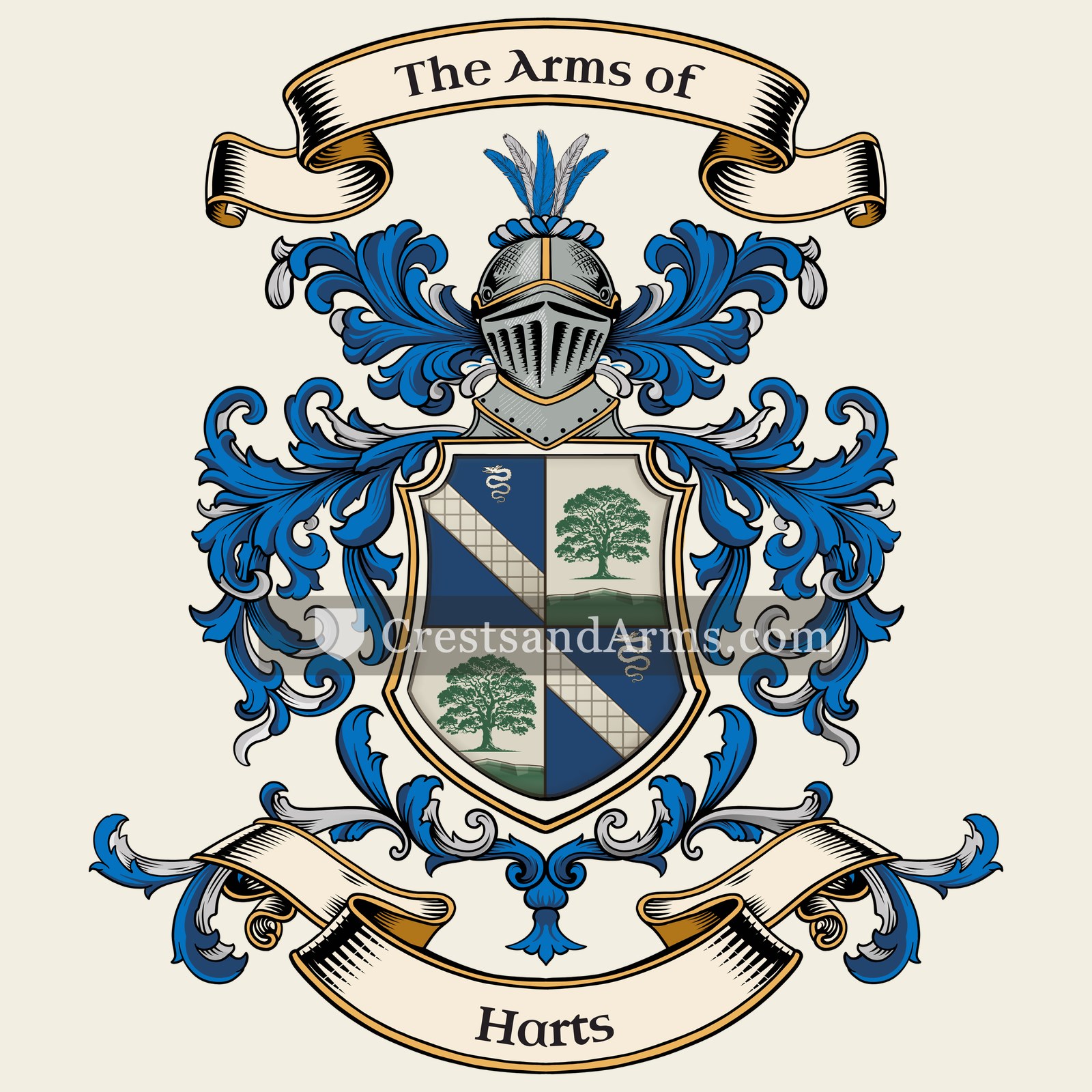
A record of documented arms, meaning and origin, researched for the Harts family of Germany.
Reg. 0140 · German, G–I
Coat of Arms & Family Crest Details
Symbols on this shield
mountThe ground held, and steadfastness upon it
fessThe military belt, and readiness to serve
serpentWisdom, healing and prudence
treeLife, endurance and deep roots
Colours
Blue (Azure)Means: Loyalty and truth
Silver (Argent)Means: Peace and sincerity
Green (Vert)Means: Hope
Historical info
Source
J. B. Rietstap, Armorial Général, Gouda: G. B. van Goor Zonen, 1884–87
Blazon (the actual original written record)
“Ec.: aux 1 et 4 d'azur à un bâton d'arg., accolé d'un serpent du même, tenant entre ses dents un trèfle de sin.; le serpent du 1 cont.; aux 2 et 3 d'arg. à un sapin de sin., posé sur un tertre du même. C.: un coq chantant d'arg., crêté et barbé de gu.; entre un vol d'azur, chaque aile ch. d'une fasce d'or, surch. du meuble du 1. L. d'arg. et d'azur.”
BavariaBavaria, c. 1825
Where the Harts Arms Were Recorded
Bavaria
Map of Germany showing where the Harts arms are recorded
The Harts arms were recorded in Bavaria, c. 1825.
Bavaria was a country of old landed families and walled market towns. Estates passed down the same line for centuries, and both the landowners and the leading townsmen kept arms, which is why so many Bavarian names sit in the registers.
This is where the arms were entered in the register. Families often moved to other parts of the country, so the same name can turn up in more than one region.
The body that granted and recorded arms in Germany in this period.
Frederick William III of Prussia
Sovereign of the period
Frederick William III of Prussia
1797–1840
Reigning in Germany when the Harts arms are first recorded.
How Arms Worked in Germany
Prussian heraldry was strictly tied to social rank and noble status rather than being a free choice for every citizen. These symbols were treated as permanent family property that moved through the generations to all legitimate heirs. If a family branch wanted to change their design to stand out, they had to apply for official permission to alter their specific version of the shield.
Granting authority
The Prussian Heroldsamt acted as the central state office that managed and strictly controlled all noble titles and coats of arms.
How they got arms
Families usually obtained their arms through formal royal grants or by proving their long-standing noble status to the state authorities.
Where arms were recorded
All official coats of arms were kept in the rolls of the Prussian Heroldsamt, which functioned from 1706 until 1918.
The family's standing
Recorded among the armigerous families of Bavaria.
Origin & History of the Harts Family in Germany
The family name Harts is deeply rooted in the historical landscape of Bavaria, where records confirm the presence of family members as early as 1825. The name likely originated as a descriptive term or a topographic identifier, reflecting the linguistic traditions of the German-speaking regions during that era. In the early nineteenth century, Bavaria was a kingdom undergoing significant social and administrative changes, and families like the Harts were often tied to the land through agricultural work or local trade. As the region transitioned into a more modern state, many families began to settle into specific towns, establishing deep community ties that lasted for generations. By studying the migration patterns and local parish records of this time, we can see how the name became a permanent part of the cultural fabric of southern Germany before many members eventually sought new opportunities abroad.
Related Branches & Arms
Root word
Hard
Old High German word meaning brave, hardy, or strong.
This name
HartsA patronymic or descriptive surname referring to a person who is courageous or physically robust.
also spelled
Harts
Documented Sources
J. B. Rietstap, Armorial Général, Gouda: G. B. van Goor Zonen, 1884–87


 mountThe ground held, and steadfastness upon it
 fessThe military belt, and readiness to serve
 serpentWisdom, healing and prudence
 treeLife, endurance and deep roots
 mountThe ground held, and steadfastness upon it
 fessThe military belt, and readiness to serve
 serpentWisdom, healing and prudence
 treeLife, endurance and deep roots