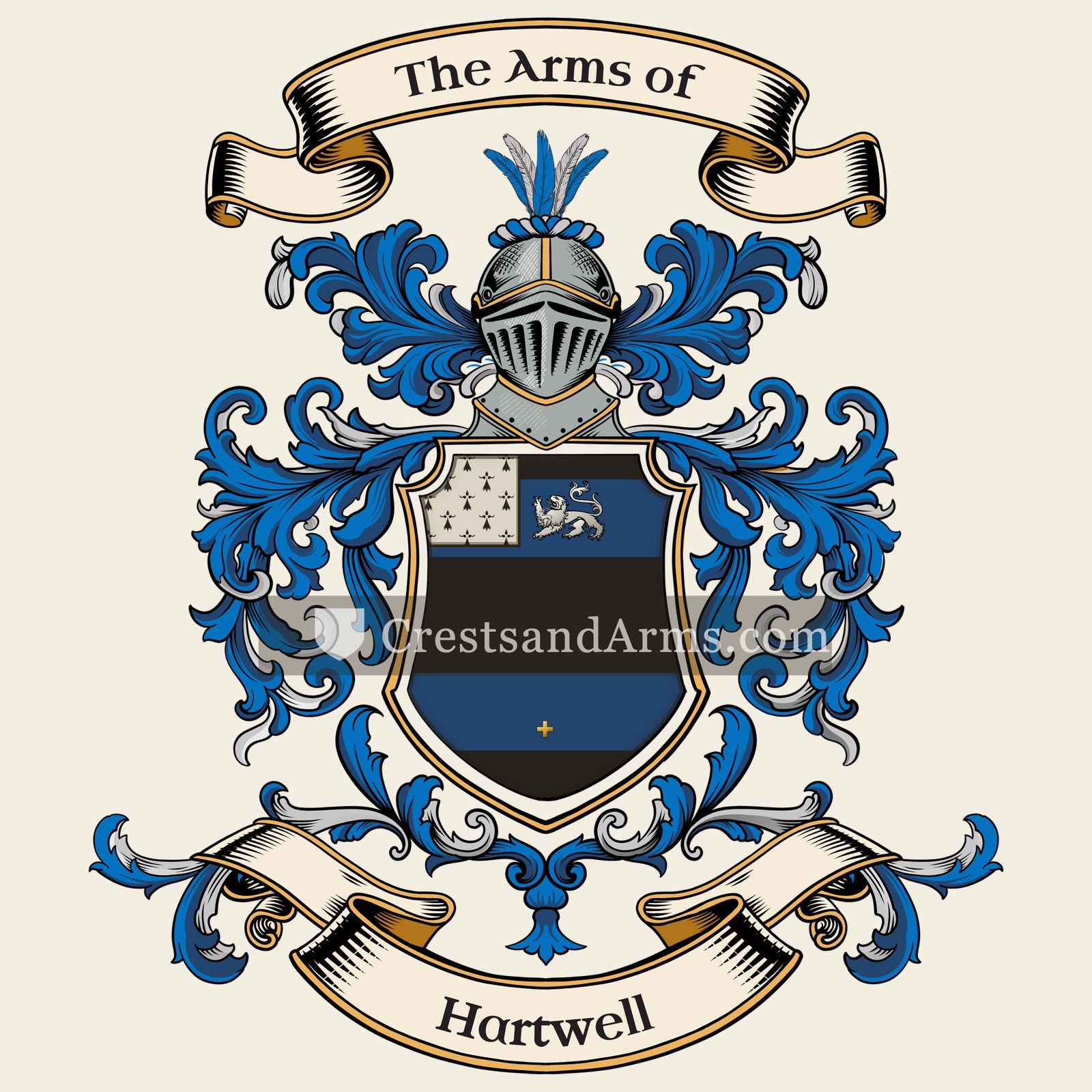
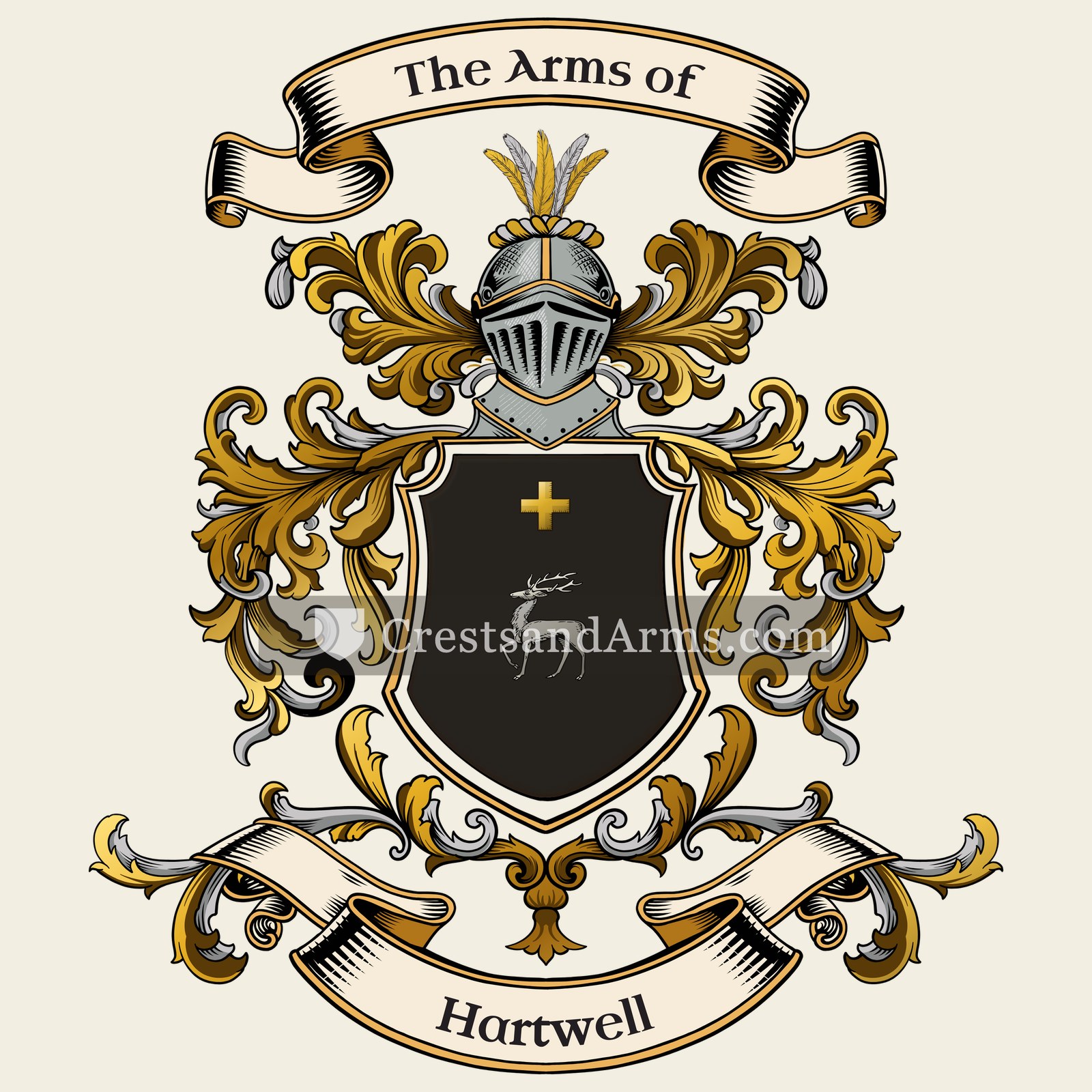
A record of documented arms, meaning and origin, researched for the Hartwell family lines. Documented in 2 countries.
Reg. 0764 · Britain, G–I
Coat of Arms & Family Crest Details
Symbols on this shield
cross symbolChristian faith and service
cantonA mark of honour granted by the sovereign
fessThe military belt, and readiness to serve
mountThe ground held, and steadfastness upon it
lionCourage, strength and royalty
stagPeace and harmony, and one who will not fight unprovoked
Colours
Black (Sable)Means: Constancy
Blue (Azure)Means: Loyalty and truth
ErmineMeans: Dignity
Silver (Argent)Means: Peace and sincerity
Gold (Or)Means: Generosity
Historical info
Source
J. B. Rietstap, Armorial Général, Gouda: G. B. van Goor Zonen, 1884–87
Blazon (the actual original written record)
“De sa. à un léopard parti d'arg. et d'or en chef, et un rencontre de cerf d'arg., ramé d'or, en p.; à la croix pattée au pied fiché d'or, posée entre les cornes du cerf; au canton d'herm., ch. de deux fasces parties d'azur et de gu. C.: un cerf d'arg., couché sur un tertre de sin., le pied dextre posé sur un puits d'arg.; le tertre entouré de sept palissades du même, les 2e et 5e ch. chacune d'un fer de pique ensanglanté; le cerf tenant entre ses dents une branche de chêne de sin. D.: SORTE SUA CONTENTUS.”
EssexEssex, c. 1805
Where the Hartwell Arms Were Recorded
Essex
Map of Britain showing where the Hartwell arms are recorded
The Hartwell arms were recorded in Essex, c. 1805.
Essex lay close enough to London for City money to buy land there. Merchants who prospered moved out to estates within a day's ride, and a new landowner almost always wanted arms to go with the ground.
This is where the arms were entered in the register. Families often moved to other parts of the country, so the same name can turn up in more than one region.
The body that granted and recorded arms in Britain in this period.
George III of Great Britain
Sovereign of the period
George III of Great Britain
1801–1820
Reigning in Britain when the Hartwell arms are first recorded.
How Arms Worked in Britain
English heraldry allowed arms to be shared by all legitimate descendants of the original owner. These symbols were treated as personal property that moved through the generations to all children. While the eldest son kept the original design, other family members could use the same shield without needing to change it or register their own unique versions.
Granting authority
The College of Arms in London has regulated the use of coats of arms throughout England and Wales since 1484.
How they got arms
Families typically obtained their coats of arms through a formal grant from the Crown or by proving their ancient right to them.
Where arms were recorded
All official coats of arms are recorded in the registers kept at the College of Arms, which date back to the fifteenth century.
The family's standing
Recorded among the armigerous families of Essex.
Origin & History of the Hartwell Family in Britain
The surname Hartwell is a locational name that originated in England during the Middle Ages. It is derived from Old English words meaning a spring or stream frequented by stags. Families bearing this name were historically tied to specific parishes and manors, particularly in the county of Essex, where records confirm their presence by the early nineteenth century. During this period, the Hartwell family was deeply integrated into the local agricultural and social fabric of the region. As the Industrial Revolution began to reshape Britain, many families with this name transitioned from traditional rural livelihoods to the growing opportunities in towns and cities. By 1805, the family was well-established in Essex, reflecting a long history of residence in the English countryside that likely stretched back several generations before the turn of the century.
Coat of Arms & Family Crest Details
Symbols on this shield
cross symbolChristian faith and service
stagPeace and harmony, and one who will not fight unprovoked
Colours
Black (Sable)Means: Constancy
Silver (Argent)Means: Peace and sincerity
Gold (Or)Means: Generosity
Historical info
Source
Sir Bernard Burke, The General Armory of England, Scotland, Ireland and Wales, London: Harrison & Sons, 1884
Blazon (the actual original written record)
“Sa. a buck's head cabossed ar. betw. the attires a cross formée or”
NorthamptonNorthampton, c. 1620
Where the Hartwell Arms Were Recorded
Northampton
Map of England showing where the Hartwell arms are recorded
The Hartwell arms were recorded in Northampton, c. 1620.
Northamptonshire was grazing and hunting country in the middle of England, thick with manor houses. Its families were numerous and long-settled, and a settled landed family almost always ended up with arms.
This is where the arms were entered in the register. Families often moved to other parts of the country, so the same name can turn up in more than one region.
The body that granted and recorded arms in England in this period.
James VI and I
Sovereign of the period
James VI and I
1603–1625
Reigning in Britain when the Hartwell arms are first recorded.
How Arms Worked in England
English heraldry allowed arms to be shared by all legitimate descendants of the original owner. These symbols were treated as personal property that moved through the generations to all children. While the eldest son kept the original design, other family members could use the same shield without needing to change it or register their own unique versions.
Granting authority
The College of Arms in London has regulated the use of coats of arms throughout England and Wales since 1484.
How they got arms
Families typically obtained their coats of arms through a formal grant from the Crown or by proving their ancient right to them.
Where arms were recorded
All official coats of arms are recorded in the registers kept at the College of Arms, which date back to the fifteenth century.
The family's standing
Recorded among the armigerous families of Northampton.
Origin & History of the Hartwell Family in England
The name Hartwell is a locational surname that originated in England, specifically referring to people who lived near a spring or stream frequented by stags. The name is derived from the Old English words "heort," meaning stag, and "wella," meaning a spring or well. By the early 17th century, the family had established a notable presence in Northamptonshire. Records from 1620 confirm that members of the Hartwell family were active in this region during a period of significant social and economic transition in England. As the family grew, they became part of the local fabric of Northampton, contributing to the community life of the county long before many of their descendants eventually migrated to the American colonies. This history reflects the common practice of families taking their names from the natural landmarks of their ancestral villages.
Related Branches & Arms
Root word
Heort and Wielle
Old English terms for a stag and a spring or stream.
This name
HartwellA topographical name referring to a spring or stream frequented by stags.
also spelled
Hartwel
Hartwill
Hartwille
Documented Sources
J. B. Rietstap, Armorial Général, Gouda: G. B. van Goor Zonen, 1884–87
Reaney, P.H., A Dictionary of British Surnames, 1958
Essex Record Office, Parish Registers for the County of Essex, D/P series
Digital archive packCoat of arms PNG, gold border print PDF, vector SVG and the certificate of authenticity. Sent to your email in minutes.


 cross symbolChristian faith and service
 cantonA mark of honour granted by the sovereign
 fessThe military belt, and readiness to serve
 mountThe ground held, and steadfastness upon it
 lionCourage, strength and royalty
 stagPeace and harmony, and one who will not fight unprovoked
 cross symbolChristian faith and service
 cantonA mark of honour granted by the sovereign
 fessThe military belt, and readiness to serve
 mountThe ground held, and steadfastness upon it
 lionCourage, strength and royalty
 stagPeace and harmony, and one who will not fight unprovoked