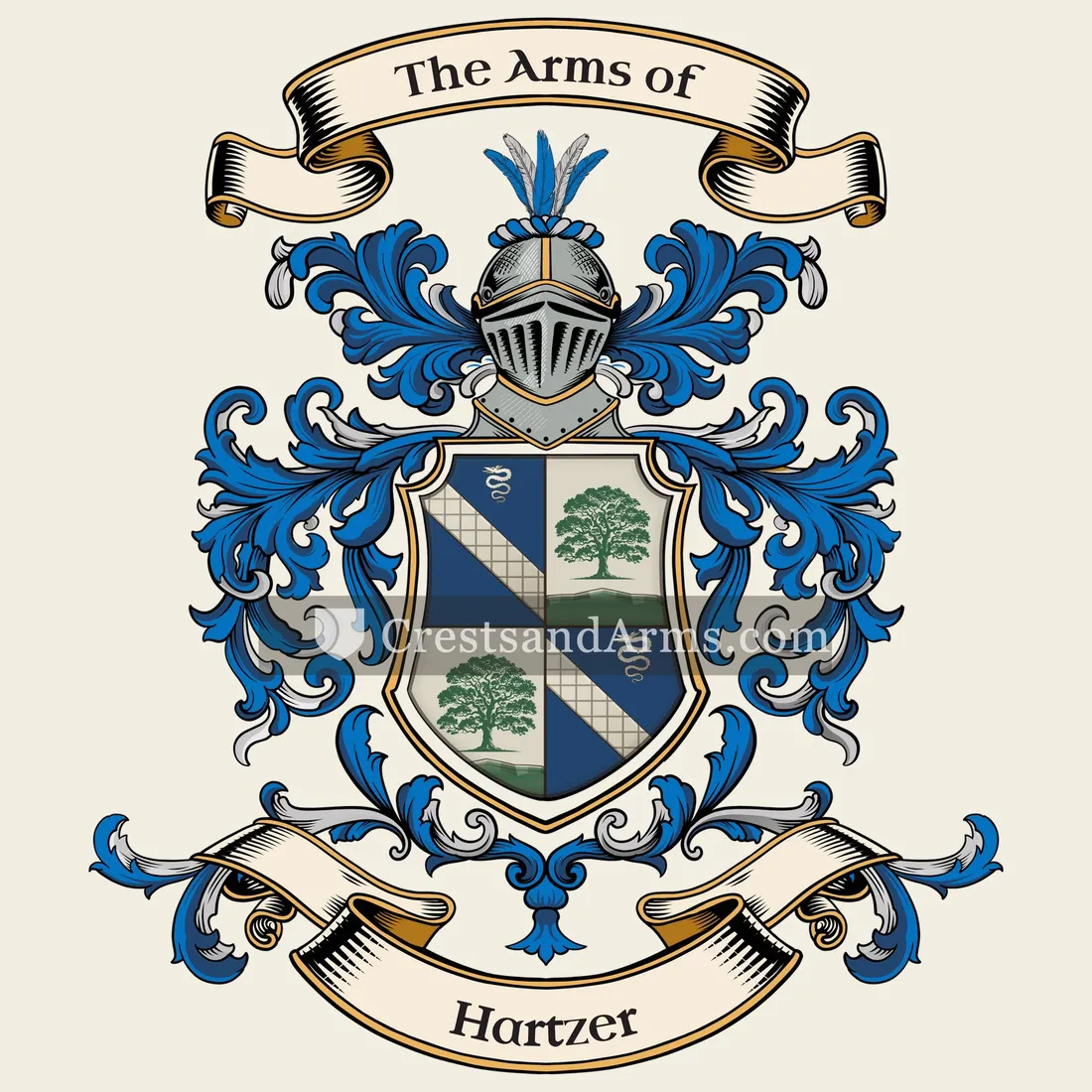
A record of documented arms, meaning and origin, researched for the Hartzer family of Germany.
Reg. 0919 · German, G–I
Meaning of the Hartzer family crest colors & symbols
Symbols on this shield
mountThe ground held, and steadfastness upon it
serpentWisdom, healing and prudence
treeLife, endurance and deep roots
Colours
Blue (Azure)Means: Loyalty and truth
Silver (Argent)Means: Peace and sincerity
Green (Vert)Means: Hope
Historical info
Source
J. B. Rietstap, Armorial Général, Gouda: G. B. van Goor Zonen, 1884–87
Blazon (the actual original written record)
“Ec.: aux 1 et 4 d'azur à un bâton d'arg., accolé d'un serpent du même, tenant entre ses dents un trèfle de sin.; le serpent du 1 cont.; aux 2 et 3 d'arg. à un sapin de sin., posé sur un tertre du même. C.: un coq chantant d'arg., crêté et barbé de gu.; entre un vol d'azur, chaque aile ch. d'une fasce d'or, surch. du meuble du 1. L. d'arg. et d'azur.”
BavariaBavaria, c. 1825
Digital archive packCoat of arms PNG, gold border print PDF, vector SVG and the certificate of authenticity. Sent to your email in minutes.
Map of Germany showing where the Hartzer arms are recorded
The Hartzer arms were recorded in Bavaria, c. 1825.
Bavaria was a country of old landed families and walled market towns. Estates passed down the same line for centuries, and both the landowners and the leading townsmen kept arms, which is why so many Bavarian names sit in the registers.
This is where the arms were entered in the register. Families often moved to other parts of the country, so the same name can turn up in more than one region.
The body that granted and recorded arms in Germany in this period.
Frederick William III of Prussia
Sovereign of the period
Frederick William III of Prussia
1797–1840
Reigning in Germany when the Hartzer arms are first recorded.
How Arms Worked in Germany
Prussian heraldry was strictly tied to social rank and noble status rather than being a free choice for every citizen. These symbols were treated as permanent family property that moved through the generations to all legitimate heirs. If a family branch wanted to change their design to stand out, they had to apply for official permission to alter their specific version of the shield.
Granting authority
The Prussian Heroldsamt acted as the central state office that managed and strictly controlled all noble titles and coats of arms.
How they got arms
Families usually obtained their arms through formal royal grants or by proving their long-standing noble status to the state authorities.
Where arms were recorded
All official coats of arms were kept in the rolls of the Prussian Heroldsamt, which functioned from 1706 until 1918.
The family's standing
Recorded among the armigerous families of Bavaria.
Origin & History of the Hartzer Family in Germany
The surname Hartzer is rooted in the historical regions of Southern Germany, specifically within the state of Bavaria. By the early 19th century, records confirm that families bearing this name were well-established in the Bavarian landscape. The name is likely derived from the Middle High German word "hart," which refers to a wooded hill or a forest clearing. This suggests that the earliest ancestors were likely people who lived near or worked within these specific types of landscapes. As the family grew during the 1820s, they were part of a society transitioning through significant agricultural and social changes in the German states. These ancestors were typically tied to the land, working as farmers or skilled tradespeople who helped shape the local economy of their villages. Over time, the name became a permanent marker of their heritage, reflecting a deep connection to the geography of the Bavarian countryside.
Hartzer Meaning & Related Branches
Root word
Hart
Old High German word meaning brave, hardy, or strong.
This name
HartzerAn occupational or descriptive name for a person who was exceptionally tough or courageous.
also spelled
Harts
Documented Sources
J. B. Rietstap, Armorial Général, Gouda: G. B. van Goor Zonen, 1884–87
Bayerisches Hauptstaatsarchiv, Königlich Bayerisches Staatsministerium des Innern, Kirchenbücher und Standesregister
Bredt, Johann Victor, Die Entwicklung des deutschen Namenswesens, 1927
Heintze, Albert, Die deutschen Familiennamen: geschichtlich, geographisch, sprachlich, 1903
Digital archive packCoat of arms PNG, gold border print PDF, vector SVG and the certificate of authenticity. Sent to your email in minutes.


 mountThe ground held, and steadfastness upon it
 serpentWisdom, healing and prudence
 treeLife, endurance and deep roots
 mountThe ground held, and steadfastness upon it
 serpentWisdom, healing and prudence
 treeLife, endurance and deep roots