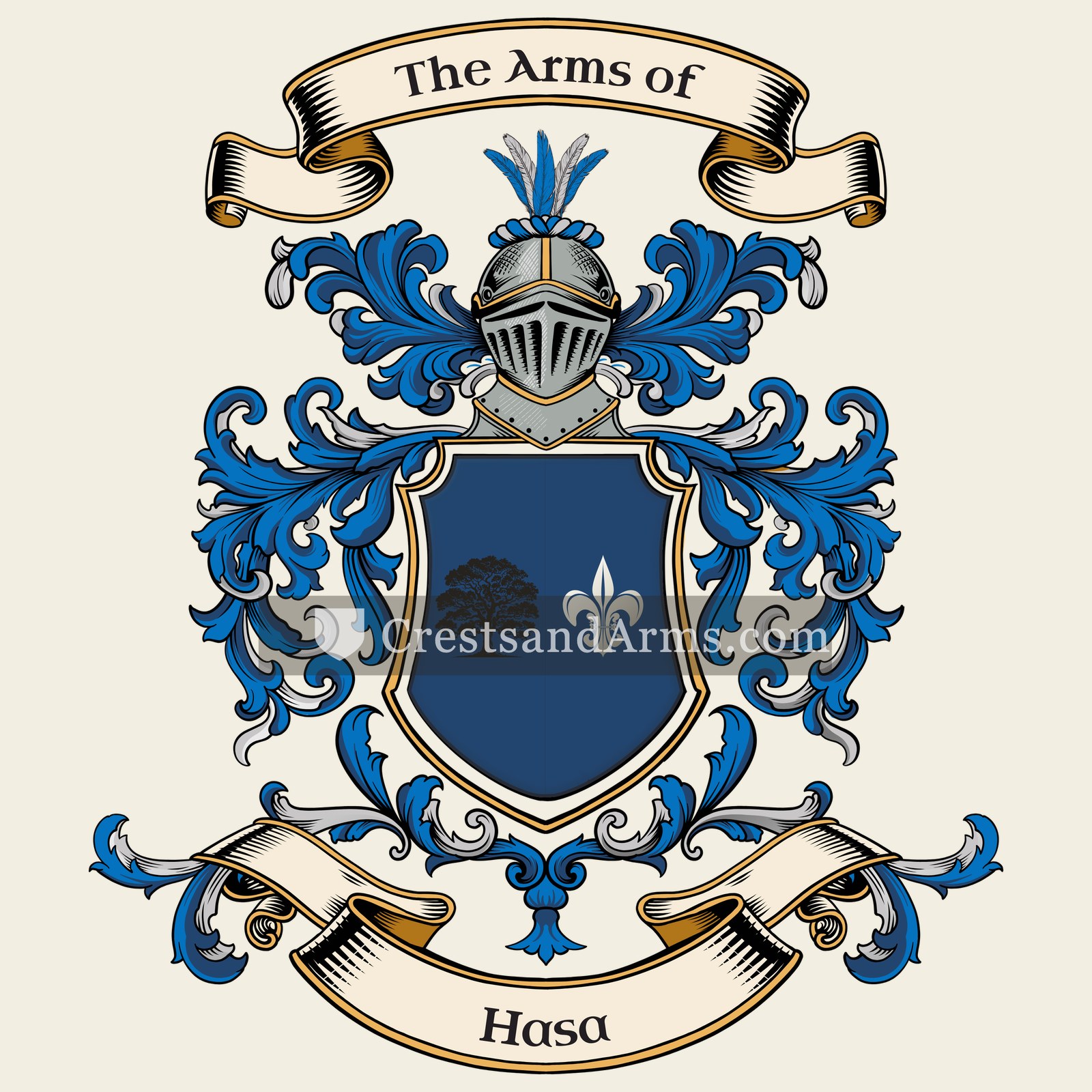
A record of documented arms, meaning and origin, researched for the Hasa family of Germany.
Reg. 7787 · German, G–I
Coat of Arms & Family Crest Details
Symbols on this shield
treeLife, endurance and deep roots
fleur de lisPurity, light, and the sixth son
Colours
Blue (Azure)Means: Loyalty and truth
Black (Sable)Means: Constancy
Silver (Argent)Means: Peace and sincerity
Historical info
Source
J. B. Rietstap, Armorial Général, Gouda: G. B. van Goor Zonen, 1884–87
Blazon (the actual original written record)
“Parti: au 1 d'azur à un chicot de sa. en pal, fruité à dextre de trois fruits de gu., l'un sur l'autre; au 2 d'azur à une demi fleur-de-lis d'arg., mouv. du parti. Cq. cour. C.: le chicot, posé en pal, privé des fruits; entre un vol, coupé d'arg. sur azur. L. d'arg. et d'azur.”
GermanyBerlin, c. 1725
Where the Hasa Arms Were Recorded
Berlin
Map of Germany showing where the Hasa arms are recorded
The Hasa arms were recorded in Berlin, c. 1725.
This is where the arms were entered in the register. Families often moved to other parts of the country, so the same name can turn up in more than one region.
The body that granted and recorded arms in Germany in this period.
Charles VI, Holy Roman Emperor
Sovereign of the period
Charles VI, Holy Roman Emperor
1711–1740
Reigning in Germany when the Hasa arms are first recorded.
How Arms Worked in Germany
In the Holy Roman Empire, coats of arms were often granted to individuals by the Emperor or his representatives. These arms were then passed down through the generations to all legitimate descendants of the original holder. Younger branches of a family usually kept the same shield design without needing to change it, as the arms belonged to the entire lineage.
Granting authority
The Holy Roman Emperor held the sole power to grant new coats of arms throughout his vast imperial territories.
How they got arms
Families typically obtained their coats of arms through a formal imperial grant or by proving their noble status to the authorities.
Where arms were recorded
These grants were officially recorded in the Imperial Chancery registers, which began keeping formal records of such honors during the Middle Ages.
The family's standing
Recorded among the armigerous families of Germany.
Origin & History of the Hasa Family in Germany
The Hasa family name has roots that trace back to the vibrant urban landscape of eighteenth-century Berlin. By 1725, records confirm that members of the family were already established residents within the city. During this period, Berlin was undergoing significant growth as a center for trade and administration under the Prussian monarchy. Families like the Hasas often played roles in the city’s developing craft guilds or local mercantile networks, which were essential to the daily function of the capital. While the name itself may have evolved from local linguistic patterns or regional dialects common to the Brandenburg area, its presence in the city archives highlights a long-standing connection to the social and economic life of early modern Germany. This early documentation suggests that the family was part of the steady migration and urbanization that defined Berlin as it transformed into a major European power.
Related Branches & Arms
Root word
Hasso
A short form of Germanic names containing the element hadu meaning battle.
This name
HasaA habitational name derived from the Old High German word for a hare or a battle-hardened warrior.
also spelled
Hassen
Hasseh
Hass
Hasa
Documented Sources
J. B. Rietstap, Armorial Général, Gouda: G. B. van Goor Zonen, 1884–87
Landesarchiv Berlin, Kirchenbücher der Berliner Gemeinden (Church records of Berlin parishes)


 treeLife, endurance and deep roots
 fleur de lisPurity, light, and the sixth son
 treeLife, endurance and deep roots
 fleur de lisPurity, light, and the sixth son