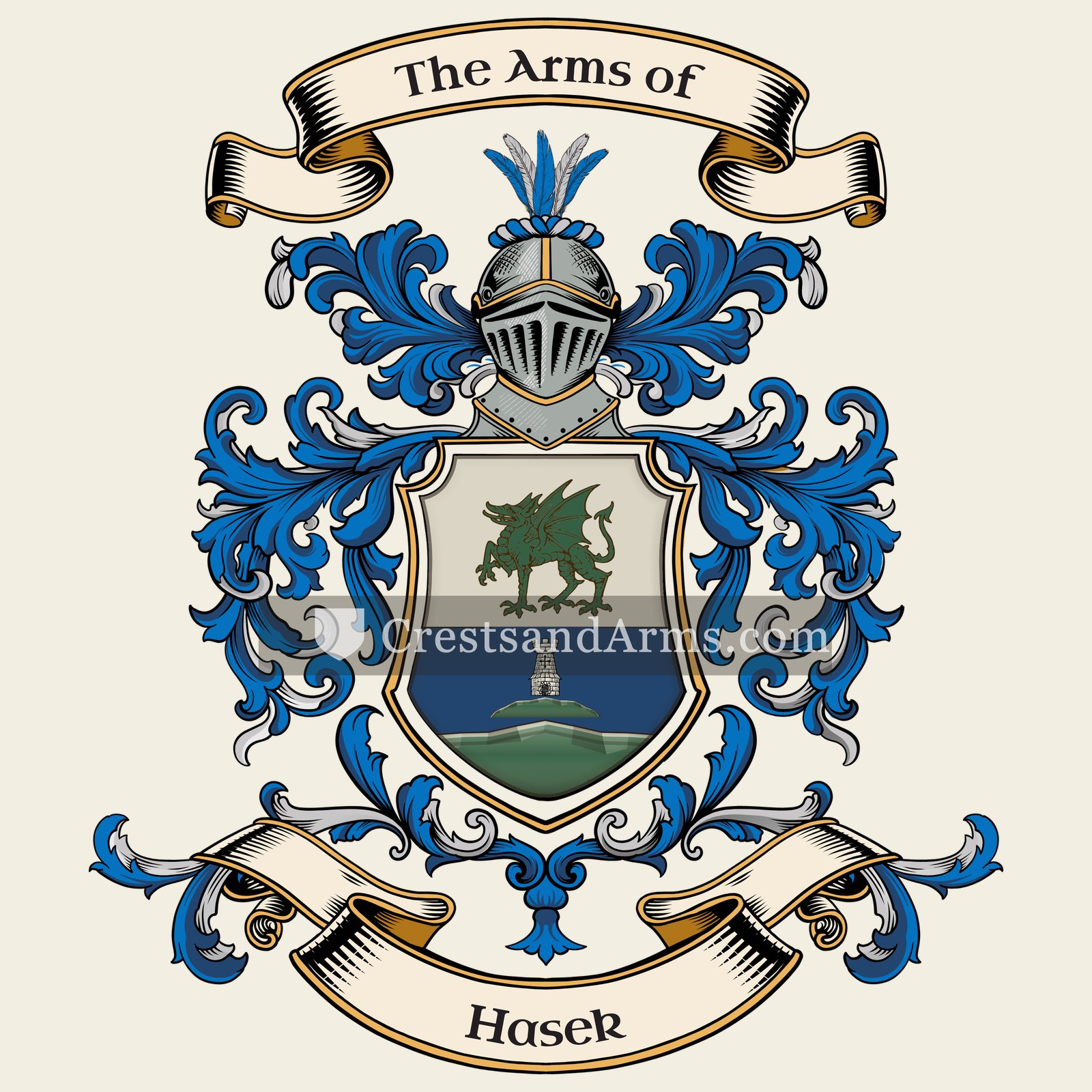
A record of documented arms, meaning and origin, researched for the Hasek family of Austria.
Reg. 2761 · Austrian, G–I
Coat of Arms & Family Crest Details
Symbols on this shield
mountThe ground held, and steadfastness upon it
dragonA most valiant defender of treasure
towerGrandeur and solidity, and a stronghold defended
Colours
Silver (Argent)Means: Peace and sincerity
Blue (Azure)Means: Loyalty and truth
Green (Vert)Means: Hope
Historical info
Source
J. B. Rietstap, Armorial Général, Gouda: G. B. van Goor Zonen, 1884–87
Blazon (the actual original written record)
“Coupé: au 1 d'arg. à un dragon de sin., langué de gu., les ailes levées, pass. sur la ligne du coupé; au 2 d'azur à un château d'arg., maçonné de sa., sommé de deux tours d'arg., la porte fermée, posé sur une terrasse de sin. Cq. cour. C.: un bras, arm. d'arg., lisé d'or, brandissant une épée d'arg., garnie d'or; entre un vol, coupé alt. d'arg. et d'azur. L. d'arg. et d'azur.”
Austriac. 1772
Where the Hasek Arms Were Recorded
Tyrol
Map of Austria showing where the Hasek arms are recorded
The Hasek arms were recorded in Austria, c. 1772.
Arms such as these were typically recorded in Tyrol.
Tyrol was mountain country in western Austria, where the valleys were held by families who had been there a very long time. Old tenure counted for more than money, and old families carried arms.
This is where the arms were entered in the register. Families often moved to other parts of the country, so the same name can turn up in more than one region.
Region
Tyrol
First recorded
1772
Granting Authority for the Hasek Arms
Imperial and Royal chancery
Sodacan · CC BY-SA 3.0
The body that granted and recorded arms in Austria in this period.
Joseph II, Holy Roman Emperor
Sovereign of the period
Joseph II, Holy Roman Emperor
1765–1790
Reigning in Austria when the Hasek arms are first recorded.
How Arms Worked in Austria
Austrian coats of arms were often linked directly to noble titles granted by the Emperor. These symbols belonged to the entire family line rather than just one individual. When a family grew, new branches kept the original design without needing to change it. This system allowed all members of a noble house to share the same identity across many generations.
Granting authority
The Imperial and Royal chancery managed all heraldic matters and controlled the official granting of arms throughout the Austrian lands.
How they got arms
Families typically received their arms through a formal imperial decree that often accompanied the elevation of a person to noble status.
Where arms were recorded
Official records of these grants were kept in the Imperial Register of Nobility which began its formal documentation process in 1453.
The family's standing
Recorded among the armigerous families of Austria.
Origin & History of the Hasek Family in Austria
The surname Hasek has deep roots in the historical region of Tyrol, where records confirm the presence of the family as early as 1772. The name likely originated as a diminutive form of the Slavic word for hare, which suggests that early ancestors may have been known for their speed, agility, or perhaps their occupation as hunters in the rugged Alpine landscape. During the late 18th century, Tyrol was a crossroads of culture and trade within the Habsburg Empire, and families like the Haseks were often integrated into the local agrarian or craft-based economies that defined mountain village life. As the family established themselves in this region, they became part of the unique social fabric of the Tyrolian highlands, where community identity was shaped by both the harsh mountain environment and the complex political shifts of Central Europe. Over time, the name persisted as a marker of this specific lineage, connecting modern descendants to the traditions and daily struggles of their ancestors living in the shadow of the Alps.
Related Branches & Arms
Root word
Havel
A Czech diminutive form of the name Gallus or Gall.
This name
HasekA patronymic surname derived from a nickname for a person named Havel.
also spelled
Hasseck
Hasek
Hasseke
Documented Sources
J. B. Rietstap, Armorial Général, Gouda: G. B. van Goor Zonen, 1884–87
Tiroler Landesarchiv, Tiroler Tauf- und Heiratsregister (Tyrolean Baptism and Marriage Registers)


 mountThe ground held, and steadfastness upon it
 dragonA most valiant defender of treasure
 towerGrandeur and solidity, and a stronghold defended
 mountThe ground held, and steadfastness upon it
 dragonA most valiant defender of treasure
 towerGrandeur and solidity, and a stronghold defended