A record of documented arms, meaning and origin, researched for the Hashman family lines. Documented in 2 countries.
Reg. 7656 · German, G–I
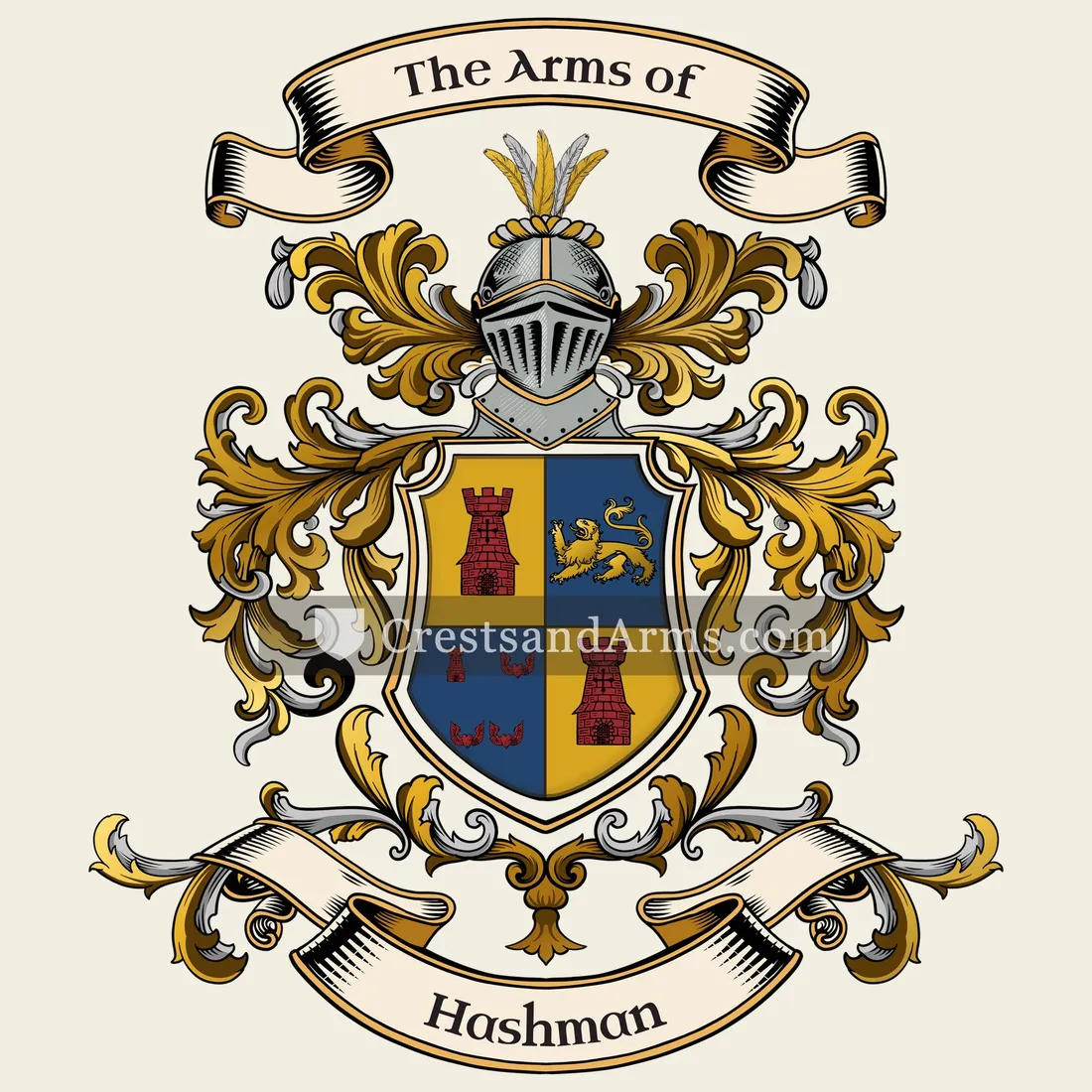
Meaning of the Hashman family crest colors & symbols
Symbols on this shield
towerGrandeur and solidity, and a stronghold defended
lionCourage, strength and royalty
heartSincerity, charity and true affection
Colours
Gold (Or)Means: Generosity
Blue (Azure)Means: Loyalty and truth
Red (Gules)Means: Military strength
Historical info
Source
J. B. Rietstap, Armorial Général, Gouda: G. B. van Goor Zonen, 1884–87
Blazon (the actual original written record)
“Ec.: aux 1 et 4 d'or à une maisonnette de gu., sommée de deux girouettes du même, l'une sur le devant et l'autre sur le derrière du toit; au 2 d'azur au lion d'or, cour. du même, tenant de chaque patte un drapeau de gu.; au 3 d'arg. à un château de gu. en chef, surmontant trois coeurs de gu., 2 et 1. Cq. cour. C.: un vol d'arg.”
GermanyBrème, c. 1737
Digital archive packCoat of arms PNG, gold border print PDF, vector SVG and the certificate of authenticity. Sent to your email in minutes.
Map of Germany showing where the Hashman arms are recorded
The Hashman arms were recorded in Brème, c. 1737.
This is where the arms were entered in the register. Families often moved to other parts of the country, so the same name can turn up in more than one region.
The body that granted and recorded arms in Germany in this period.
Charles VI, Holy Roman Emperor
Sovereign of the period
Charles VI, Holy Roman Emperor
1711–1740
Reigning in Germany when the Hashman arms are first recorded.
How Arms Worked in Germany
In the Holy Roman Empire, coats of arms were often granted to individuals by the Emperor or his representatives. These arms were then passed down through the generations to all legitimate descendants of the original holder. Younger branches of a family usually kept the same shield design without needing to change it, as the arms belonged to the entire lineage.
Granting authority
The Holy Roman Emperor held the sole power to grant new coats of arms throughout his vast imperial territories.
How they got arms
Families typically obtained their coats of arms through a formal imperial grant or by proving their noble status to the authorities.
Where arms were recorded
These grants were officially recorded in the Imperial Chancery registers, which began keeping formal records of such honors during the Middle Ages.
The family's standing
Recorded among the armigerous families of Germany.
Origin & History of the Hashman Family in Germany
The family name Hashman finds its historical roots in the region of northern Germany, specifically within the city-state of Bremen. By 1737, records confirm that members of the family were already established residents of this bustling port city. During the eighteenth century, Bremen served as a vital hub for international trade and commerce, which likely influenced the daily lives and occupations of early family members. As inhabitants of a Free Imperial City, these individuals lived under a unique political structure that granted them a degree of autonomy compared to those in the surrounding territories. The name itself likely evolved from local linguistic patterns in the Lower Saxon dialect, reflecting the naming traditions common among the merchant and artisan classes of the Hanseatic region. This early presence in such a significant maritime center suggests that the family was well-integrated into the social and economic fabric of German urban life long before the waves of migration that would eventually spread the name across the globe.
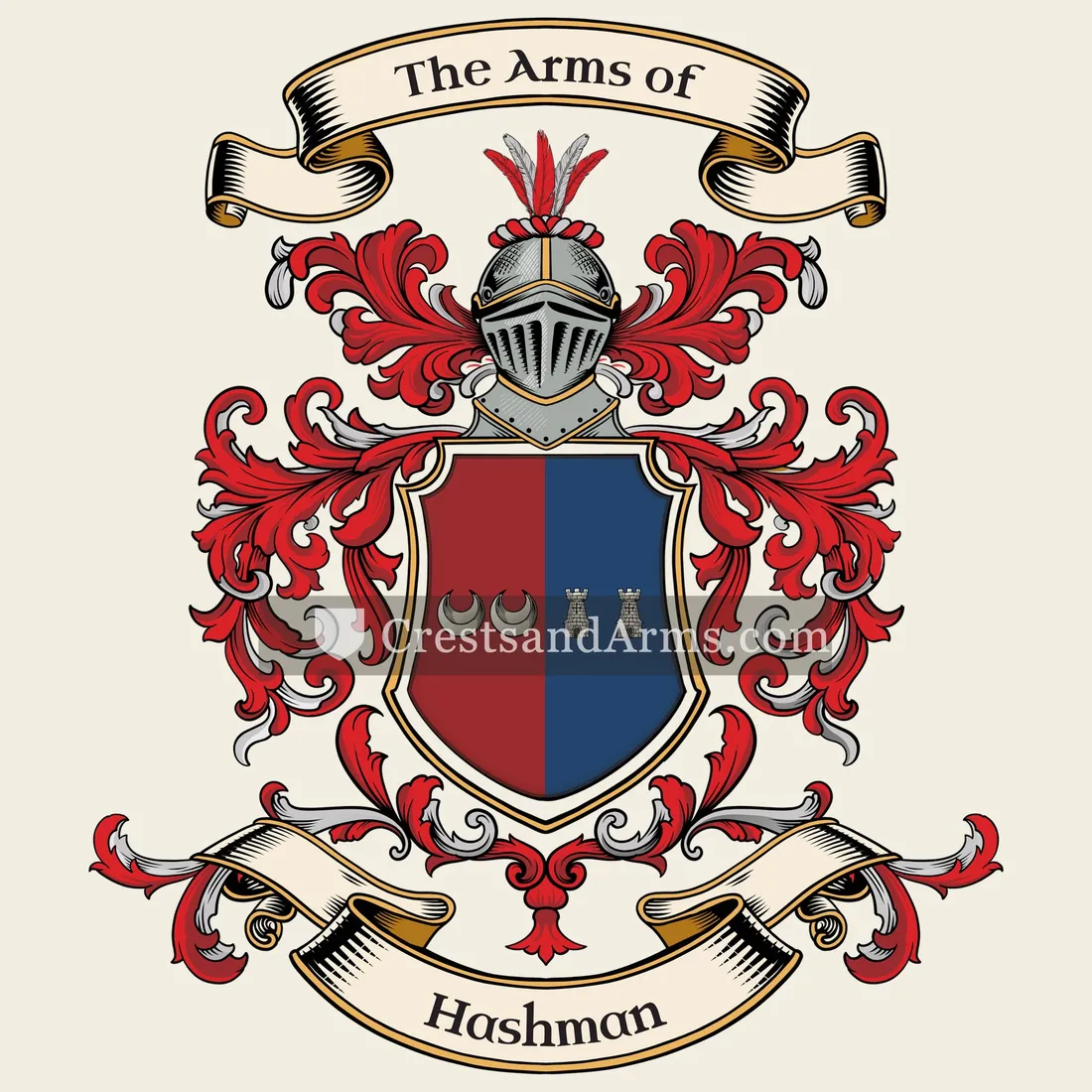
Meaning of the Hashman family crest colors & symbols
Symbols on this shield
crescentHonour by the sovereign, and the second son
towerGrandeur and solidity, and a stronghold defended
Colours
Red (Gules)Means: Military strength
Blue (Azure)Means: Loyalty and truth
Silver (Argent)Means: Peace and sincerity
Historical info
Source
J. B. Rietstap, Armorial Général, Gouda: G. B. van Goor Zonen, 1884–87
Blazon (the actual original written record)
“Parti: au 1 coupé de gu. sur arg., à deux croiss. de l'un à l'autre, celui en chef versé; au 2 d'azur à une demi-tour, mouv. du parti, senestrée de son avant-mur crén., le tout d'arg., maçonné de sa., la tour ouv. de sa. Cq. cour. C.: un ange iss., hab. d'arg. au baudrier en saut. d'azur, la tête sommée d'une croisette d'or, les ailes coupées alt. de gu. et d'arg., chaque compartiment ch. d'un croiss.”
TyrolTyrol, c. 1486
Digital archive packCoat of arms PNG, gold border print PDF, vector SVG and the certificate of authenticity. Sent to your email in minutes.
Map of Austria showing where the Hashman arms are recorded
The Hashman arms were recorded in Tyrol, c. 1486.
Tyrol was mountain country in western Austria, where the valleys were held by families who had been there a very long time. Old tenure counted for more than money, and old families carried arms.
This is where the arms were entered in the register. Families often moved to other parts of the country, so the same name can turn up in more than one region.
Region
Tyrol
First recorded
1486
Granting Authority for the Hashman Arms
Imperial and Royal chancery
Sodacan · CC BY-SA 3.0
The body that granted and recorded arms in Austria in this period.
Frederick III, Holy Roman Emperor
Sovereign of the period
Frederick III, Holy Roman Emperor
1452–1493
Reigning in Germany when the Hashman arms are first recorded.
How Arms Worked in Austria
Austrian coats of arms were often linked directly to noble titles granted by the Emperor. These symbols belonged to the entire family line rather than just one individual. When a family grew, new branches kept the original design without needing to change it. This system allowed all members of a noble house to share the same identity across many generations.
Granting authority
The Imperial and Royal chancery managed all heraldic matters and controlled the official granting of arms throughout the Austrian lands.
How they got arms
Families typically received their arms through a formal imperial decree that often accompanied the elevation of a person to noble status.
Where arms were recorded
Official records of these grants were kept in the Imperial Register of Nobility which began its formal documentation process in 1453.
The family's standing
Recorded among the armigerous families of Tyrol.
Origin & History of the Hashman Family in Austria
The history of the Hashman family in Austria is deeply rooted in the rugged landscape of the Tyrol region. By the year 1486, records indicate that family members were already established in this mountainous area. During the late Middle Ages, the name likely emerged as a way to identify individuals based on their specific trade or their connection to a particular piece of land. Life in Tyrol at this time was defined by the transition from feudal systems to more organized mining and agricultural communities. As the family settled into these alpine valleys, they became part of the local social fabric that supported the trade routes crossing the Alps. This early presence suggests that the Hashmans were likely involved in the essential labor that kept the region functioning, such as forestry, farming, or the small-scale mining operations that were common in the area during the fifteenth century.
Hashman Meaning & Related Branches
Root word
Hasen
A Germanic term referring to the animal known as a hare.
This name
HashmanAn occupational or descriptive surname for someone who hunted hares or possessed characteristics associated with the animal.
also spelled
Hausmane
Hausmans
Howsman
Hausman
Documented Sources
J. B. Rietstap, Armorial Général, Gouda: G. B. van Goor Zonen, 1884–87
Staatsarchiv Bremen, Kirchenbücher der St. Ansgarii Gemeinde, 1737
Bremisches Jahrbuch, Die Einwohnerschaft der Stadt Bremen im 18. Jahrhundert, 1924
Digital archive packCoat of arms PNG, gold border print PDF, vector SVG and the certificate of authenticity. Sent to your email in minutes.


 towerGrandeur and solidity, and a stronghold defended
 lionCourage, strength and royalty
 heartSincerity, charity and true affection
 towerGrandeur and solidity, and a stronghold defended
 lionCourage, strength and royalty
 heartSincerity, charity and true affection


 crescentHonour by the sovereign, and the second son