A record of documented arms, meaning and origin, researched for the Hasler family lines. Documented in 2 countries.
Reg. 8561 · Swiss, G–I
Coat of Arms & Family Crest Details
Symbols on this shield
lionCourage, strength and royalty
treeLife, endurance and deep roots
leafHappiness and abundance
Colours
Silver (Argent)Means: Peace and sincerity
Blue (Azure)Means: Loyalty and truth
Red (Gules)Means: Military strength
Gold (Or)Means: Generosity
Historical info
Source
J. B. Rietstap, Armorial Général, Gouda: G. B. van Goor Zonen, 1884–87
Blazon (the actual original written record)
“Coupé: au 1 d'arg. au lion léopardé de gu.; au 2 d'azur à un chicot d'or, posé en fasce, poussant en haut trois feuilles de tilleul du même. Cq. cour. C.: un lion iss. de gu., tenant de sa patte dextre trois feuilles de tilleul d'or. L.: à dextre d'arg. et de gu., à sen. d'or et d'azur.”
SwitzerlandBâle, c. 1745
Digital archive packCoat of arms PNG, gold border print PDF, vector SVG and the certificate of authenticity. Sent to your email in minutes.
Map of Switzerland showing where the Hasler arms are recorded
The Hasler arms were recorded in Bâle, c. 1745.
This is where the arms were entered in the register. Families often moved to other parts of the country, so the same name can turn up in more than one region.
The body that granted and recorded arms in Switzerland in this period.
How Arms Worked in Switzerland
In Switzerland, coats of arms were not restricted to the nobility and were often adopted by common citizens and families. These symbols were passed down through generations to show family identity. When branches of a family grew, they often changed small details of the design to distinguish their own line from the original group.
Granting authority
Cantonal and civic authorities managed the use of coats of arms within their specific regions and local jurisdictions.
How they got arms
Families typically assumed their own coats of arms based on local custom rather than receiving them from a central monarch.
Where arms were recorded
Arms were recorded in various cantonal and civic registers starting from the fourteenth century throughout the Swiss region.
The family's standing
Recorded among the armigerous families of Switzerland.
Origin & History of the Hasler Family in Switzerland
The surname Hasler is deeply rooted in the history of the Swiss Confederation, specifically within the German-speaking regions where it emerged as a descriptive name. Etymologically, the name is derived from the Middle High German word "hasel," referring to the hazel tree, which suggests that the earliest families likely lived near a hazel grove or managed land where these trees were prominent. By the time members of the family were documented in Basel in 1745, the name had already been established for generations across various Swiss cantons. During this era, families with this name were often integrated into the local guild systems and agricultural communities that defined Swiss social life. Because Switzerland was a collection of independent cantons, the Hasler name spread through local migration and trade, eventually becoming a stable part of the population in urban centers like Basel and rural districts alike.
Coat of Arms & Family Crest Details
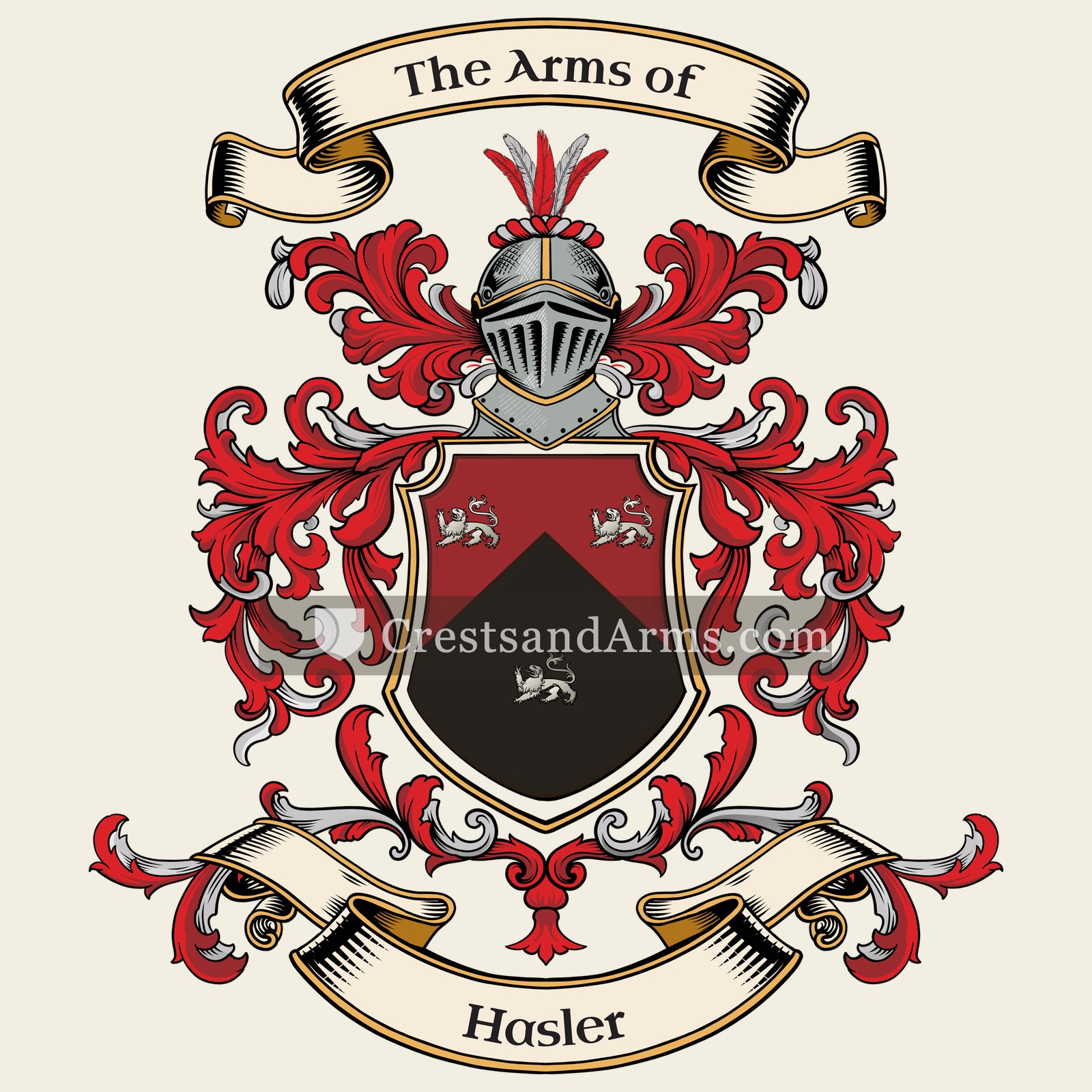
Symbols on this shield
chevronProtection, and faithful service completed
cross symbolChristian faith and service
lionCourage, strength and royalty
Colours
Red (Gules)Means: Military strength
Black (Sable)Means: Constancy
Silver (Argent)Means: Peace and sincerity
Historical info
Source
Sir Bernard Burke, The General Armory of England, Scotland, Ireland and Wales, London: Harrison & Sons, 1884
Blazon (the actual original written record)
“Per chev. gu. and sa. three lions ramp. ar. each charged on the shoulder with a cross pattée az”
SussexAldingbourne · Sussex, c. 1620
Digital archive packCoat of arms PNG, gold border print PDF, vector SVG and the certificate of authenticity. Sent to your email in minutes.
Map of England showing where the Hasler arms are recorded
The Hasler arms were recorded in Sussex, c. 1620.
Sussex had ironworks in its woods and good farmland on its downs. Both made money, and families who made it bought manors, which is what put their names in the heraldic records.
This is where the arms were entered in the register. Families often moved to other parts of the country, so the same name can turn up in more than one region.
The body that granted and recorded arms in England in this period.
James VI and I
Sovereign of the period
James VI and I
1603–1625
Reigning in Switzerland when the Hasler arms are first recorded.
How Arms Worked in England
English heraldry allowed arms to be shared by all legitimate descendants of the original owner. These symbols were treated as personal property that moved through the generations to all children. While the eldest son kept the original design, other family members could use the same shield without needing to change it or register their own unique versions.
Granting authority
The College of Arms in London has regulated the use of coats of arms throughout England and Wales since 1484.
How they got arms
Families typically obtained their coats of arms through a formal grant from the Crown or by proving their ancient right to them.
Where arms were recorded
All official coats of arms are recorded in the registers kept at the College of Arms, which date back to the fifteenth century.
The family's standing
Recorded among the armigerous families of Sussex.
Origin & History of the Hasler Family in England
The Hasler family name has deep roots in the English county of Sussex, where records confirm members of the family were established by the early seventeenth century. The name is generally classified as a topographical surname, which means it was likely adopted by people who lived near a specific local landmark or a distinct piece of land. In the case of the Haslers, the name is thought to be derived from the Old English word "hæsel," referring to a hazel tree or a grove where hazel bushes grew. By the year 1620, families bearing this name were already integrated into the rural life of Sussex, working as farmers or tradespeople within their local parishes. As these families grew, they became part of the social fabric of the region, leaving behind traces in local tax lists and church registers that document their daily lives and contributions to the community over several generations.
Related Branches & Arms
Root word
Hasel
A type of deciduous shrub or tree known as the hazel.
This name
HaslerAn occupational or topographic name for someone who lived near a hazel grove.
also spelled
Hassler
Haseler
Haslar
Hazler
Haslair
Related arms
Tardysimilar arms
von Scriversimilar arms
Häselervariant spelling
Hasslervariant spelling
Documented Sources
J. B. Rietstap, Armorial Général, Gouda: G. B. van Goor Zonen, 1884–87
Bahlow, Hans. Deutsches Namenlexikon: Familien- und Vornamen nach Ursprung und Sinn erklärt. 1967
Brechenmacher, Josef Karlmann. Etymologisches Wörterbuch der Deutschen Familiennamen. 1957
Suter, Paul. Die Basler Familiennamen. 1951
Staatsarchiv Basel-Stadt, Bürgerverzeichnisse und Einwohnerregister
Digital archive packCoat of arms PNG, gold border print PDF, vector SVG and the certificate of authenticity. Sent to your email in minutes.


 lionCourage, strength and royalty
 treeLife, endurance and deep roots
 leafHappiness and abundance
 lionCourage, strength and royalty
 treeLife, endurance and deep roots
 leafHappiness and abundance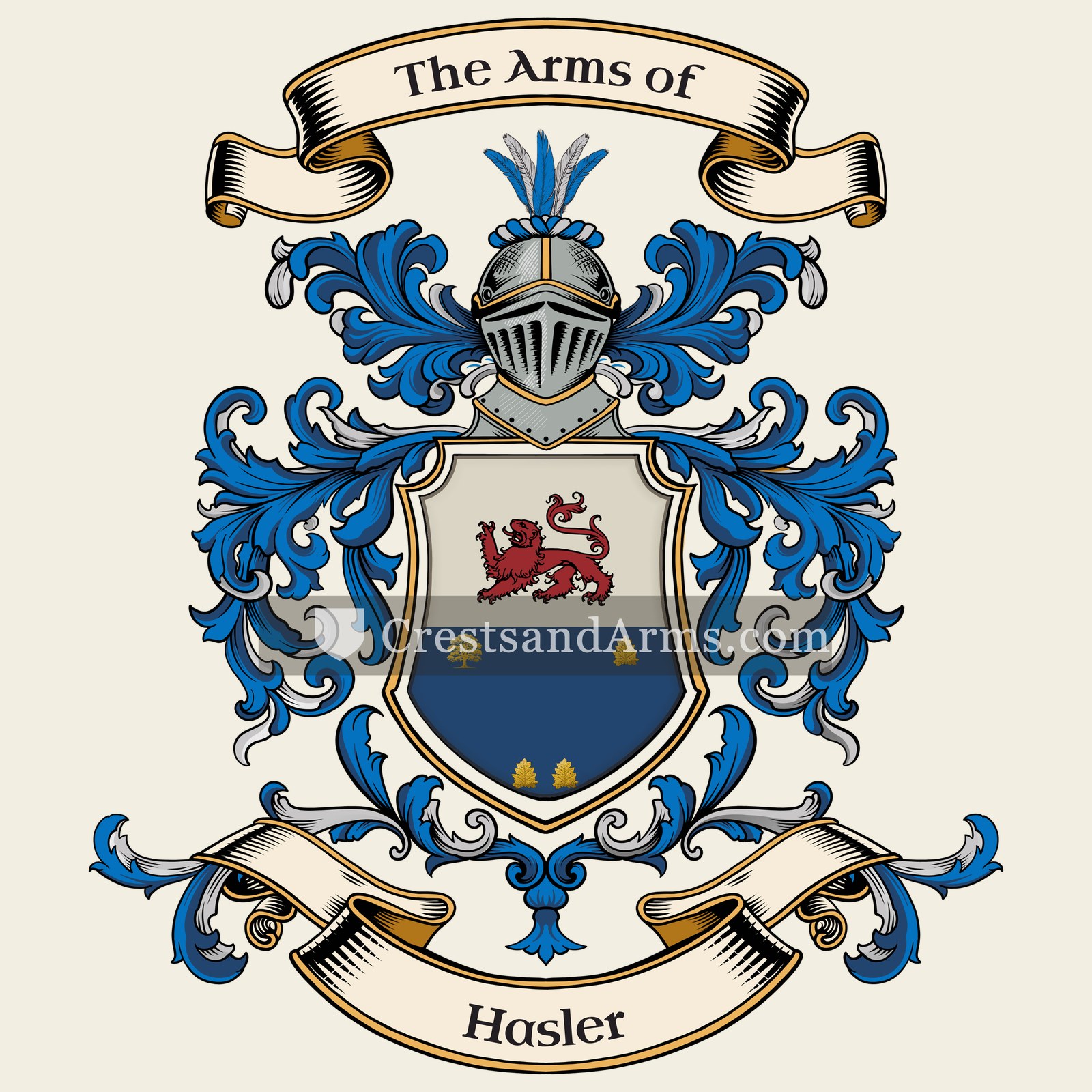

 chevronProtection, and faithful service completed
 cross symbolChristian faith and service